Friday, October 31, 2008

Pool Sharks: Harbin, Friends, Bath Tub


Friends,

Happy Halloween.

Although Harbin Hot Springs was bought most recently in 1972 and was significantly shaped by that time and the countercultural language that emerged then, I have found that its pools can help facilitate eliciting the relaxation response in far-reaching ways, and more so and more often (in that they're always open) than, for example, in {Quaker} silent meeting. I enjoy this 'coming home' experience and neurophysiology a lot.

So, emerging from the early 1970s, Harbin has attracted the most colorful and varied folks ever imaginable, - wildly so, in some ways.... hippies, musicians, spiritual teachers, artists, hobos, flower children, free-lovers, vagabonds, astrologers, gypsies, (apple-raspberry) tarts, travelers, pool sharks, circus performers, jewelry makers, communards, comedians, Wavy Gray, the Green Tortoise Adventure Bus Line, swingers, Ken Kesey, Fritz Perls, Timothy O'Leary, jugglers, tripsters, mathematicians, writers, shamanic healers, and many other folks, esp. from northern California, etc. Anthropologically, as a participant observer, the 'relaxation response' (my language, and not language I've heard at Harbin, nor among Friends recently, - although I imagine Friends used this term in the 1970s about Friends' Meeting when the book was published) is for me central to the unique aspects of life that occur vis-a-vis the Harbin pool area and the pools. As two churches {Heart Consciousness Church (HCC) and New Age Church of Being (NACOB)} - which may have been started in hippie-fashion - but which have led to a beautiful Harbin and its beautiful temple et al., Harbin probably shares similarities with early Quakers' processes emerging from Cromwellian England, but in Harbin's instance out of the freedom-seeking movements of the 1960s and 1970s.

Harbin's simple rooms and rustic facility, as hot springs' retreat center, remind me a little of Pendle Hill, a Quaker Center for Study and Contemplation, near Philadelphia, PA, although Harbin may have been more variable in terms of cleanliness in the first 30 years of its history.

Having lived outside - while hiking the Pacific Crest Trail for 4 months one year and 1 1/2 months 2 years later, and enjoying rustic (simplicity, in a Quaker sense) aspects of travel - I find Harbin uniquely comfortable in the winter, even while camping, because the pools are warm, there's a community kitchen, and there are warm spaces to hang out in. I'm not sure when you visited, but I think that Harbin's buildings, etc., have improved over time.

I read and enjoyed Jeffrey Kripal's "Esalen: America and the Religion of No Religion" after you mentioned it last fall. I'm writing an ethnography of Harbin - my field site - with the intention to create virtual Harbin as a form of ethnographic representation, and as a comparable virtual field site. Examining the distinctions between virtual and actual raises fascinating anthropological questions.

I'm also curious to explore how one might begin to represent the beautiful aspects of Harbin in a virtual world, in order to help elicit, Harbin-wise, the benefits {clothing-optional and open-ended sociality} of the relaxation response, in one's own bathtub {where one can control the temperature}.

~ Plant Trees Scott


*


vulture shark sculpture park


...


Thursday, October 30, 2008

Natives: Fauna, Flora, Species at Harbin


The large fauna in the Harbin valley include humans, deer, quail, and wild turkey. There are numerous bird species, and wild pigs came into the valley as recently as the 1990s, but were too aggressive.

Native flora includes . . .


*


...

Wednesday, October 29, 2008

Land: Alternative Vision, Roots, Back to the Land


I have some good friends who went back to the land in the early 1950s. They moved from a mid-West city to as-rural-as-you-can-get eastern Oregon, worked very hard, and eventually were able to buy a 700 acre ranch, and build their own house with lumber from their property, where they've lived for decades. They tree-farmed sustainably, and gardened, taught college and school, and realized a vision. They had gone to a Quaker college, - part of this back-to-land, sustainable vision emerged in this context, I think.

This kind of vision grew in the 1960s and 1970s. An estimated 2 - 10 million people tried to go back to the land in the late 1960s and early 70s (Turner). And hippies developed this vision to include hippy communes, of which only a few remain, partly due to a lack of organization business-wise, I think.

My good friends (my aunt and uncle Ted and Mary Brown) were sensible business-wise and they also practiced sustainable forestry, creating a kind of tree-garden on their land, which nevertheless involved very hard work. Not only did they realize a kind of 'little house on the prairie' American pioneering dream, without costs to Native Americans, they also raised a family in the process.

I find it fascinating that the hippie-countercultural social freedom movements of the 1960s have long prior roots - my good friends are an example - from the 1950s and before. And my friends sought and found a kind of freedom.


***

For some, Harbin, as hippie commune, similarly involved a return to living on the land, and a sustainable environmental vision. The Harbin garden, now beautiful, but with all its ups and downs, is one expression of this vision. And visitors continue to return to the land and the experience of nature - in the pools, too - when they come into the Harbin valley.


Heading to the pools, soon.


*


https://en.wikipedia.org/wiki/Wallowa_Mountains

https://en.wikipedia.org/wiki/Wallowa–Whitman_National_Forest

(http://www.pacificforest.org/stewardship/images/brown.jpg) 


...


Tuesday, October 28, 2008

Cornucopia: Intention, Skills, Flourishing


intention, cognition and volition


"I'm going to flourish..." {or elicit loving bliss:) - with MDMA as reference experience}

{If someone were to say this, how would this work - philosophically in terms of the philosophy of mind - and actually, so neurophysiologically in context?}

One philosopher at UC Berkeley I know (J.S.) doesn't think it's possible to develop such intention, cognition and volition vis-a-vis 'flourishing.' :)


Will knowledge- and reason-oriented people ever learn the skills to do this in self-defined, optimal ways?


How? What are the neuronal correlates of consciousness (NCC)?

Here's a free MIT Open Course Ware course for learning how a functional Magnetic Resonance Imaging tool might be used to study related areas of brain functioning, particularly vision.

Functional Magnetic Resonance Imaging: Data Acquisition and Analysis

https://ocw.mit.edu/courses/health-sciences-and-technology/hst-583-functional-magnetic-resonance-imaging-data-acquisition-and-analysis-fall-2008/

(was -
ocw.mit.edu/OcwWeb/Brain-and-Cognitive-Sciences/9-71Fall-2004/CourseHome/)


Perhaps I'll write a book about intentionality and counterculture in India, at a later date.


Back to the Harbin pools soon, and the relaxation response . . .


*


...


Monday, October 27, 2008

Harvest: Sawain, Heart Consciousness, Pools

At Harbin this past weekend, there were pumpkins around the warm pools and Halloween decorations in the restaurant.

In years past, Sawain, the harvest festival and remembrance for people who have passed away, might have been practiced or celebrated, possibly even to the exclusion of Halloween at Harbin. While the carved pumpkins around the pools are beautifully creative, what has changed such that Harbin is celebrating the U.S. holiday of Halloween (which doesn't really have any religious connotations, anyway)?

I think it reflects a kind of Harbin expression of similarity with widespread United States' social patterns. And while New Age and pagan rituals, like Sawain, may be celebrated as well this year - I'll see this weekend - I wonder if this celebration of Halloween reflects a kind of Harbin movement away from Harbin's 'cultural' roots in the late 1960s and 70s, and the fundamental questioning that was part of that fabric of life. In general, I think holidays have not been that significant to Harbin, even in the 1970s. (To be seen . . . )

I also think that Harbin might continue to celebrate Sawain for generations into the future. Even in Harbin's connection and expressions of similarities with widespread U.S. social practices, 'Harbin' continues to remember and cultivate alternative practices at the same time.


***

Harbin's 'Heart Consciousness Church,' and 'New Age Church of Being' are examples of this. Each organization is its own unique entity, and both have emerged from Harbin itself. Heart Consciousness Church {HCC} operates Harbin, and the New Age Church of Being {NACOB} is an educational program, which ordains 'ministers,' - even in all of Harbin's freedom. NACOB has ordained about 20 ministers so far. NACOB is a church within another church {HCC}. Harbin, in general, is curious vis-a-vis religion, which it plays down, but, at the same time, has given rise the unique milieu of Harbin, and kind of alternative vision, which for some has a spiritual side. Hippie-ness was very creative with religion, and counterculture gave form to a spiritual revolution, of which Harbin is .


***

But in Harbin's curiousness, the pools themselves are where you might most likely experience a significant degree of harmony and oneness, (and ease and openness) and without thinking about it, ~ very Taoist - and in a clothing optional environment. How did this happen? This emergence has something to do with the 'energy' of the pool area and the valley.

Sunday, October 26, 2008

Soil and Roots: Actual and Virtual Harbin - Problem and Venue

Problem and Venue in Actual and Virtual Harbin


Problem

The site, space, or discourse that is Harbin Hot Springs emerges into the present out of a blockage, difficulty, or breakdown that was the late 1960s and early 1970s, (as well as modernity) where widespread expressions of counterculture found form. Harbin's ongoing expression as site, space, or discourse requires both the conceptual work of understanding this unique assemblage, as well as the narratives that emerge there which inform the Harbin experience. The parallel practical work which my fieldwork as well as my creation of virtual Harbin Hot Springs in Second Life / OpenSim gives rise to, as problem, concerns the disjunctions that develop in the actual-virtual space.

The blockage that is Harbin vis-a-vis modernity, and as an organization - in the present - becomes the platform for the elaboration of tensions, where the people, actors and organizations that are my informants, and Harbin, Heart Consciousness Church, New Age Church of Being, and the Watsu Center, etc., both give rise to breakdowns, as well as shape practices in an ongoing way that make up the 'Harbin experience.' Additionally, in examining these breakdowns that occur 1) in studying actual Harbin ethnographically, 2) in creating a virtual Harbin, and 3) in giving form to these blockages vis-a-vis both the 'actual' and the 'virtual,' the disjunctions that emerge between these two aspects give new form to this study of Harbin.


Venue

Two venues, then, emerge from this problem. 'Actual' Harbin becomes the venue that shapes both the narratives and the objects of inquiry, including the pools, the pool area, etc., explicit understandings of the present, questions of embodiment, and the Harbin experience.

And 'virtual' Harbin, as information technology in the form of virtual world building, and then avatar interaction in what will become a comparative in-world, field site, which then gives expression to new forms of narrativity. So, venue includes here a new form of 'textual' generation.

In addition to the venue of actual Harbin, the venue here becomes both literally a kind of informational technological equipment – virtual Harbin, as well as the generation of this as ethnographic practice – in the present.

Saturday, October 25, 2008

Thyme in the Pools: Music, Tantra, Language

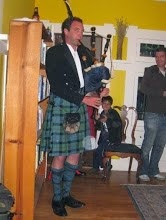
I went to sit on a tent platform this morning to play my practice chanter (for my Scottish Highland Bagpipe) and startled a deer, a stag, that was resting on the ground. It stood up and moved away from me and the platform, but not far at all. This deer had a large sack hanging under its right eye, and it also had antlers; although it looked fairly mature, it only had one antler with one spike and the other antler had no spikes. I started to play my practice chanter, and the stag stayed around as if listening. It even moved closer to me as if appreciating the music and wanting to 'join' with it. It's my reading that this deer was drawing close to me listening with the intention for a kind of oneness. Lyrical and melifluous sounds elicit a kind of connection and connectivity that I thought this deer wanted to further, as it edged closer to me, with its head down.


I went to a Tantra workshop facilitated charmingly by Steve Carter in the Harbin Temple last night that was listed in the Harbin schedule.


Here's a loose structure of last night's workshop.


Imaging and Imagining
A golden orb


Tantra

When Steve first heard about Tantra, he thought it was about orgasm. Someone else said they thought it was about sex, when they first heard about it.

Steve said Tantra was about 'yes' and 'receptivity,' and good communication, that can then facilitate great intimacy, including sexuality.


In practice, and with a couple modeling this, they (and we later) created a bubble around themselves, while sitting facing one another.

What emerges are a series of rituals, or practices for good communication and intimacy.


They honor each other by bending forward to bring their foreheads together.

From this imaginary bubble, they added and took out 'things' they didn't want to have in their Tantra session. "I add openness," he said speaking outloud, and she said "I add good communication." And "I'll add my shiva energy," she says. "And I'll add my shakti energy," he says

"And I'm going to take out impatience," and "I'm going to remove from the circle frustration." "I'm going to take out my monkey brain." And they do this by physically play-acting the removal of something from their circle.


They then communicate their desires, fears, and boundaries - first one, then the other.

Then Steve encourages the woman model to sit in the lap of the man model, if they want to. And they do, and model intimacy.


With some New Age language and ideas (mostly drawn from India), they developed a series of practices, which would be very helpful and therapeutic for couples wanting to deepen intimacy and communication.


Thyme, who looks like she was a 'flower child,' {there's a light in her face, and her long hair is free, and she's relaxed, open and alternative is normal for her} is probably in her mid-50s, and has been around Harbin for a long time, enjoys the pools a lot, I think, - a little like an otter enjoys water. I often see Thyme in the pools, and while there she plays and explores, as if at home like a river otter. In my observations, her comfort in the water, and attraction to it, is unique-to-Harbin fit by someone touched by the 1960s and 70s, - hippie.


Anonymity at Harbin can be great . . . and a variety of names, including spiritual ones, exist.


Sexuality

In a kind of hippie language and understanding, men have sex with sisters, it's part of being a sister – and sisters have sex with brothers. The language and shared understandings seem to shape this opening, that's widespread, and different from many current norms vis-a-vis sexuality.

Friday, October 24, 2008

Bioregion: Counterculture, Flow, Ecstasy

In a way, counterculture, which emerged in the 1960s and 1970s, asked what culture, tradition, and norms, as well as socioeconomic processes, were generating - both personally and societally - especially in terms of their limitations, and questioned these processes to explore creatively freedom.

There was a widespread, fundamental questioning of many received patterns, especially concerning politics, spirituality, sexuality, art, race, science, the academy, and ideas, as well as in terms of vision. A great many individuals gave rise to an amazing variety of great understandings and visions, and collectively, too. There were widespread protests against all kinds of wrong doing, often by governments, like war, in every city in the West. A language and literature emerged. People experimented with marijuana, psychedelics, and drugs. Music, especially rock and roll, became far out, and contributed profoundly to counterculture and this vision. People returned to the land, started communes, and became environmentally conscious and activist, for example. Organic farms and the organic farming movement spread grew.


How did this happen?

So, for example, a student might bring an interesting book to other students at UC Berkeley, sitting on the grass talking, that completely re-envisions 'reality' as they knew it before - for example, the Upanishads or "Flow: the Psychology of Optimal Experience." Other students would begin to explore this, and new cultural practices emerge.


Here Csikszentmihalyi characterizes 'flow' in a TED talk on ecstasy:

http://www.ted.com/index.php/talks/mihaly_csikszentmihalyi_on_flow.html


So, out of this, for example, David Rains Wallace writes "The Klamath Knot" (Sierra Club 1983 / University of California Press 2004) combining questions of evolutionary history (40 million years of relatively unbroken history in these northern California / southern Oregon Klamath / Siskiyou mountain ranges) with the experience of living in these wilderness areas, in beautifully written essays. He also helps to characterize 'bioregions' in essay form.


How to elicit 'loving bliss' counterculturally in far-reaching ways, and at Harbin?

To begin, I've found it has something to do with easing, the relaxation response and 'coming home, '~ a kind of oneness.


Heading to the Harbin pools shortly . . . :)

Thursday, October 23, 2008

Cantaloupe Melon: Counterculture, Loving Bliss, Brains


Here's an interesting area of inquiry to come in the study of information technology and counterculture:

Find {serendipitously?}, meet {synchronistically?} and talk with countercultural folks~bodyminds~'brains'~{hippies} which took shape in the 1960s and 1970s {'culture' giving new form to brains?}, of all ethnicities, who have generated a remarkable degree of 'loving bliss' - in Northern California, on the West Coast of the American continent, India, and around the world, especially in terms of optimal experience and enjoyment.

Amma, from India, is one example.

Whose minds generate loving bliss and optimal enjoyment, in part due to a re-orientation in understanding emerging in the freedom-seeking movements and processes of the 1960s and 1970s?

How does culture (counterculture) inform biology (brains), possibly distinct from the loving bliss that these minds might have generated without the 1960s and 1970s? India is a particularly fertile land for this, to complement these questions and related travel and get togethers on the West Coast.


***


At UC Berkeley today, I walked from Bancroft and Telegraph Aves. into the central area through Sather Gate and in front of Dwinelle Hall at lunch time to a place where there were a group of people sitting under what I think was a cedar tree. Folks were relaxing and lying on the grass, haphazardly. One person was playing a guitar. A 60-ish year old man with white dread locks, whom I've seen playing this guitar quite well usually, was playing chess on the grass with someone else, - he had lent his guitar to a student who was playing it. Another young guy was wearing a Cal / UC Berkeley t-shirt. There was one woman, also probably a student, who looked hippie-ish. Most of these people looked like they were students. Many of the men had slightly long-ish hair, but not as long as pony-tail length. I sat down with them and ate my lunch.

I think that groups like this one, and similar individuals, were the 'seeds' of the 1960s and the emergence of counterculture ~ {little groups, for example, just hanging out, talking, making music and being} ~ sitting on a little grassy corner in the middle of this large University, taking it easy. I see relatively few of these kinds of nascent, alternative, loose, free-minded groups around Cal or the city of Berkeley these days, but the city of Berkeley is still pretty thoughtful and alternative, as well as prosperous, as a whole.


***

{

Here's some related research to the above counterculture > brain questions {from which the above photo comes - click on the title}:


The God Experiments
by John Horgan / Discover Magazine (Nov 2006)


http://richarddawkins.net/article,361,The-God-Experiments,John-Horgan--Discover-Magazine ...

http://discovermagazine.com/2006/dec/god-experiments/

}


To the Harbin dance and pools soon ...


.


Wednesday, October 22, 2008

Hot Springs: Harbin Hot Springs and Modernity

Harbin Hot Springs and Modernity

I'd like to examine how Harbin Hot Springs as {countercultural} place (Basso) that gives rise to an unique culture (Aubrey, Herder, Brothers Grimm) which emerges as a response to modernity (Baumann & Briggs). By examining this binary relation vis-à-vis de Certeau ("Practices of the Everyday"), I'll examine ways in which Harbin as counterculture emerges as a form of tactic in relation to the techno-rational-bureaucratic-legal 'strategies' of modernity. To do this, I'll examine Harbin particularly as a construction of place in terms of Herder's and the Brother Grimm's 'constructions' of traditionality vis-à-vis Romanticism, but also in terms of Harbin as a singularity (Kopytoff). Using interviews and textual analyses, I'll examine also how today's Harbin Hot Springs, emerging from the late 1960s and early 1970s (as counterculture), then, gives rise to place-related practices that instantiate, in an ongoing way, alternative practices in relation to modernity. As place (Basso), too, I'll examine questions of the poetics of Harbin as place, where the experience of 'oneness' as part of the founder Ishvara's understanding of Harbin and New Age practices - particularly in the pools {and the 'relaxation response'} and uniquely mediated by Harbin's milieu - emerges in response to modernity; traditionality, vis-à-vis Native American practices are similarly invoked by Harbin residents and in Harbin literature. As a response to modernity, Harbin's beautiful, natural setting thus makes possible a return to nature, accentuated by the pools. I'll then examine ways in which Harbin as emerging from counterculture informs a reading of modernity as culture.

In my project to create a virtual Harbin in OpenSim / Second Life 3-D virtual world software, which is ethnographically comparable with actual Harbin, I'll explore ways that information technology and virtual world software emerge from the 'project' of modernity, and in which an 'alternative' virtual Harbin makes in-world (in a virtual 'space') ethnographic fieldwork possible through the creation of a virtual field, thus giving rise to new instantiations of countercultural place, virtually. In so doing, however, I'll examine ways in which people anthropologically might elicit similar virtual experiences {i.e. in their bathtubs} to those that people actually have at Harbin {i.e. the relaxation response in the pools}, as well as related 'flow: the psychology of optimal experience' experiences (Csikszentmihalyi), thus engaging a virtual experience of Harbin. As a virtual “field site,” I'll examine also ways in which a virtual Harbin may become a countercultural ‘destination’ as field site unto itself, vis-à-vis modernity.

The pools are central to the Harbin experience as a retreat (from modernity), and many people come to Harbin simply to soak in the pools and relax in the pool area, but also for its alternative culture. This going-to-natural-hot-springs took on unique (counter)cultural and historical expressions in the 1960s and 1970s, which I'll also use to contextualize Harbin's emergence. Methodologically, I'll use fieldwork and interviews to examine how, through language (parole in de Certeau's usage), Harbin residents, in what is loosely a hippie commune, engage New Age, astrological, Human Potential Movement, wildman (Taussig), environmental, and communitarian ideas to cast modernity in a unique-to-Harbin way which gives form to Harbin's milieu, both actually and in a virtual world.