Harbin ethnography:
... to float around the upper spaces of the Harbin Conference Center.
As you come to float in your sphere above the DJ, still dancing in the virtual sphere with Rose, Heartsong in the virtual Harbin warm pool across the valley in the Mainside area texts you, and a little dialog box pops up in the type chat communicate window you've been using to type chat with friends, in its “Local Chat” dialogue box, and privately with avatars like Rose and Heartsong. You ask her what she's doing, and she's says her avatar is getting floated in the warm pool, and the person who's floating her has been teaches Watsu in the school. You tell here you're dancing with Rose in the conference center, but you'll head to the Heart Pool soon because Rose hasn't been there yet.
(http://scott-macleod.blogspot.com/2010/04/sierra-nevada-sunset-as-you-come-to.html - April 16, 2010)
Friday, April 16, 2010


Klamath Basin: Atheist on the Supreme Court?, Identity Diversity, Native American Chief Justice?, Friends Committee on National Legislation
Atheist on the Supreme Court?
Nontheist Friends,
How about someone of Native American background on the Supreme Court? ... Very few Native Americans in the Supreme Court's history. Does anyone know of any? FCNL doesn't seem to focus on Native Americans on the Supreme Court ... only on these other issues: fcnl.org/nativeam Why is there so little mention of this in the media?
Scott
*
Here are some Navajo Supreme Court justices:
britannica.com/EBchecked/topic-art/1357826/92361/Navajo-Supreme-Court-justices-questioning-counsel-during-a-hearing.
Why no discussion of this for the U.S. Supreme Court?
Identity and societal processes have deep roots.
How might nontheist Friends, with Friends Committee on National Legislation, for example, help get a Native American Supreme Court justice on the Supreme Court bench, as a justice?
Scott
*
Nontheist Friends,
In the United States, identity diversity on the US Supreme Court is both very important for fairness, but it also affects questions of justice in far reaching ways, if you read history. I only wish the many Supreme Courts in the U.S., like the Navajo Supreme court, were more equal. There are 150-170 Native American languages in the US, and never a Supreme Court Justice with any of these native backgrounds. It's been a long! trail of tears and suffering for native peoples in the US, oft forgotten, but not by Native Americans. Fortunately, we have a variety of Supreme Courts. Now in a globalized world, with around 220 nation states and a limited United Nations, perhaps nation state sovereignty questions are being rewritten a lot, legally especially, due to the internet and a connected world (e.g. a $40 billion loan for Greece in a European Union which hasn't yet received Turkey), but in a very haphazard fashion. How we conceptualize justice and diversity is the first step, and, while I share J's interest in having another liberal on the court, I would prefer someone who is not any of the present, multiple identities on the court. The U.S. is very diverse, and sophisticated 'representation' on the U.S. Supreme Court is key to the fabric of U.S. society. I think we're hearing too many calls of more of the same, and may well get more of the same, with Obama, especially, who seems somewhat conservative to me, if you read the second chapter of his second book on the Supreme Court, for example. Supporting Friends Committee on National Legislation's Native American programs is one constructive step to responding to what seems likely to be more of the same.
With friendly greetings,
Scott
scottmacleod.com
worlduniversity.wikia.com/wiki/Nontheist_Friends_%28atheist_Quakers%3F%29
(http://scott-macleod.blogspot.com/2010/04/klamath-basin-atheist-on-supreme-court.html - April 16, 2010)
Nontheist Friends,
How about someone of Native American background on the Supreme Court? ... Very few Native Americans in the Supreme Court's history. Does anyone know of any? FCNL doesn't seem to focus on Native Americans on the Supreme Court ... only on these other issues: fcnl.org/nativeam Why is there so little mention of this in the media?
Scott
*
Here are some Navajo Supreme Court justices:
britannica.com/EBchecked/topic-art/1357826/92361/Navajo-Supreme-Court-justices-questioning-counsel-during-a-hearing.
Why no discussion of this for the U.S. Supreme Court?
Identity and societal processes have deep roots.
How might nontheist Friends, with Friends Committee on National Legislation, for example, help get a Native American Supreme Court justice on the Supreme Court bench, as a justice?
Scott
*
Nontheist Friends,
In the United States, identity diversity on the US Supreme Court is both very important for fairness, but it also affects questions of justice in far reaching ways, if you read history. I only wish the many Supreme Courts in the U.S., like the Navajo Supreme court, were more equal. There are 150-170 Native American languages in the US, and never a Supreme Court Justice with any of these native backgrounds. It's been a long! trail of tears and suffering for native peoples in the US, oft forgotten, but not by Native Americans. Fortunately, we have a variety of Supreme Courts. Now in a globalized world, with around 220 nation states and a limited United Nations, perhaps nation state sovereignty questions are being rewritten a lot, legally especially, due to the internet and a connected world (e.g. a $40 billion loan for Greece in a European Union which hasn't yet received Turkey), but in a very haphazard fashion. How we conceptualize justice and diversity is the first step, and, while I share J's interest in having another liberal on the court, I would prefer someone who is not any of the present, multiple identities on the court. The U.S. is very diverse, and sophisticated 'representation' on the U.S. Supreme Court is key to the fabric of U.S. society. I think we're hearing too many calls of more of the same, and may well get more of the same, with Obama, especially, who seems somewhat conservative to me, if you read the second chapter of his second book on the Supreme Court, for example. Supporting Friends Committee on National Legislation's Native American programs is one constructive step to responding to what seems likely to be more of the same.
With friendly greetings,
Scott
scottmacleod.com
worlduniversity.wikia.com/wiki/Nontheist_Friends_%28atheist_Quakers%3F%29
(http://scott-macleod.blogspot.com/2010/04/klamath-basin-atheist-on-supreme-court.html - April 16, 2010)
Eastern Deciduous Forest: I see Friends/Quakers as an identity, as a community, as a historical trajectory, as a kind of troopbond
Nontheist Friends,
In response to J's observation "But Quakerism is a religion--I don't see how there's any way of getting around that fact. If I reject religion outright, I reject Quakerism" -
I see Friends/Quakers as an identity, as a community, as a historical trajectory, as a kind of troopbond, and I, personally, actually don't see the Society of Friends as a religion. I also see the bond aspect of religion as scary and dangerous - a kind of brainwashing potentially. For example, Catholicism can be viewed quite realistically as a death cult, by anthropologists and sociologists, for example, with its key central symbol what it is. It is also a global, 2000 year old institution - an interesting and long example in contemporary historical terms, notwithstanding evolutionary history. And the differences between religions and cults aren't great, yet religions and cults are so widespread - think ancient Greece. I see much religious behavior and thinking as troopbonding around ideas and symbols. Why are religion and cults so brainwashing? I think we might look to Richard Dawkins for some clear-minded explanations, informed by evolutionary biology.
And Quakers, too, can and do perpetuate negative aspects of religion, in my experience, in conjunction with all the good which Friends do, and the senses of community and caring which Meetings create. So I see nontheistic Friends are shaping an important discourse, in this Friendly openness to the areligious, to the nonreligious, to the nonspiritual and to the antireligious. So I think agency and thinking vis-a-vis Meetings is very sensible; negative 'politics' can emerge anywhere. In fact, it's the creative possibilities for this discourse to be ongoingly generative of conversations around nontheism in these respects, which is fascinating to me. I appreciate the connectedness and friendliness, too, of Quakers, and nontheist Friends, and especially the pragmatic service orientation, but I find it great that we can create a conversation around areligiosity, and that, in this nontheistically Friendly Google Group as minuting process and archive, this discourse becomes something which many can engage conversationally through many cycles of the moon, and rotations of the earth, 10s of thousands of generations ahead.
With friendly greetings,
Scott
http://scottmacleod.com
(http://scott-macleod.blogspot.com/2010/04/eastern-deciduous-forest-i-see.html - April 16, 2010)
Thursday, April 15, 2010
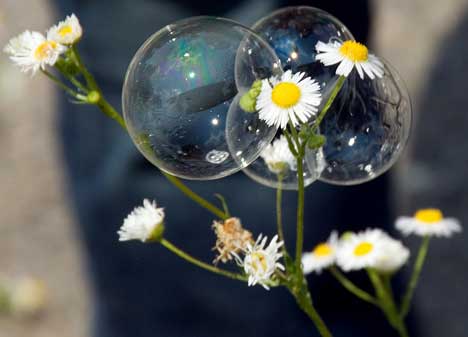
Bubble Flowers: Avatar Bubblemeister is dancing around the Harbin Conference Center blowing virtual bubbles, He's scripted some of these bubbles
Harbin ethnography:
... Second Life is both very flexible and open to avatar creativity.
Avatar Bubblemeister is dancing around the Harbin Conference Center blowing virtual bubbles. He's scripted some of these bubbles, as they come out of his soap bottle, to grow very large, and for their diaphanous skins to show psychedelic light shows and video clips of rock and roll bands, that he finds on youtube.com. Rose, who is no longer looking at the share-pile of clothes, some of which seem to have a life of their own, in the way which they shimmer, and even move – one sweater even says the words “wear me, put me on” - asks me to show her how to create something in Second Life. I ask her if her avatar would like would like to dance inside a very large bubble which floats and rolls. She nods yes, and says “with you.” So I click on the ground, choose “create” from the pie-like menu, and another menu pops up with building options. I select the sphere shape, and with the magic wand cursor, create a sphere in the corner of the Conference Center dance space by clicking on the ground. I choose the 'object tab' and go to the x y z dimensions, and enlarge each of these to 7 Second Life meters. I choose the 'transparent' setting, and then go to the 'texture' tab. First I choose the bioluminescent texture, and add ribs of jellyfish-like moving rainbow lights to the sphere Rose and I are about to step into to dance. Then I go to the video link, which is in development, and doesn't always work very well. I select a clip of the Grateful Dead playing that beautiful ballad Peggy-O on April 12, 1978, and slide the opacity bar to the very opaque side of the scale, then I drag and drop it onto the side of the sphere. I say to Rose “just hop through the skin of the sphere, and start dancing; the sphere will lift you as it begins to float. I hop in to it, too. I click the 'suspend gravity' box and, just as avatars can fly in Second Life, this sphere begins to rise up. And we start dancing slowly as the sphere begins to float around the upper spaces of the Harbin Conference Center.
(http://scott-macleod.blogspot.com/2010/04/bubble-flowers-avatar-bubblemeister-is.html - April 15, 2010)
Wednesday, April 14, 2010
Night Sky: As avatars are dancing, someone types for all to see: “I have clothes in my inventory for people to share.”
Harbin ethnography:
... thus bringing the virtual and actual together in my bodymind.
As avatars are dancing, someone types for all to see: “I have clothes in my inventory for people to share.” And she starts to put on the ground on the edge of the dance floor the most beautiful virtual clothes, all of which she has made. She says “Since this is the Harbin Dance, these are all free, no Linden dollars are needed.” Some of the hats have antennae on them with eyes on the end. Some pants are rainbow colored, and shimmer like biolumenescence. Some shirts have diaphanous wings, which even flutter like butterfly and ladybug wings; one shirt even seemed to start to rise and flutter away. A few avatars start to gather round. Nearby, I take a flowery texture out of my own inventory, and ask her if I can change the cape I see in front of me, which she has made, from its starry night texture to a multi-flowered texture. She types “Yes, the cape is set to be edited” and I simply drag and drop my flowered texture onto the cape and it changes. Someone on the other side of the pile of beautiful clothes offers me a texture from his inventory. I accept and he hands it to me, and I store it in my texture folder in my inventory. In Second Life, objects are made from prims, by pushing and pulling them to change their dimensions, then adding textures to them, which can be anything, including made from photos and imported into Second Life. Second Life is both very flexible and open to avatar creativity.
Avatar Bubblemeister is dancing around the Harbin Conference Center ...
(http://scott-macleod.blogspot.com/2010/04/night-sky-as-avatars-are-dancing.html - April 14, 2010)
Lascaux Animals: In general, I've posted below what I understand as 'evolution,', a) language, b) troopbondage, c) relaxation response
Hi nontheist Friends,
In general, I've posted below what I understand as evolution, and what I return to when I read this word. I see a) language, b) troopbondage among higher primates (I think Money's 'Concepts' are edifying and relevant conceptions for understanding humans, as well as helpful to bring into conversation with nontheist Friends, vis-a-vis the syllogism "If nontheism, then evolutionary biology), and c) the possibility to elicit the neurophysiology of the relaxation response - most readily in a warm bath, or hot springs - as emerging from evolution by natural selection. And I tend to return to these as reference points, when thinking about some aspects of religion.
As an anthropologist, I'm a cultural relativist. Cultural relativism suggests, for example, that the grotto painters at Lascaux 17000 years ago may have differed from neighboring grotto painters in Italy 32,000 years ago (Fumane Caves), but that one is not superior to another. Cultural relativism has been a challenge for some aspects of religion. Huston Smith's "Religions of Man" suggesting 7 - 8 +, etc. great religions is an expression of cultural relativism vis-a-vis religion. And there are 3000-8000 languages, and humans have also invented languages - e.g. Tolkien's Sindarin and Elvenlatin, Ursula Le Guin's Kesh, Na'vi in the film "Avatar," and this list is actually very long. (I hope to make the space for all languages here at World University & School: http://worlduniversity.wikia.com/wiki/Languages. In sociocultural anthropology, my discipline, culture doesn't have deep epistemological, metaphysical or ontological roots. Instead ethnography is a genre, and an interpretive practice, for understanding aspects of 'culture.'
In terms of evolution, and evolutionary biological, explanations of religion, I tend to draw on evolutionary thinkers and thinking like Richard Dawkins' "The God Delusion" (and I find his meme idea in his "The Selfish Gene"), "Religion Explained" by Pascal Boyer, "Breaking the Spell: Religion as a Natural Phenomenon" by Daniel C. Dennett, Scott Atran's "In Gods We Trust: The Evolutionary Landscape of Religion," Matt Ridley's"The Origins of Virtue: Human Instincts and the Evolution of Cooperation", David Sloan Wilson's "Darwin's Cathedral: Evolution, Religion, and the Nature of Society." These books are all at World University and School in the 'Religious Studies' subject in the reference section under 'Evolution Biology and Religious Studies ' - http://worlduniversity.wikia.com/wiki/Religious_Studies. And Terrence Deacon's "The Symbolic Species: The Co-evolution of Language and the Brain" explains language's origins for me - biologically in a sense.
Within this context, and vis-a-vis the 8 major religions that Huston Smith characterizes, I view the history of the last 2500 years, as a little arbitrary vis-a-vis religion. For example, the Ancient Greek world, while making possible reason as part of public discourse, significantly, was also very religiously polytheistical. (I'm listening to Will Durant's Life of Greece these days). I find the Protestant Reformation out of which Quakerism loosely emerges, in a sense, as coming into conversation with what came before in the West, religiously - e.g. Catholocism +. But Quakers were doing their own 'thing' in chaotic, what some may call Cromwellian England, and were relatively untouched by Lutheranism, as well as Calvinism, as well as Presbyterianism, etc., and certainly seeking religious freedom, as I understand these histories. While these are religious histories, they also give form to expressions of identity, as I see them, anthropologically, as well as are expressions of troopbonding. So the relaxation response and silent meeting, and the caring among people in communities, such as nontheist Friends, Quakers, Harbin Hot Springs, etc., are important and salutary aspect of these kinds of communities (Communities, Churches, etc.), as are the relaxation response, especially for me in warm pools.
Within this context, I also draw on Quaker thinking, vis-a-vis caring, as expressed in service that Meetings undertake, as well as what the AFSC and FCNL do - pragmatic expressions of service - which have helped Friends be helpful in the world.
So first, evolutionary biology and then a lot of troopbonding and history or human primates, informed by this ... is a little how I see evolutionary biology and religion.
With friendly greetings,
Scott
http://scottmacleod.com
http://worlduniversity.wikia.com/wiki/Nontheist_Friends_%28atheist_Quakers%3F%29
"Evolution is the change in the inherited traits of a population of organisms through successive generations.[1] After a population splits into smaller groups, these groups evolve independently and may eventually diversify into new species. A nested hierarchy of anatomical and genetic similarities, geographical distribution of similar species and the fossil record indicate that all organisms are descended from a common ancestor through a long series of these divergent events, stretching back in a tree of life that has grown over the 3,500 million years of life on Earth.[2]
Evolution is the product of two opposing forces: processes that constantly introduce variation in traits, and processes that make particular variants become more common or rare. A trait is a particular characteristic, such as eye color, height, or a behavior, that is expressed when an organism's genes interact with its environment, translating its genotypic predispositions into phenotypic phenomena. Genes vary within populations, so organisms show heritable differences (variation) in their traits.
The main cause of variation is mutation, which changes the sequence of a gene. Altered genes, or alleles, are then inherited by offspring. There can sometimes also be transfer of genes between species. Two main processes cause variants to become more common or rare in a population. One is natural selection, which causes traits that aid survival and reproduction to become more common, and traits that hinder survival and reproduction to become more rare.[1][3] Natural selection occurs because only a few individuals in each generation will survive, since resources are limited and organisms produce many more offspring than their environment can support. Over many generations, mutations produce successive, small, random changes in traits, which are then filtered by natural selection and the beneficial changes retained. This adjusts traits so they become suited to an organism's environment: these adjustments are called adaptations.[4] Not every trait, however, is an adaptation. Another cause of evolution is genetic drift, an independent process that produces entirely random changes in how common traits are in a population. Genetic drift comes from the role that chance plays in whether a trait will be passed on to the next generation.
Evolutionary biologists document the fact that evolution occurs, and also develop and test theories that explain its causes. The study of evolutionary biology began in the mid-nineteenth century, when research into the fossil record and the diversity of living organisms convinced most scientists that species changed over time.[5][6] The mechanism driving these changes remained unclear until the theories of natural selection were independently proposed by Charles Darwin and Alfred Wallace. In 1859, Darwin's seminal work On the Origin of Species brought the new theories of evolution by natural selection to a wide audience,[7] leading to the overwhelming acceptance of evolution among scientists.[8][9][10][11] In the 1930s, Darwinian natural selection became understood in combination with Mendelian inheritance, forming the modern evolutionary synthesis,[12] which connected the units of evolution (genes) and the mechanism of evolution (natural selection). This powerful explanatory and predictive theory has become the central organizing principle of modern biology, directing research and providing a unifying explanation for the history and diversity of life on Earth.[9][10][13] Evolution is therefore applied and studied in fields as diverse as ecology, anthropology, conservation biology, paleontology, agriculture, medicine, psychology, philosophy and others."
(http://en.wikipedia.org/wiki/Evolution)
On Wed, Apr 14, 2010 at 10:12 AM, Peter Lawson wrote:
> Friends,
> A really fine book addresses these issues.
> Spontaneous Evolution: Our Positive Future (and a Way to Get There from
> Here) by Bruce H. Lipton Ph.D. and Steve Bhaerman (Hardcover - Sept. 15,
> 2009)
> Have a look at the reviews. Better still beg, borrow or steal it and read
> it.
> Peter
> On Apr 13, 2010, at 10:09 PM, Ian Hughes wrote:
>
> Hi Scott
> I'm not sure I understand your meaning in all the details below, and I agree
> that "evolutionary biology, and evolution by natural selection, have
> fascinating implications for we [nontheist Friends]".
>
> However I think that evolution in terms of biology and natural selection
> only goes part of the way towards explaining religion.
>
> To take an example you use. We all learn language by about the age of 2, so
> this capacity seems biological. But I can't see a biological explanation for
> why some of us speak English and others Hindustani or Pitjanjanjara. Clearly
> this is not a matter of natural selection operating through genes. The
> capacity to learn language is biologically based, but its expression in
> which language is learned and how it is used seem not to be biologically
> determined or genetically inherited.
>
> Similarly with religion. It seems to me we have a biologically evolved and
> genetically inherited capacity (or drive) to form groups, think in abstract
> ideas and make sense of the our experience of the world. As an ex-catholic I
> am sure that there is not an inherited genetic difference between theist
> Catholics and nontheist Quakers. This was a process of social and individual
> learning.
>
> In short, I think biological evolution provides us with capability for
> culture and learning but we need another mechanism, other than biological
> natural selection, to account for cultural change and social learning.
>
> I have read that tolerance of lactose is a genetically inherited trait which
> gave a 'natural selection' to herders of cattle. In this and maybe other
> instances, a specific cultural change precedes and leads to evolution of a
> specific biological trait.
>
> We can account for (ie see causes of) cultural change and historical events
> in retrospect, but we have no reliable method for predicting historical
> change. This is in part related to feedback loops. Prediction of a cultural
> change becomes part of the context and can change the outcome it predicted
> (think of stock exchange forecasts).
>
> The most significant driver of evolution today is human cultural activity
> which, for example, through global warming is causing extinction of many
> species. Cultural adaptation has overtaken the role of biological adaptation
> for humans in seeking food sources, extending human life span, regulating
> the density of human population and so on.
>
> I don't think we have identified a cultural mechanism equivalent to the
> biological mechanism of natural selection - and I'm not sure whether it is
> correct to speak of 'cultural selection' in the same way. But it seems clear
> to me that something like this is happening and is now more important for
> survival of our species (and other species) than natural selection.
>
> Theory of 'Memes' was one not fully successful attempt at a theory of
> cultural evolution. Whatever theory we use, it seems to me that cultural
> change is an outcome of cultural processes, and that consciousness is part
> (and only part) of the picture, so that we have some, albeit limited
> capacity' to make choices which may affect future cultural evolution.
>
> In my thinking this puts 'The Evolutionary Potential of Quakerism' into
> context. Is it possible that Quakerism has potential to affect the direction
> of human evolution? If so, can we maximise the positive potential?
>
> Just a little thought
> In friendship
> Ian
>
>
> -----Original Message-----
> From: Scott MacLeod [mailto:helianth@gmail.com]
> Sent: Wednesday, 14 April 2010 12:55 PM
> To: nontheist-friends@googlegroups.com
> Subject: Re: [NTF-talk] Geography of Entiefania
>
> Hi nontheist Friends,
>
> I see the 'biology' in evolutionary biology as important, and perhaps
> under-considered in this ongoing conversation among nontheist Friends,
> - not evolutionary psychology. Religion is another question.
>
> For me, the relaxation response, 'troopbondage' (viz. Money), and
> language (an unusual characterization of language in the academic
> literature, from Saussure forward but maybe excluding Terrence
> Deacon's "The Symbolic Species" - and we ALL nevertheless learn
> language from around age 2, so it clearly seems biological) are all
> examples of this 'biology' which emerged for we primates, Homo
> sapiens, in the context of evolutionary biology and evolution by
> natural selection over at least 10s of thousands of generations. And
> building on the Johns Hopkins emeritus professor, and sexologist, John
> Money's 'Concepts of Determinism,' - he had a Harvard Ph.D. and was
> attempting to analyze sexuality scientifically - as universal,
> transhistorical and transcultural, the other 4 exigencies he writes
> about are also biology, in my unique reading here: pairbondage,
> abidance, ycleptance and foredoomance, as would be the coping
> strategies he mentions: adhibition, inhibition and explication.
>
> I see 350 years of Quakerism, and nontheist Friends as well, as
> expressions of a constellation of this 'biology' - the 5 'Concepts of
> Determinism,' especially troopbondage, language and the relaxation
> response, as emerging out of the early context of the industrial
> revolution in England, where Friends formed a network around Fox's
> charisma, narrative ability, and all of their use of language
> together. Early Friends formed networks via a) Meetings, b) Quaker
> process including Silent Meeting and Meeting for Business, c)
> epistles, and d) Quaker mercantilism, )e +, and Friends had integrity,
> possibly due to religious language (as close as I come to religion),
> and became prosperous, trading among themselves, and with other non
> Quakers via their reputation for integrity. These latter
> interpretations are sociological and not biological, or rest on what
> I'm calling 'biology.' Group relaxation response in silent meeting,
> and language (ycleptance) exchange, deepened this troopbonding.
>
> These last interpretations of mine therefore all build on the
> 'biology' of Money's five "Concepts of Determinism," especially
> troopbondage, as well as Friendly language and the
> uniquely-for-Friends emerging biological practice of the corporate
> relaxation response, and are therefore expressions of religion as bond
> (etymologically), - troopbondage - but emerging from my unique reading
> of evolutionary/primate biology, including the relaxation response,
> which I see as happening passively but with many corporate benefits
> uniquely among Friends.
>
> As I see it, evolutionary biology, and evolution by natural selection,
> have fascinating implications for we nontheistically Friendly Homo
> Sapiens.
>
> With friendly greetings,
> Scott
>
>
> http://worlduniversity.wikia.com/wiki/Nontheist_Friends_%28atheist_Quakers%3
> F%29
>
>
>
>
>
>
>
>
>
>
>
>
>
>
> On Tue, Apr 13, 2010 at 7:00 PM, Scott MacLeod wrote:
>
> I met Red Stephenson along the Quaker way - but I can't actually
>
> remember where. Sorry to hear he died. Thanks for letting us know.
>
> With friendly greetings,
>
> Scott
>
>
>
>
>
> On Tue, Apr 13, 2010 at 10:30 AM, Peter Lawson
>
> wrote:
>
> Tim,
>
> Thanks for this.
>
> Last Saturday our MM held a Memorial for Edwin (Red) Stephenson who died
>
> of
>
> a stroke at age 94. The recital of what he meant to so many of the 260
>
> gathered was overwhelming.
>
> The web of relationships around him continues and has been strengthened
>
> by
>
> our gathering to celebrate his many gifts to us.
>
> That's enough meaning for most of us. Give and it shall be given unto
>
> you.
>
> Peter
>
>
> On Apr 12, 2010, at 8:54 PM, tbrennan38@earthlink.net wrote:
>
> It seems to me that this discussion of “meaning” has several
>
> cross-cutting
>
> meanings and that these may be causing some confusion because each seems
>
> legitimate. I would certainly not disagree with Mike on the absolute
>
> “meaninglessness” of our hopes, aspirations, etc in some ultimate sense
>
> and
>
> the folly of a grim determination hold onto such things. Similarly, I can
>
> agree with Bill on the use of meaning in some “communicative sense”,
>
> almost
>
> as in information theory and a “signal-to-noise” ratio.
>
> But my own main emphasis is close to themes in James statements. I think
>
> this strikes at a core part of the existentialist approach to meaning and
>
> the essential way in which the major “meanings” of our lives are wrapped
>
> up
>
> within the main relationship of our lives (to people, things, sciences,
>
> arts, etc). This theme seems to capture the importance and significance
>
> of
>
> meaning as those things, people or pursuits (art, sciences, dancing, NTF
>
> discussions, children, family, rock climbing, etc) that we enter into, or
>
> have a “caring relationship”. I agree that these relations can be
>
> transitory
>
> but for the time we have them they can be very meaningful even precious,
>
> while we also realize they ultimately end. But for the time that we have
>
> them we can care immensely and thus try to nurture the other as much as
>
> we
>
> can. I got part of this understanding from a time when I had to study
>
> “bereavement” and the enormous loss, kick in the gut, depression,
>
> anguish,
>
> it brings. The loss of a caring relationship involves a loss of
>
> “meanings”.
>
> These caring relationship center our lives, lose them and we become very
>
> uncentered and lost. The amazing thing was that as people recover from
>
> grief
>
> and bereavement this process seems to involve transitions that involve
>
> letting go…..but also gradually the recovery of resurrected aspects of
>
> the
>
> meanings invested in the lost relationship.
>
> Tim
>
>
> -----Original Message-----
>
> From: James Riemermann
>
> Sent: Apr 12, 2010 10:29 PM
>
> To: nontheist-friends
>
> Subject: Re: [NTF-talk] Geography of Entiefania
>
> I should add to my last post that the sort of meaning I'm talking about
>
> is
>
> in us, or perhaps more significantly, *it is not in us*. Some people
>
> sometimes, often for long stretches, lose their ability to enjoy a meal,
>
> a
>
> conversation, painting a fence, writing a message, getting out of bed in
>
> the
>
> morning. Knowing that other people enjoy these things is really not that
>
> much help.
>
> Some get help with medications, or through therapy, or by sheer force of
>
> will going through the motions of things they used to enjoy until the
>
> worst
>
> of the depression passes, or working hard to change their lives. As a
>
> person
>
> who has always struggled with depression and never found a medication
>
> that
>
> worked for me, I don't have any great answers. But I will say it's hard,
>
> damned hard, and no philosophy or perspective on life works for me unless
>
> it
>
> acknowledges that hardness up front.
>
> --
>
> James Riemermann
>
> Minneapolis/St. Paul, Minnesota
>
>
> On Mon, Apr 12, 2010 at 9:02 PM, James Riemermann
>
> wrote:
>
> A couple of points. First, the word "meaning" has more than one accepted
>
> meaning, and one of those relates to the subjective value, the
>
> significance,
>
> of a thing or an experience, aside from "information". We certainly
>
> could
>
> use other words for such value and significance, but there's nothing
>
> radical, new, or particularly misleading about using the word meaning for
>
> this sense.
>
> Second, if people can't find significance, value, meaning, whatever you
>
> want to call it, in their lives, their lives will be the worse for
>
> it--much
>
> worse. Finding meaning of this sort in one's life is absolutely critical
>
> to
>
> mental and emotional health. Failing to find it sometimes drives people
>
> to
>
> suicide, as Mike alludes to. There is nothing phony about it. If someone
>
> values something, anything, in their life, that is meaning.
>
> I think the essential problem is assuming that such "meaning" needs to be
>
> singular, ultimate, permanent. It is subjective and different from
>
> individual to individual, and it is not out there in the universe. It is
>
> in
>
> us.
>
>
>
>
> --
>
> To unsubscribe, reply using "remove me" as the subject.
>
>
>
>
>
>
> --
>
> This email is intended only for the use of the individual or entity to
>
> which it is addressed and may contain information that is privileged
>
> and confidential. If the reader of this email message is not the
>
> intended recipient, you are hereby notified that any dissemination,
>
> distribution, or copying of this communication is prohibited. If you
>
> have received this email in error, please notify the sender and
>
> destroy/delete all copies of the transmittal. Thank you.
>
>
>
>
> --
> This email is intended only for the use of the individual or entity to
> which it is addressed and may contain information that is privileged
> and confidential. If the reader of this email message is not the
> intended recipient, you are hereby notified that any dissemination,
> distribution, or copying of this communication is prohibited. If you
> have received this email in error, please notify the sender and
> destroy/delete all copies of the transmittal. Thank you.
>
>
>
--
This email is intended only for the use of the individual or entity to which it is addressed and may contain information that is privileged and confidential. If the reader of this email message is not the intended recipient, you are hereby notified that any dissemination, distribution, or copying of this communication is prohibited. If you have received this email in error, please notify the sender and destroy/delete all copies of the transmittal. Thank you.
(http://scott-macleod.blogspot.com/2010/04/lascaux-animals-in-general-ive-posted.html - April 14, 2010)
In general, I've posted below what I understand as evolution, and what I return to when I read this word. I see a) language, b) troopbondage among higher primates (I think Money's 'Concepts' are edifying and relevant conceptions for understanding humans, as well as helpful to bring into conversation with nontheist Friends, vis-a-vis the syllogism "If nontheism, then evolutionary biology), and c) the possibility to elicit the neurophysiology of the relaxation response - most readily in a warm bath, or hot springs - as emerging from evolution by natural selection. And I tend to return to these as reference points, when thinking about some aspects of religion.
As an anthropologist, I'm a cultural relativist. Cultural relativism suggests, for example, that the grotto painters at Lascaux 17000 years ago may have differed from neighboring grotto painters in Italy 32,000 years ago (Fumane Caves), but that one is not superior to another. Cultural relativism has been a challenge for some aspects of religion. Huston Smith's "Religions of Man" suggesting 7 - 8 +, etc. great religions is an expression of cultural relativism vis-a-vis religion. And there are 3000-8000 languages, and humans have also invented languages - e.g. Tolkien's Sindarin and Elvenlatin, Ursula Le Guin's Kesh, Na'vi in the film "Avatar," and this list is actually very long. (I hope to make the space for all languages here at World University & School: http://worlduniversity.wikia.com/wiki/Languages. In sociocultural anthropology, my discipline, culture doesn't have deep epistemological, metaphysical or ontological roots. Instead ethnography is a genre, and an interpretive practice, for understanding aspects of 'culture.'
In terms of evolution, and evolutionary biological, explanations of religion, I tend to draw on evolutionary thinkers and thinking like Richard Dawkins' "The God Delusion" (and I find his meme idea in his "The Selfish Gene"), "Religion Explained" by Pascal Boyer, "Breaking the Spell: Religion as a Natural Phenomenon" by Daniel C. Dennett, Scott Atran's "In Gods We Trust: The Evolutionary Landscape of Religion," Matt Ridley's"The Origins of Virtue: Human Instincts and the Evolution of Cooperation", David Sloan Wilson's "Darwin's Cathedral: Evolution, Religion, and the Nature of Society." These books are all at World University and School in the 'Religious Studies' subject in the reference section under 'Evolution Biology and Religious Studies ' - http://worlduniversity.wikia.com/wiki/Religious_Studies. And Terrence Deacon's "The Symbolic Species: The Co-evolution of Language and the Brain" explains language's origins for me - biologically in a sense.
Within this context, and vis-a-vis the 8 major religions that Huston Smith characterizes, I view the history of the last 2500 years, as a little arbitrary vis-a-vis religion. For example, the Ancient Greek world, while making possible reason as part of public discourse, significantly, was also very religiously polytheistical. (I'm listening to Will Durant's Life of Greece these days). I find the Protestant Reformation out of which Quakerism loosely emerges, in a sense, as coming into conversation with what came before in the West, religiously - e.g. Catholocism +. But Quakers were doing their own 'thing' in chaotic, what some may call Cromwellian England, and were relatively untouched by Lutheranism, as well as Calvinism, as well as Presbyterianism, etc., and certainly seeking religious freedom, as I understand these histories. While these are religious histories, they also give form to expressions of identity, as I see them, anthropologically, as well as are expressions of troopbonding. So the relaxation response and silent meeting, and the caring among people in communities, such as nontheist Friends, Quakers, Harbin Hot Springs, etc., are important and salutary aspect of these kinds of communities (Communities, Churches, etc.), as are the relaxation response, especially for me in warm pools.
Within this context, I also draw on Quaker thinking, vis-a-vis caring, as expressed in service that Meetings undertake, as well as what the AFSC and FCNL do - pragmatic expressions of service - which have helped Friends be helpful in the world.
So first, evolutionary biology and then a lot of troopbonding and history or human primates, informed by this ... is a little how I see evolutionary biology and religion.
With friendly greetings,
Scott
http://scottmacleod.com
http://worlduniversity.wikia.com/wiki/Nontheist_Friends_%28atheist_Quakers%3F%29
"Evolution is the change in the inherited traits of a population of organisms through successive generations.[1] After a population splits into smaller groups, these groups evolve independently and may eventually diversify into new species. A nested hierarchy of anatomical and genetic similarities, geographical distribution of similar species and the fossil record indicate that all organisms are descended from a common ancestor through a long series of these divergent events, stretching back in a tree of life that has grown over the 3,500 million years of life on Earth.[2]
Evolution is the product of two opposing forces: processes that constantly introduce variation in traits, and processes that make particular variants become more common or rare. A trait is a particular characteristic, such as eye color, height, or a behavior, that is expressed when an organism's genes interact with its environment, translating its genotypic predispositions into phenotypic phenomena. Genes vary within populations, so organisms show heritable differences (variation) in their traits.
The main cause of variation is mutation, which changes the sequence of a gene. Altered genes, or alleles, are then inherited by offspring. There can sometimes also be transfer of genes between species. Two main processes cause variants to become more common or rare in a population. One is natural selection, which causes traits that aid survival and reproduction to become more common, and traits that hinder survival and reproduction to become more rare.[1][3] Natural selection occurs because only a few individuals in each generation will survive, since resources are limited and organisms produce many more offspring than their environment can support. Over many generations, mutations produce successive, small, random changes in traits, which are then filtered by natural selection and the beneficial changes retained. This adjusts traits so they become suited to an organism's environment: these adjustments are called adaptations.[4] Not every trait, however, is an adaptation. Another cause of evolution is genetic drift, an independent process that produces entirely random changes in how common traits are in a population. Genetic drift comes from the role that chance plays in whether a trait will be passed on to the next generation.
Evolutionary biologists document the fact that evolution occurs, and also develop and test theories that explain its causes. The study of evolutionary biology began in the mid-nineteenth century, when research into the fossil record and the diversity of living organisms convinced most scientists that species changed over time.[5][6] The mechanism driving these changes remained unclear until the theories of natural selection were independently proposed by Charles Darwin and Alfred Wallace. In 1859, Darwin's seminal work On the Origin of Species brought the new theories of evolution by natural selection to a wide audience,[7] leading to the overwhelming acceptance of evolution among scientists.[8][9][10][11] In the 1930s, Darwinian natural selection became understood in combination with Mendelian inheritance, forming the modern evolutionary synthesis,[12] which connected the units of evolution (genes) and the mechanism of evolution (natural selection). This powerful explanatory and predictive theory has become the central organizing principle of modern biology, directing research and providing a unifying explanation for the history and diversity of life on Earth.[9][10][13] Evolution is therefore applied and studied in fields as diverse as ecology, anthropology, conservation biology, paleontology, agriculture, medicine, psychology, philosophy and others."
(http://en.wikipedia.org/wiki/Evolution)
On Wed, Apr 14, 2010 at 10:12 AM, Peter Lawson
> Friends,
> A really fine book addresses these issues.
> Spontaneous Evolution: Our Positive Future (and a Way to Get There from
> Here) by Bruce H. Lipton Ph.D. and Steve Bhaerman (Hardcover - Sept. 15,
> 2009)
> Have a look at the reviews. Better still beg, borrow or steal it and read
> it.
> Peter
> On Apr 13, 2010, at 10:09 PM, Ian Hughes wrote:
>
> Hi Scott
> I'm not sure I understand your meaning in all the details below, and I agree
> that "evolutionary biology, and evolution by natural selection, have
> fascinating implications for we [nontheist Friends]".
>
> However I think that evolution in terms of biology and natural selection
> only goes part of the way towards explaining religion.
>
> To take an example you use. We all learn language by about the age of 2, so
> this capacity seems biological. But I can't see a biological explanation for
> why some of us speak English and others Hindustani or Pitjanjanjara. Clearly
> this is not a matter of natural selection operating through genes. The
> capacity to learn language is biologically based, but its expression in
> which language is learned and how it is used seem not to be biologically
> determined or genetically inherited.
>
> Similarly with religion. It seems to me we have a biologically evolved and
> genetically inherited capacity (or drive) to form groups, think in abstract
> ideas and make sense of the our experience of the world. As an ex-catholic I
> am sure that there is not an inherited genetic difference between theist
> Catholics and nontheist Quakers. This was a process of social and individual
> learning.
>
> In short, I think biological evolution provides us with capability for
> culture and learning but we need another mechanism, other than biological
> natural selection, to account for cultural change and social learning.
>
> I have read that tolerance of lactose is a genetically inherited trait which
> gave a 'natural selection' to herders of cattle. In this and maybe other
> instances, a specific cultural change precedes and leads to evolution of a
> specific biological trait.
>
> We can account for (ie see causes of) cultural change and historical events
> in retrospect, but we have no reliable method for predicting historical
> change. This is in part related to feedback loops. Prediction of a cultural
> change becomes part of the context and can change the outcome it predicted
> (think of stock exchange forecasts).
>
> The most significant driver of evolution today is human cultural activity
> which, for example, through global warming is causing extinction of many
> species. Cultural adaptation has overtaken the role of biological adaptation
> for humans in seeking food sources, extending human life span, regulating
> the density of human population and so on.
>
> I don't think we have identified a cultural mechanism equivalent to the
> biological mechanism of natural selection - and I'm not sure whether it is
> correct to speak of 'cultural selection' in the same way. But it seems clear
> to me that something like this is happening and is now more important for
> survival of our species (and other species) than natural selection.
>
> Theory of 'Memes' was one not fully successful attempt at a theory of
> cultural evolution. Whatever theory we use, it seems to me that cultural
> change is an outcome of cultural processes, and that consciousness is part
> (and only part) of the picture, so that we have some, albeit limited
> capacity' to make choices which may affect future cultural evolution.
>
> In my thinking this puts 'The Evolutionary Potential of Quakerism' into
> context. Is it possible that Quakerism has potential to affect the direction
> of human evolution? If so, can we maximise the positive potential?
>
> Just a little thought
> In friendship
> Ian
>
>
> -----Original Message-----
> From: Scott MacLeod [mailto:helianth@gmail.com]
> Sent: Wednesday, 14 April 2010 12:55 PM
> To: nontheist-friends@googlegroups.com
> Subject: Re: [NTF-talk] Geography of Entiefania
>
> Hi nontheist Friends,
>
> I see the 'biology' in evolutionary biology as important, and perhaps
> under-considered in this ongoing conversation among nontheist Friends,
> - not evolutionary psychology. Religion is another question.
>
> For me, the relaxation response, 'troopbondage' (viz. Money), and
> language (an unusual characterization of language in the academic
> literature, from Saussure forward but maybe excluding Terrence
> Deacon's "The Symbolic Species" - and we ALL nevertheless learn
> language from around age 2, so it clearly seems biological) are all
> examples of this 'biology' which emerged for we primates, Homo
> sapiens, in the context of evolutionary biology and evolution by
> natural selection over at least 10s of thousands of generations. And
> building on the Johns Hopkins emeritus professor, and sexologist, John
> Money's 'Concepts of Determinism,' - he had a Harvard Ph.D. and was
> attempting to analyze sexuality scientifically - as universal,
> transhistorical and transcultural, the other 4 exigencies he writes
> about are also biology, in my unique reading here: pairbondage,
> abidance, ycleptance and foredoomance, as would be the coping
> strategies he mentions: adhibition, inhibition and explication.
>
> I see 350 years of Quakerism, and nontheist Friends as well, as
> expressions of a constellation of this 'biology' - the 5 'Concepts of
> Determinism,' especially troopbondage, language and the relaxation
> response, as emerging out of the early context of the industrial
> revolution in England, where Friends formed a network around Fox's
> charisma, narrative ability, and all of their use of language
> together. Early Friends formed networks via a) Meetings, b) Quaker
> process including Silent Meeting and Meeting for Business, c)
> epistles, and d) Quaker mercantilism, )e +, and Friends had integrity,
> possibly due to religious language (as close as I come to religion),
> and became prosperous, trading among themselves, and with other non
> Quakers via their reputation for integrity. These latter
> interpretations are sociological and not biological, or rest on what
> I'm calling 'biology.' Group relaxation response in silent meeting,
> and language (ycleptance) exchange, deepened this troopbonding.
>
> These last interpretations of mine therefore all build on the
> 'biology' of Money's five "Concepts of Determinism," especially
> troopbondage, as well as Friendly language and the
> uniquely-for-Friends emerging biological practice of the corporate
> relaxation response, and are therefore expressions of religion as bond
> (etymologically), - troopbondage - but emerging from my unique reading
> of evolutionary/primate biology, including the relaxation response,
> which I see as happening passively but with many corporate benefits
> uniquely among Friends.
>
> As I see it, evolutionary biology, and evolution by natural selection,
> have fascinating implications for we nontheistically Friendly Homo
> Sapiens.
>
> With friendly greetings,
> Scott
>
>
> http://worlduniversity.wikia.com/wiki/Nontheist_Friends_%28atheist_Quakers%3
> F%29
>
>
>
>
>
>
>
>
>
>
>
>
>
>
> On Tue, Apr 13, 2010 at 7:00 PM, Scott MacLeod
>
> I met Red Stephenson along the Quaker way - but I can't actually
>
> remember where. Sorry to hear he died. Thanks for letting us know.
>
> With friendly greetings,
>
> Scott
>
>
>
>
>
> On Tue, Apr 13, 2010 at 10:30 AM, Peter Lawson
>
> wrote:
>
> Tim,
>
> Thanks for this.
>
> Last Saturday our MM held a Memorial for Edwin (Red) Stephenson who died
>
> of
>
> a stroke at age 94. The recital of what he meant to so many of the 260
>
> gathered was overwhelming.
>
> The web of relationships around him continues and has been strengthened
>
> by
>
> our gathering to celebrate his many gifts to us.
>
> That's enough meaning for most of us. Give and it shall be given unto
>
> you.
>
> Peter
>
>
> On Apr 12, 2010, at 8:54 PM, tbrennan38@earthlink.net wrote:
>
> It seems to me that this discussion of “meaning” has several
>
> cross-cutting
>
> meanings and that these may be causing some confusion because each seems
>
> legitimate. I would certainly not disagree with Mike on the absolute
>
> “meaninglessness” of our hopes, aspirations, etc in some ultimate sense
>
> and
>
> the folly of a grim determination hold onto such things. Similarly, I can
>
> agree with Bill on the use of meaning in some “communicative sense”,
>
> almost
>
> as in information theory and a “signal-to-noise” ratio.
>
> But my own main emphasis is close to themes in James statements. I think
>
> this strikes at a core part of the existentialist approach to meaning and
>
> the essential way in which the major “meanings” of our lives are wrapped
>
> up
>
> within the main relationship of our lives (to people, things, sciences,
>
> arts, etc). This theme seems to capture the importance and significance
>
> of
>
> meaning as those things, people or pursuits (art, sciences, dancing, NTF
>
> discussions, children, family, rock climbing, etc) that we enter into, or
>
> have a “caring relationship”. I agree that these relations can be
>
> transitory
>
> but for the time we have them they can be very meaningful even precious,
>
> while we also realize they ultimately end. But for the time that we have
>
> them we can care immensely and thus try to nurture the other as much as
>
> we
>
> can. I got part of this understanding from a time when I had to study
>
> “bereavement” and the enormous loss, kick in the gut, depression,
>
> anguish,
>
> it brings. The loss of a caring relationship involves a loss of
>
> “meanings”.
>
> These caring relationship center our lives, lose them and we become very
>
> uncentered and lost. The amazing thing was that as people recover from
>
> grief
>
> and bereavement this process seems to involve transitions that involve
>
> letting go…..but also gradually the recovery of resurrected aspects of
>
> the
>
> meanings invested in the lost relationship.
>
> Tim
>
>
> -----Original Message-----
>
> From: James Riemermann
>
> Sent: Apr 12, 2010 10:29 PM
>
> To: nontheist-friends
>
> Subject: Re: [NTF-talk] Geography of Entiefania
>
> I should add to my last post that the sort of meaning I'm talking about
>
> is
>
> in us, or perhaps more significantly, *it is not in us*. Some people
>
> sometimes, often for long stretches, lose their ability to enjoy a meal,
>
> a
>
> conversation, painting a fence, writing a message, getting out of bed in
>
> the
>
> morning. Knowing that other people enjoy these things is really not that
>
> much help.
>
> Some get help with medications, or through therapy, or by sheer force of
>
> will going through the motions of things they used to enjoy until the
>
> worst
>
> of the depression passes, or working hard to change their lives. As a
>
> person
>
> who has always struggled with depression and never found a medication
>
> that
>
> worked for me, I don't have any great answers. But I will say it's hard,
>
> damned hard, and no philosophy or perspective on life works for me unless
>
> it
>
> acknowledges that hardness up front.
>
> --
>
> James Riemermann
>
> Minneapolis/St. Paul, Minnesota
>
>
> On Mon, Apr 12, 2010 at 9:02 PM, James Riemermann
>
> wrote:
>
> A couple of points. First, the word "meaning" has more than one accepted
>
> meaning, and one of those relates to the subjective value, the
>
> significance,
>
> of a thing or an experience, aside from "information". We certainly
>
> could
>
> use other words for such value and significance, but there's nothing
>
> radical, new, or particularly misleading about using the word meaning for
>
> this sense.
>
> Second, if people can't find significance, value, meaning, whatever you
>
> want to call it, in their lives, their lives will be the worse for
>
> it--much
>
> worse. Finding meaning of this sort in one's life is absolutely critical
>
> to
>
> mental and emotional health. Failing to find it sometimes drives people
>
> to
>
> suicide, as Mike alludes to. There is nothing phony about it. If someone
>
> values something, anything, in their life, that is meaning.
>
> I think the essential problem is assuming that such "meaning" needs to be
>
> singular, ultimate, permanent. It is subjective and different from
>
> individual to individual, and it is not out there in the universe. It is
>
> in
>
> us.
>
>
>
>
> --
>
> To unsubscribe, reply using "remove me" as the subject.
>
>
>
>
>
>
> --
>
> This email is intended only for the use of the individual or entity to
>
> which it is addressed and may contain information that is privileged
>
> and confidential. If the reader of this email message is not the
>
> intended recipient, you are hereby notified that any dissemination,
>
> distribution, or copying of this communication is prohibited. If you
>
> have received this email in error, please notify the sender and
>
> destroy/delete all copies of the transmittal. Thank you.
>
>
>
>
> --
> This email is intended only for the use of the individual or entity to
> which it is addressed and may contain information that is privileged
> and confidential. If the reader of this email message is not the
> intended recipient, you are hereby notified that any dissemination,
> distribution, or copying of this communication is prohibited. If you
> have received this email in error, please notify the sender and
> destroy/delete all copies of the transmittal. Thank you.
>
>
>
--
This email is intended only for the use of the individual or entity to which it is addressed and may contain information that is privileged and confidential. If the reader of this email message is not the intended recipient, you are hereby notified that any dissemination, distribution, or copying of this communication is prohibited. If you have received this email in error, please notify the sender and destroy/delete all copies of the transmittal. Thank you.
(http://scott-macleod.blogspot.com/2010/04/lascaux-animals-in-general-ive-posted.html - April 14, 2010)
Tuesday, April 13, 2010
Bonobo on tree: I see the 'biology' in evolutionary biology as important in this ongoing conversation among nontheist Friends
Hi nontheist Friends,
I see the 'biology' in evolutionary biology as important, and perhaps under-considered in this ongoing conversation among nontheist Friends, - not evolutionary psychology. Religion is another question.
For me, the relaxation response, 'troopbondage' (viz. Money), and language (an unusual characterization of language in the academic literature, from Saussure forward but maybe excluding Terrence Deacon's "The Symbolic Species" - and we ALL nevertheless learn language from around age 2, so it clearly seems biological) are all examples of this 'biology' which emerged for we primates, Homo sapiens, in the context of evolutionary biology and evolution by natural selection over at least 10s of thousands of generations. And building on the Johns Hopkins emeritus professor, and sexologist, John Money's 'Concepts of Determinism,' - he had a Harvard Ph.D. and was attempting to analyze sexuality scientifically - as universal, transhistorical and transcultural, the other 4 exigencies he writes about are also biology, in my unique reading here: pairbondage, abidance, ycleptance and foredoomance, as would be the coping strategies he mentions: adhibition, inhibition and explication.
I see 350 years of Quakerism, and nontheist Friends as well, as expressions of a constellation of this 'biology' - the 5 'Concepts of Determinism,' especially troopbondage, language and the relaxation response, as emerging out of the early context of the industrial revolution in England, where Friends formed a network around Fox's charisma, narrative ability, and all of their use of language together. Early Friends formed networks via a) Meetings, b) Quaker process including Silent Meeting and Meeting for Business, c) epistles, and d) Quaker mercantilism, )e +, and Friends had integrity, possibly due to religious language (as close as I come to religion), and became prosperous, trading among themselves, and with other non Quakers via their reputation for integrity. These latter interpretations are sociological and not biological, or rest on what I'm calling 'biology.' Group relaxation response in silent meeting, and language (ycleptance) exchange, deepened this troopbonding.
These last interpretations of mine therefore all build on the 'biology' of Money's five "Concepts of Determinism," especially troopbondage, as well as Friendly language and the uniquely-for-Friends emerging biological practice of the corporate relaxation response, and are therefore expressions of religion as bond (etymologically), - troopbondage - but emerging from my unique reading of evolutionary/primate biology, including the relaxation response, which I see as happening passively but with many corporate benefits uniquely among Friends.
As I see it, evolutionary biology, and evolution by natural selection, have fascinating implications for we nontheistically Friendly Homo sapiens.
With friendly greetings,
Scott
worlduniversity.wikia.com/wiki/Nontheist_Friends_%28atheist_Quakers%3F%29
(http://scott-macleod.blogspot.com/2010/04/bonobo-on-tree-i-see-biology-in.html - April 13, 2010)
Monday, April 12, 2010
Seeds as Gene Libraries: All of these libraries at World University & School are free and open, and we can add more, World Univ is growing
All of these libraries at World University & School - worlduniversity.wikia.com/wiki/Library_Resources - are free and open, and we can add more. WUaS is growing.
*
(... added a Harvard 'Copyright for Librarians' course for the Emerging / Developing world to the new 'Library Science' subject at worlduniversity.wikia.com/wiki/Subjects and also in 'individual courses' - http://worlduniversity.wikia.com/wiki/Courses#Individual_courses) ...
(http://scott-macleod.blogspot.com/2010/04/seeds-as-gene-libraries-all-of-these.html - April 11, 2010)
Sunday, April 11, 2010
Petrified Wood: Virtual Worlds, Education, Enjoyment v-a-v Csikszentmhalyi's 'Flow,' Yesterday's Info Tech & Soc Class Transcript on Harvard's Island
Welcome to Information Technology and Society
Week 10
Here's the wiki with course material: http://socinfotech.pbworks.com/FrontPage.
In this class we'll focus on how the information technology revolution developed, especially vis-a-vis long time Berkeley Professor Manuel Castells' research on the Network Society, as well as http://webnographers.org - a wiki bibliography on virtual ethnography.
I invite your questions, and I'll post a version of the text from each class to http://socinfotech.pbworks.com/FrontPage over the weeks.
There's already a lot of information on this wiki, which will develop with this class.
And please join the Google Group for World University and School - like Wikipedia with MIT Open Course Ware -
http://groups.google.com/group/World-University-and-School.
[11:03] Sophie Zuta is Online
[11:03] Luna Bliss is Online
[11:03] Eme Capalini is Online
[11:03] Reed Steamroller is Online
[11:03] Cat Abeyante is Online
[11:03] Bon McLeod is Online
[11:03] Lemondrop Serendipity is Online
[11:03] Pooky Amsterdam is Online
[11:03] Kate Miranda is Online
[11:03] go1984 Winsmore is Online
[11:03] Patio Plasma is Online
[11:03] Arawn Spitteler is Online
[11:03] Buffy Beale is Online
[11:03] Dallas Trefoil is Online
[11:03] JenzZa Misfit is Online
[11:03] zippidy Serendipity is Online
[11:03] Breeze Underwood is Online
[11:03] Spider Mycron is Online
[11:03] Connecting to in-world Voice Chat...
[11:03] You decline Friends Meeting, Sea Turtle Island (188, 21, 25) from A group member named Scot Jung.
[11:03] Connected
[11:03] Pooky Amsterdam is Offline
[11:04] Aphilo Aarde: Hello Buffy and Dallas!
[11:04] Buffy Beale: Hi Aphilo! and Dallas
[11:04] Aphilo Aarde: How are things for you?
[11:05] Dallas Trefoil: hello
[11:05] Dallas Trefoil: Not sure if I'm in the right place?
[11:05] Buffy Beale: things are good for me thanks, just back from holidays
[11:05] Aphilo Aarde: Information Technology and Society class will begin in 5 minutes.
[11:05] Aphilo Aarde: Here's the wiki:
[11:06] Aphilo Aarde: http://socinfotech.pbworks.com/
[11:06] Dallas Trefoil: Yes, I'm looking at it now... thanks!
[11:06] Aphilo Aarde: It's the first class at World University & School
[11:06] Aphilo Aarde: which is like Wikipedia with MIT Open Course Ware and UC Berkeley Webcasts
[11:07] Aphilo Aarde: There's a lot here already - http://worlduniversity.wikia.com/wiki/Courses - for example, there's a free Ph.D. from Harvard for 2011 and 2012
[11:07] Aphilo Aarde: Dallas
[11:07] Aphilo Aarde: I think we met about 3 weeks ago
[11:07] Dallas Trefoil: yes?
[11:08] Aphilo Aarde: on another virtual island where you were teaching, or the moderator for a class
[11:08] Aphilo Aarde: Is that right?
[11:08] Dallas Trefoil: I recall now. On sloodle island?
[11:08] Aphilo Aarde: Welcome.
[11:08] Aphilo Aarde: That's right.
[11:08] Aphilo Aarde: Sloodle is here on the
[11:08] Dallas Trefoil: I'm interested in the Ph.D....
[11:08] Aphilo Aarde: World University wiki -
[11:09] Aphilo Aarde: http://worlduniversity.wikia.com/wiki/Educational_Software#Course_Management_Systems
[11:09] Aphilo Aarde: I hope people will continue to add free Ph.D.s from around the world, as we can
[11:09] Pooky Amsterdam is Online
[11:09] Dallas Trefoil: yes
[11:09] Aphilo Aarde: But this Harvard Ph.D. involves applying to Harvard
[11:10] Keystone Bouchard is Online
[11:10] Aphilo Aarde: Here is the free Ph.D. section: worlduniversity.wikia.com/wiki/Courses#Free_Ph.D.s
[11:11] Aphilo Aarde: I'm curious, too, about what you would choose to learn, if you could learn anything.
[11:11] Aphilo Aarde: Already, WUaS has much open, free content - including great, free software
[11:11] Dallas Trefoil: :)
[11:11] Aphilo Aarde: worlduniversity.wikia.com/wiki/Educational_Software
[11:12] Aphilo Aarde: There's a budding music school
[11:12] Lemondrop Serendipity is Offline
[11:12] Dallas Trefoil: People will probably learn what is most beneficial to their active community
[11:12] Dallas Trefoil: We thrive when we contribute impact to a group.
[11:12] Aphilo Aarde: We will begin with what I'd like to focus on today in a moment, waiting to see if other people come.
[11:12] Tara Yeats is Online
[11:12] Aphilo Aarde: True - and I know you, Dallas, have written about education and digital technologies.
[11:13] Aphilo Aarde: I found one article you read edifying.
[11:13] Malburns Writer is Online
[11:13] Dallas Trefoil: What is the topic of your talk today?
[11:13] Dallas Trefoil: ty
[11:13] Aphilo Aarde: But the articulation of place and learning, gets rewritten by this real time world wide communication network,
[11:14] Aphilo Aarde: or community, place and learning - which frees up words and representation in new ways, vis-a-vis text - since Gutenberg, say
[11:14] Lemondrop Serendipity is Online
[11:14] In Kenzo is Online
[11:15] Aphilo Aarde: What I'd like to focus on today continues an examination of sociality, alienation and empirical studies of the internet.
[11:15] Aphilo Aarde: We're at about week 9 of this course which will probably end on
[11:15] Aphilo Aarde: May 1.
[11:16] Ju Roussel is Online
[11:16] Aphilo Aarde: And the transcripts are on the wiki - http://socinfotech.pbworks.com/
[11:16] Aphilo Aarde: Hello Oronoque
[11:16] Oronoque Westland: sorry to be late
[11:16] Oronoque Westland: hello
[11:16] Buffy Beale: Oro hi!
[11:16] Aphilo Aarde: Welcome to "Information Technology and Society"
[11:16] Oronoque Westland: Hi Buffy...long time lol
[11:16] Aphilo Aarde: Here is the wiki - http://socinfotech.pbworks.com/
[11:17] Buffy Beale: before you start Aphilo, did you disable the friend notifications in the chat history?
[11:17] Buffy Beale: lol Oro yes
[11:17] Aphilo Aarde: And I'll invite you shortly to the SL group, and give you a notecard with more relevant information.
[11:17] Aphilo Aarde: Hello Ju!
[11:17] Ju Roussel: Hello!
[11:17] Buffy Beale: Hi Ju
[11:17] Dallas Trefoil: brb... coffee
[11:17] Aphilo Aarde: No I don't think so, Buffy - I haven't used them before, actually.
[11:18] Ju Roussel is Offline
[11:18] Ju Roussel is Online
[11:18] Buffy Beale: Edit - Prefs - Communication - deselect "Show online Friend notifications'
[11:18] Dallas Trefoil accepted your inventory offer.
[11:18] Oronoque Westland accepted your inventory offer.
[11:19] Dallas Trefoil: ready!
[11:19] Buffy Beale: just makes for a cleaner chat log
[11:19] Dallas Trefoil: ready willing and caffeinated
[11:19] Aphilo Aarde: Great ... Welcome Rudd to a class on the info tech revolution
[11:20] Buffy Beale: oh, and can deselect "Include IM in chat console" too
[11:20] Aphilo Aarde: Thanks - done ...
[11:20] Buffy Beale: :)
[11:20] Oronoque Westland: Thanks
[11:21] Aphilo Aarde: I encourage all of you who haven't been in this course to come to the first talks when they happen again -
[11:22] Aphilo Aarde: I engage Berkeley Prof. Manuel Castells' work on the Network Society and they offer a fascinating overview of the IT revolution.
[11:22] Aphilo Aarde: They are all in the transcripts, but the interaction in Second Life is more edifying.
[11:22] Aphilo Aarde: ... because it's in real time and offers the possibility for conversation.
[11:22] Ju Roussel: Oldbies can confirm that :)
[11:23] Aphilo Aarde: ... which I welcome heartily - leading as it does to multiple lines of reasoning, a transcript which is a form of group knowledge production from conversation
[11:23] Aphilo Aarde: and the possibility to follow up on various lines of the conversation throughout.
[11:24] Aphilo Aarde: Backchat is also edifying, because people engage, while not being disruptive
[11:24] Aphilo Aarde: And when people engage in learning, I find we all learn more
[11:24] Aphilo Aarde: I also find that avatar mediated communication in Second Life
[11:24] Dallas Trefoil: contributory and participatory learning
[11:24] Buffy Beale: yes and informal learning too
[11:25] Aphilo Aarde: opens up possibilities for a kind of change in the social psychology of a class
[11:25] Aphilo Aarde: :) yes
[11:25] Dallas Trefoil: and more relaxing than on a webcam!
[11:25] Aphilo Aarde: where because many of us are somewhat unknown or anonymous, the teacher and student roles get rewritten
[11:25] Aphilo Aarde: agreed, Dallas
[11:26] Dallas Trefoil: community of learners then right?
[11:26] Dallas Trefoil: just in time!
[11:26] Aphilo Aarde: A clear sense of where the teacher wants to go, within the class conversation
[11:26] Aphilo Aarde: is also important ... to help focus
[11:26] Aphilo Aarde: Yes, Dallas - so I welcome and we welcome all of our real time observations and questions,
[11:27] Aphilo Aarde: which many of may be able to respond to, or have answers for.
[11:27] Aphilo Aarde: So, to begin, where we left off two weeks ago - last week I had a conversation primarily with Xiu - who is from China living in London
[11:28] Aphilo Aarde: In looking at the emergence of community and sociality online in the mid
[11:28] Aphilo Aarde: 1990s when the browser helped
[11:28] Aphilo Aarde: popularize the world wide web dramatically
[11:28] Aphilo Aarde: first through Mosaic and the graphical user interface and then Netscape and early internet explorer
[11:28] Dallas Trefoil: community centered around static artifact (ie web page) more than interaction?
[11:29] Aphilo Aarde: the Media jumped on the world wide web and portrayed it in a somewhat negative way
[11:29] Dallas Trefoil: I recall
[11:29] Aphilo Aarde: about which empirical social science research began to study what was actually happening on the web
[11:30] Aphilo Aarde: Partly, Dallas
[11:30] Aphilo Aarde: virtual worlds certainly create a lot of interesting
[11:30] Aphilo Aarde: interactive possibilities and they have been around actually since the 1980s, I think
[11:31] Aphilo Aarde: But web pages were predominantly engaged in the mid 90s, as web use grew by jumps and bounds
[11:31] Oronoque Westland: I was just posting something yesterday about how advances in virtual worlds helps take "distance" out of distance learning
[11:31] Dallas Trefoil: cool!
[11:32] Aphilo Aarde: There's a course on Virtual Worlds by Rebecca Nesson at Harvard at World University and School, which you might like to glance
[11:32] Buffy Beale: great ty
[11:32] Dallas Trefoil: I like that. Time/space/identity barriers removed
[11:32] Oronoque Westland: thanks
[11:32] Aphilo Aarde: through - worlduniversity.wikia.com/wiki/Courses#Individual_courses - It's the bottom most course
[11:32] Aphilo Aarde: Those are interesting developments due to the web
[11:33] Aphilo Aarde: It's true, remarkably, Oronoque- but
[11:33] Aphilo Aarde: it's still not a readily engaged substitute either ...
[11:33] Dallas Trefoil: how so?
[11:34] Aphilo Aarde: What I find interesting and distinctive about the multimedia on the web, to respond to both Dallas and Oronoque
[11:34] Aphilo Aarde: are the following 5 attributes of multimedia
[11:35] Dallas Trefoil: You've go my attention... :)
[11:35] Dallas Trefoil: *got
[11:35] Aphilo Aarde: These are interactivity, immersion, hypermedia
[11:36] Aphilo Aarde: integration and hypermedia
[11:37] Aphilo Aarde: And Packer and Jordan in "Multimedia: From Wagner to Virtual Reality" identify these in their examination of a remarkable series of advances in virtual reality since Wagner
[11:38] You decline Music Island, Sea Turtle Island (46, 26, 22) from A group member named Kate Miranda.
[11:38] Aphilo Aarde: This book is at webnographers.org - a remarkable resource of most of the academic literature on
[11:38] Aphilo Aarde: or relating to virtual ethnography
[11:39] Oronoque Westland: for me personally there is the tension between the social distances that virtual worlds reduce, and the digital distances (aka divides) that the systems requirements of virtual worlds create...hence my interest in mixed reality so that you can create a certain amount of redundancy across platforms
[11:39] Aphilo Aarde: webnographers.org/index.php?title=Books#Multimedia.2C_Hypermedia_and_Telecommunications
[11:39] Aphilo Aarde: Yes, Oronoque
[11:39] Oronoque Westland: I wish I knew about your course earlier...you are a regular Fort Knox of resources
[11:39] Aphilo Aarde: The digital divide is an ongoing challenge world wide
[11:39] Dallas Trefoil: wider base for multiple intelligences then?
[11:40] Aphilo Aarde: with One Laptop per Child being most proactive
[11:40] Aphilo Aarde: in changing this
[11:40] Aphilo Aarde: but to respond to an earlier thought of both of yours - education online isn't common and widespread yet
[11:40] Dallas Trefoil: what if the child's critical mind is left behind? :)
[11:40] Aphilo Aarde: And perhaps it's due to what you observe Oronoque
[11:41] Aphilo Aarde: And empirical research engaged, Dallas - such as by those academics who have published vis-a-vis http://webnographers.org
[11:41] Aphilo Aarde: ?
[11:42] Aphilo Aarde: Does mixed media mean, for you Oronoque, both classroom and digital?
[11:43] Aphilo Aarde: I look forward to the time when a class in a virtual world and with digital technologies can be more exciting and engaging than your favorite classes in real life ever.
[11:43] Oronoque Westland: it can, but right now I was thinking of mixed reality, e.g. something like Sloodle...where the materials are available in both SL and on Moodle
[11:43] Aphilo Aarde: ... because the information technologies make possible new forms of 'flow' and around academic problematics
[11:43] Aphilo Aarde: if that's people's interest, or anything.
[11:43] Oronoque Westland: those of us who can access SL are here, and those who cannot are in Moodle...yet we are communicating
[11:43] Aphilo Aarde: And I hope World University and School -
[11:44] Buffy Beale: and augmented reality will increase that even more
[11:44] Aphilo Aarde: http://worlduniversity.wikia.com/wiki/Subjects
[11:44] Aphilo Aarde: with all it's many resources which are public open and free
[11:44] Dallas Trefoil: And we could be streaming to Ustream.tv simultaneously for others how want visual impact
[11:44] Aphilo Aarde: - all the open source and free content I know of - will focus this
[11:44] Dallas Trefoil: augmenting with mobile will be critical to underdeveloped countries.
[11:45] Buffy Beale: agree Dallas
[11:45] Aphilo Aarde: Yes, Oronoque ... that kind of interoperability enhances ...
[11:45] Aphilo Aarde: but simply getting a critical mass of people in Second Life focusing on shared, somewhat serious, questions of common interest doesn't happen very often.
[11:45] Oronoque Westland: Yes, Aphilo...a few short years ago I would not have been exposed to you in such a free and easy going way...I would need to be a Harvard student...or at an academic conference
[11:46] Aphilo Aarde: It's nice to open things up
[11:46] Dallas Trefoil: The last 2 conferences I spoke at offered hundreds of sessions running simultaneously.
[11:46] Dallas Trefoil: Virtual platforms offer greater flexibility at lower cost.
[11:47] Aphilo Aarde: That's another issue Dallas - like a University - so much choice -
[11:47] Aphilo Aarde: How does one own research questions then focus one's engagement with this richness of resources - becomes my question.
[11:47] Aphilo Aarde: And I'm particularly interested in 'flow' - enjoyment.
[11:48] Aphilo Aarde: vis-a-vis learning ... how can idea exchange 'rock'
[11:48] Aphilo Aarde: I found Manuel Castells lectures at Berkeley 10 years ago captivating and riveting.
[11:48] Aphilo Aarde: Welcome Sandhya
[11:48] Oronoque Westland: heehee...now if that happened in a classroom the Prof might get "bummed out"
[11:48] Dallas Trefoil: :)
[11:48] Aphilo Aarde: His trilogy on the Network Society - "The Rise of the Network Society"
[11:49] Dallas Trefoil: Explain your question a bit more, Aphilo... I'm interested.
[11:49] Aphilo Aarde: seems to broadly explain the Information Technology revolution
[11:49] Buffy Beale: yes was wondering what 'flow enjoyment is
[11:49] Aphilo Aarde: more than any one else I've read, or whose book you might find at http://webnographers.rog
[11:50] Aphilo Aarde: There's a 6 page UC Berkeley Globetrotter interview with him here:
[11:50] Dallas Trefoil: Clay shirky has an amazing talk on Ted.com about the changing trends from institutionalized learning to networked learning.... http://www.ted.com/talks/lang/eng/clay_shirky_on_institutions_versus_collaboration.html
[11:50] Aphilo Aarde: globetrotter.berkeley.edu/people/Castells/castells-con0.html
[11:51] Dallas Trefoil: And there's a great explanation of flow here: ted.com/talks/lang/eng/mihaly_csikszentmihalyi_on_flow.html
[11:51] Buffy Beale: ty
[11:51] Dallas Trefoil: When you feel as though you are outside yourself
[11:51] Aphilo Aarde: :)
[11:51] Aphilo Aarde: Clay Shirky's organization focus is interesting.
[11:52] Dallas Trefoil: The ecstasy experienced by athletes during top performance.
[11:52] Dallas Trefoil: that's flow
[11:52] Aphilo Aarde: Yes, Dallas - agreed - Csikszentmihalyi's "flow' is a rigorous examination of enjoyment, empirically grounded a good defin
[11:52] Dallas Trefoil: when a poet "watches" his hand write...
[11:52] Aphilo Aarde: and flow happens in his research when people are focused - absorbed minds -
[11:53] Aphilo Aarde: and it happens when challenge is at the right level
[11:53] Dallas Trefoil: identifying barriers to flow and what to avoid that "breaks" flow would be useful to teachers then.
[11:53] Aphilo Aarde: and in his research, it's in a structured situation - where there are 'rules' implicit or explicit
[11:53] Oronoque Westland: there are questions being raised now about the decreased likelihood of focus in a world that enables increased multitasking
[11:54] Aphilo Aarde: and he uses the examples of a physics problem, conversation (implicit rules), chess game, or tennis
[11:54] Dallas Trefoil: The increase is intrinsically centered rather than top-down mandated.
[11:54] Aphilo Aarde: need to glance back at what all of you have said
[11:54] Aphilo Aarde: Riffing as conversation in a virtual world is a 'flow' experience for me
[11:55] Dallas Trefoil: More amateur today than professional but amateur comes from passion rather than duty.
[11:55] Aphilo Aarde: but it's not like musical instruments together, where the feedback is immediate and harmonious
[11:55] Dallas Trefoil: May be more indicative of ??
[11:55] Aphilo Aarde: a kind of flow I enjoy most, in many ways.
[11:56] Aphilo Aarde: To go back to 11:47
[11:56] Aphilo Aarde: How does one own research questions then focus one's engagement with this richness of resources - becomes my question?
[11:56] Oronoque Westland: I suspect you are a jazz lover
[11:57] Aphilo Aarde: to explain, Dallas, with so many learning opportunities in a virtual world, or at a university, it helps to focus so much possibility with academic questions, - so loosely within scholarly 'rules' vis-a-vis the flow idea
[11:58] Aphilo Aarde: And webnographers.org's books and papers are all examples of that.
[11:58] Dallas Trefoil: I like how tech can "create" flow beyond the community as in the Virtual Choir example: youtube.com/v/D7o7BrlbaDs
[11:58] Oronoque Westland: My apologies...I have a conference to return to. This has been a eal pleasure. I hope to take part again.
[11:59] Buffy Beale: bye Oro nice to see you
[11:59] Dallas Trefoil: I'm in the same conference y'all.
[11:59] Dallas Trefoil: Hate to leave. So engagine!
[11:59] Aphilo Aarde: I am a jazz love - for flow Oro
[11:59] Dallas Trefoil: Thanks, Aphilo!!
[11:59] Dallas Trefoil: Nice meeting you all!!
[11:59] Aphilo Aarde: I'll check out Virtual Choir
[11:59] Aphilo Aarde: Likewise - bye Oro
[12:00] Aphilo Aarde: :)
[12:00] Aphilo Aarde: We'll focus on my talk in the second half
[12:01] Aphilo Aarde: Welcome Sybex!
[12:01] Sybex Drachnyd: sorry I am late
[12:02] Aphilo Aarde: I'd like to take a short break after the first hour ...
[12:02] Aphilo Aarde: back at 10 after
[12:03] Buffy Beale: ok
[12:03] sandhya2 Patel: np
[12:11] Aphilo Aarde: Hi All
[12:11] Aphilo Aarde: Here's the page for today's transcript - http://socinfotech.pbworks.com/InfoTechSoc10
[12:12] Buffy Beale: back
[12:12] Aphilo Aarde: Talking as we did in the first half of class
[12:12] Aphilo Aarde: can be very engaging
[12:12] Aphilo Aarde: Observations or questions as we begin to look at
[12:13] Aphilo Aarde: ways in which academic research begin to dispel myths of the media?
[12:13] Ju Roussel: And yet Myhai C. would probably have some critical notes for us.
[12:13] Aphilo Aarde: generated in the mid-1990s, which came to define the Internet in the public sphere?
[12:14] Aphilo Aarde: Myahi C?
[12:14] Ju Roussel: The author of "Flow" concept - I'm always aprehensive about misspelling his name.
[12:14] Aphilo Aarde: I like to add people's research papers and books to http://webnographers.org
[12:14] Aphilo Aarde: :) Csikszentmihalyi
[12:15] Aphilo Aarde: Interesting observation Ju
[12:16] Aphilo Aarde: I don't know of any empirical research yet which examines how suring and focusing on the internet is a flow experience
[12:16] Aphilo Aarde: Although I could clearly postulate that surfing is very enjoyable,
[12:16] Ju Roussel: Enough was given to that in the first part though. It seems that internet added more to ADHD than to work-loving ethics that Csikszentmihalyi advocated.
[12:16] Aphilo Aarde: in that so many people spend so much time surfing the internet
[12:17] Ju Roussel: <-- completely agrees...
[12:17] Aphilo Aarde: (Always riding a crest of a wave - I don't know the etymological origin of 'surfing' vis-a-vis the intenret)
[12:18] Aphilo Aarde: I think the methods Csikszentmihalyi used in what I think are numerous research projects - pagers and surveys -
[12:18] Aphilo Aarde: could easily be applied to web studies.
[12:18] Aphilo Aarde: And I wouldn't be surprised if some researchers have done this.
[12:19] Aphilo Aarde: And yes, Csikszentmihalyi, seems to have contextualized his research within a kind of work or 'challenge at the right level' context
[12:19] Aphilo Aarde: but not exclusively
[12:20] Aphilo Aarde: perhaps this is a flaw in his studies, but perhaps he was able also to reach more readers of his scientific work than otherwise if he had focused on qualities of flow which were all enjoyment - music listening, music playing for proficient musicians ... warm water
[12:21] Ju Roussel: Well he is a positive psychology school, so the focus of his research is all around essense of human happiness, in the most pure form of it.
[12:22] Aphilo Aarde: He overlaps with that school ... but his work is significantly rooted in empiricism - his studies, I think, focusing on flow.
[12:22] Ju Roussel: no no, that sort of enjoyment is NOT the most productive in C's system
[12:22] Aphilo Aarde: In one study, he paged people who were working and when they were on vacation on the beach
[12:23] Aphilo Aarde: and found that people reported more enjoyment when they were engaged with work, than lying in the sun on the beach.
[12:23] Aphilo Aarde: He also found that people work on 75% of the time, in this study, that they're at work - data
[12:23] Aphilo Aarde: employers would love ...
[12:23] Ju Roussel: right, and then he goes on about people that do work while waiting in the airport - thus enhancing the flow experience instead of getting bored.
[12:24] Aphilo Aarde: But let's return to the emregence of community the internet and the media
[12:25] Aphilo Aarde: So, the media, I was suggesting 2 weeks ago, in the mid 1990s - probably because "bad news sells"
[12:25] Aphilo Aarde: suggested 3 profiles
[12:25] Aphilo Aarde: of internet users in this time of early widening usage
[12:26] Aphilo Aarde: 1 that everybody can form his or her own experience online, according to preferences, sociability and solidarity online.
[12:27] Aphilo Aarde: 2 that the World Wide Web was an instrument of social deviants, - and that if they're not, they will become so. And in the mid 1990s, this was a dominant view of the media - that the internet was a medium of alienated masses -
[12:27] Aphilo Aarde: I don't know how prevalent this view still is ... it's certainly around
[12:28] Aphilo Aarde: And 3 that the internet was an instrument of role playing - of building fake identities
[12:29] Aphilo Aarde: These were some ways the media was interpreting the rise of this real time world wide communication network, with no precedent in history
[12:29] Aphilo Aarde: But these interpretations in many ways are boring
[12:29] Aphilo Aarde: What really was happening?
[12:29] Aphilo Aarde: There were some good sociological studies in different countries - the U.S. England, etc.
[12:30] Aphilo Aarde: And what was happening? Not much
[12:30] Aphilo Aarde: People were using the world wide web to adapt to life
[12:30] Aphilo Aarde: They were putting information online at the service of what they wanted
[12:31] Aphilo Aarde: People were twisting and adapting to this new medium.
[12:31] Aphilo Aarde: People's sociability was moving to the internet, was what these studies found.
[12:32] Aphilo Aarde: Concrete statistics were needed.
[12:33] Aphilo Aarde: And the Pew internet Research project emerged to gather statistics, right
[12:33] Aphilo Aarde: from the beginning of the internet's growth in popularity.
[12:34] Aphilo Aarde: Pew Research Center's Internet & American Life Project
[12:34] Aphilo Aarde: pewinternet.org/
[12:34] Aphilo Aarde: which has a remarkable amound of data and studies dating from around 1993 or 94 I think.
[12:35] Aphilo Aarde: The first set of questions all of these empirical studies were asking had to do with patterns of sociability.
[12:36] Aphilo Aarde: For example, how much do people meet with their families and neighbors now with with the internet, compared with prior to the Internet.
[12:36] Aphilo Aarde: And what do people do with these meetings?
[12:36] Aphilo Aarde: Another set of questions they asked had to do with activiites that people were doing with the internet beyond work.
[12:37] Aphilo Aarde: And what the Pew Center concluded was that the use of the Internet was either unrelated to social interaction or positively related.
[12:37] Buffy Beale: interesting how it's changed
[12:37] Aphilo Aarde: This was significant first empirical data.
[12:37] Aphilo Aarde: How so, Buffy?
[12:38] Aphilo Aarde: That the empirical research is showing new data?
[12:38] Buffy Beale: well now it's all about collaborating and meeting
[12:38] JonathanE Cortes: hello al , sorry late could not on SL proper
[12:38] Buffy Beale: facebook myspace twitter etc
[12:38] Buffy Beale: hi JonE
[12:38] Aphilo Aarde: I see, you are observing that people have simply extended sociality in new ways thanks to the internet.
[12:38] Buffy Beale: but back then very few had computers at home
[12:38] Aphilo Aarde: Welcome Jonathan
[12:38] Buffy Beale: yes
[12:39] Aphilo Aarde: Yes, social networking is one very significant trajectory ... and these early studies showed that the seeds of this were happening, empirically.
[12:40] Aphilo Aarde: Here's one resource: pewinternet.org/topics/social-networking.aspx
[12:40] Aphilo Aarde: And here's another: webnographers.org/index.php?title=Books#Social_Networking
[12:41] Aphilo Aarde: webnographers.org/index.php?title=Papers#Social_Networks
[12:41] Aphilo Aarde: And those are papers about this topic.
[12:41] Aphilo Aarde: carrying on this research started in the early mid 1990s.
[12:41] Buffy Beale: oh oh Aphilo, think this is a griefer attack
[12:42] Buffy Beale: the smilie face boxes
[12:42] Aphilo Aarde: :) here's another
[12:43] Aphilo Aarde: So using the internet then was positively associated with sociality, especially compared with prior to the internet, to see it in comparative analysis.
[12:43] Aphilo Aarde: And what these studies did was compare Internet and non Internet usage vis-a-vis social behavior.
[12:44] Aphilo Aarde: And what they found was that internet use and family reinforce each other.
[12:44] Aphilo Aarde: sorry what they found was that internet use and telecommunications access positively reinforce each other.
[12:45] Aphilo Aarde: BUT that there was no relation whatsoever
[12:45] Aphilo Aarde: to acutal changes in patterns of sociability
[12:45] Aphilo Aarde: Boring
[12:45] Ju Roussel: paralelly, church attendance has been found to reinsforce family communication too...
[12:45] Aphilo Aarde: Other studies emerged from this, as well as interpretations
[12:46] Aphilo Aarde: interesting .. JU ... haven't seen a comparison with internet use and church attendance yet, .. and I'm curious.
[12:46] Ju Roussel: No, it's the family research that was looking into marriage longevity factors.
[12:47] Aphilo Aarde: So these further studies began to look at the usage time of the internet daily
[12:47] Aphilo Aarde: comparing those who have the internet and those who don't
[12:47] Ju Roussel: But probably one does not exclude the other. I observed especially in US, church is actively entering use of internet...
[12:47] Aphilo Aarde: interesting Ju ... I'm also curious about such data compared with internet use
[12:48] Aphilo Aarde: Adn they found that those who had fewer friends still had fewer friends.
[12:48] Aphilo Aarde: And those who had more friends, still had more friends.
[12:49] Aphilo Aarde: The ONLY positively related correlate that these studies found
[12:49] Ju Roussel: I'll have to look it up. Have not noticed anything that would include all the three - families, internet, and tradition - either reinforcing or conflicting
[12:49] Aphilo Aarde: was that when you have Internet access you spend more time on email - but no other difference in sociability.
[12:50] Aphilo Aarde: Please add any studies you find to webnographers.org! - would be useful data
[12:50] Aphilo Aarde: So, to recap, before we perhaps converse in these last 10 minutes,
[12:51] Aphilo Aarde: the internet didn't change very much vis-a-vis sociality when people started
[12:51] Aphilo Aarde: to use the Internet a lot in the mid 1990s, is what these studies showed.
[12:52] Aphilo Aarde: The only solid data researchers found was that more internet access meant more email use
[12:52] Aphilo Aarde: Hmmm
[12:53] Aphilo Aarde: I'm curious in the last few minutes what each of you find vis-a-vis the internet and sociality, which you might understand as a little negative
[12:53] Aphilo Aarde: and how you might change this?
[12:53] Aphilo Aarde: So that we might study some of these questions empirically - anthorpologically perhaps - drawing on our own experiene.
[12:54] Ju Roussel: I gather there is a wast distance between personal perception of the issue and whatever research might find.
[12:54] Aphilo Aarde: I greatly appreciate the internet, but I found I sometimes get absorbed with it - enjoyably - in a way that makes my eyes tired, for example.
[12:54] Aphilo Aarde: Let's see if we can articulate these perspectives, Ju.
[12:54] Aphilo Aarde: Perhaps you're research for your Ph.D will show something different.
[12:55] sandhya2 Patel: I find i do not move around enough when using the internet
[12:55] Aphilo Aarde: I'm also curious how we might engage the internet to elicit the neurophysiology of bliss, for example.
[12:55] sandhya2 Patel: thus i have to exercise more to counteract my lack of motion
[12:55] Ju Roussel: I "leach" on observing families and close friends tweeting their cozy feelings. My PhD is unfortunately not about these.
[12:55] sandhya2 Patel: sometimes my hands or neck get tired
[12:55] Aphilo Aarde: greed, Sandhya
[12:55] Aphilo Aarde: Good solution.
[12:56] Aphilo Aarde: agreed8*
[12:56] Aphilo Aarde: *agreed, Sandhya
[12:56] Buffy Beale: Yes, I find I have to unplug myself often, it consumes a lot of time
[12:56] Aphilo Aarde: And I feel more 'connected' when I am fit and exercising a lot ... and media in general can lead to more sedentary life styles
[12:57] Sybex Drachnyd: When i am at meetings with friends they are constantly using thier phones to b e on the net
[12:57] Aphilo Aarde: Leach? Ju? - sounds like your interest in family dovetails with some of this empirical research.
[12:57] Aphilo Aarde: Yes, Buffy , scheduling time away because the internet is absorbing to me, is helpful.
[12:57] Ju Roussel: Ha, for someone who lugs laptop to the gym in order to have the favourite workout routine videos... you can reconcile the 2 :)
[12:57] Sybex Drachnyd: i wonder if they are really all the way with me or of devided attention means they are getting less understanding.
[12:58] Aphilo Aarde: Interesting Sybex ... mobile usage is a widespread phenomena
[12:58] Aphilo Aarde: There's a fair amount of research hear on webnographers.org about that
[12:58] Aphilo Aarde: webnographers.org/index.php?title=Papers#Mobile_Communication_Webnography
[12:58] Aphilo Aarde: *here
[12:58] Ju Roussel: Oh well, in that other life that they call RL, I am very social, but also extremely lonely. Perusing through that empirics is my hobby of sorts.
[12:59] Aphilo Aarde: So, in that the internet is social, and many people experience loneliness, I wonder how the internet could be a tool or technology for moving beyond loneliness - to the contrary
[13:00] Ju Roussel: I see a lot of polarization entering... what most see in trends of income distribution, can be easily seen in human relations.
[13:01] Aphilo Aarde: If only from new ideas - for example - 'Re-evaluation counseling " is a practice of listening the same amount of time mutually with a co-counselor - listening closely
[13:01] Aphilo Aarde: and could be done on the web.
[13:01] Aphilo Aarde: Here's World University & School's 'edit this page' 'Psychotherapy' section
[13:01] Aphilo Aarde: worlduniversity.wikia.com/wiki/Psychotherapy
[13:01] Ju Roussel: People with support networks can use technologies to add to the strength of those networks. The loners can get on the faulty path of illusion.
[13:01] Buffy Beale: thats already happening now in SL with nonprofit support groups
[13:02] Aphilo Aarde: And the reevaluation counseling RC web site is here - it's a good practice
[13:02] Aphilo Aarde: might start a different section with it
[13:03] Aphilo Aarde: It's different kinds of attention and sociality mediated by the web, but I wouldn't call it illusion - and I like face-to-face positive attention.
[13:03] Aphilo Aarde: ... over the internet - I do find avatar mediated communication fascinating helpful and great, but face to face conversation and listening with a friend is also great
[13:04] Aphilo Aarde: Well let's close for today
[13:04] Buffy Beale: Aphilo the f2f is essential in my mind
[13:04] Ju Roussel: :) Great session as always. Mr. C, btw, has talked about acquired taste for solitude , too :)
[13:05] Aphilo Aarde: Agreed, Buffy ... and it won't go away given our evolutionary and social histories - it's how to cultivate these in ways that rock that's interesting to me.
[13:05] Aphilo Aarde: Mr.C.?
[13:05] Buffy Beale: yes, but for the next genners they'll be much more at ease using the web tools
[13:06] Ju Roussel: The flow author :). I pronounce the name by now, just don't spell. This is how all management professors call him: Mr. C.!
[13:06] Aphilo Aarde: Agreed ... Digital Natives is another body of research
[13:06] Aphilo Aarde: webnographers.org/index.php?title=Papers#Digital_Natives_and_Youth
[13:07] Buffy Beale: thanks for another great session Aphilo, see you next week
[13:07] Aphilo Aarde: :)
[13:07] Aphilo Aarde: See you next week.
[13:07] Ju Roussel: Oh, no to forget. Metanomics having their 100th show next Wednesday, and OK Cupid creators are on :). Everybody welcome
[13:07] Buffy Beale: by all
[13:08] Buffy Beale: oh yes great thanks for reminder Ju
[13:08] Aphilo Aarde: Bye, Buffy!
[13:08] Buffy Beale: :)
[13:08] Ju Roussel: a dose of sociology of relationships building, I expect.
[13:08] Aphilo Aarde: Thanks, Ju, for the information![13:08] Sybex Drachnyd: Thank you aphilo
[13:08] Sybex Drachnyd: interestin class as usual
[13:08] Ju Roussel: Let me know if you'd like an invite to the group - I volunteer for Metanomics.
[13:09] Aphilo Aarde: socinfotech.pbworks.com/InfoTechSoc10 - is the transcript
[13:09] Aphilo Aarde: Yes, please invite metanomics people to this course, Ju!
[13:09] Aphilo Aarde: Thanks, Sybex.
(http://scott-macleod.blogspot.com/2010/04/petrified-wood-virtual-worlds-education.html - April 11, 2010)
Big Pumpkin: World University & School is GROWING - YOGA, SOCIAL INVESTING and VIRTUAL CHOIR subjects today
World University & School is GROWING - YOGA and social INVESTING subjects today.
WUaS welcomes much open content.
Invitation to teach, create, learn.
*
Yoga:
worlduniversity.wikia.com/wiki/Yoga
*
Social Responsible Investing:
worlduniversity.wikia.com/wiki/Investing_-_Socially_Responsible
*
Virtual Choir
At the open, free, 'edit this page' World University & School, WUaS started a new 'subject' in the budding "Music School" and added your virtual choir video: worlduniversity.wikia.com/wiki/Virtual_Choir. This is great ! :) Thanks.
(http://scott-macleod.blogspot.com/2010/04/big-pumpkin-world-univ-sch-is-growing.html - April 11, 2010)
Subscribe to:
Posts (Atom)

 Posts