Contact improv connects ... people, bodies ...
it's different from much of life/modernity I know these days
The communication in the room is intuitive and associative ...
sweetness and happiness producing (salutary neurophysiology)
and the movement (exercise, too) is health promoting - beneficial for bodyminds - and creative :)
*
Making Contact: Atlanta Contact Improv Jam 2006:
youtube.com/watch?v=GUNfM-n_Soo
(http://scott-macleod.blogspot.com/2010/09/geyser-rainbow-contact-improv-connects.html - September 11, 2010)
Saturday, September 11, 2010


Friday, September 10, 2010
Paradise Bird: How to normalize bliss practices in the same way that seeing a medical doctor, listening to chamber music, or singing, is normalized?
How to normalize bliss practices in the same way, say, that going to see a medical doctor in the Kaiser Health Care system (in California), is normalized, singing, or going to a chamber music concert, or to hear the Grateful Dead, or to school or university, or to Harbin Hot Springs, or to unprogrammed Quaker Meeting?
All have been societally normalized, accepted, legitimized, and can be financially successful.
How to innovate practices, especially in a secular sense, is part of the question. Chamber music, and the Dead, are both innovations, by way of comparison.
Here's one beginning:
http://scottmacleod.com/links.htm
:)
And here's World University and School's 'Loving Bliss Eliciting' subject page, for open idea exchange:
http://worlduniversity.wikia.com/wiki/Loving_Bliss_%28eliciting_this_neurophysiology%29
*
And here's the Loving Bliss category in this blog:
http://scott-macleod.blogspot.com/search/label/loving%20bliss
(http://scott-macleod.blogspot.com/2010/09/paradise-of-paradise-how-to-normalize.html - September 8, 2010)
Sierra Wilderness: Place, and the idea of place, as distinct from the actual, The Physical, Actual and Virtual, ethnographically
Harbin ethnography:
... It thus focuses the idea of 'place' in word - , and representation-, form, which is an expression of the heart-idea, - here in the form of the heart-shaped pool.
While this ethnography emphasizes the physical Harbin valley and its pools first as place, and distinguishes between the actual and the virtual, in terms of physicality of place and the software which represents place, virtual Harbin also allows for the possibility to distinguish between place in-world and the actual world, ethnographically. And while virtual worlds persist (Boellstorff 2008: 47) even when specific endusers log out of them or go offline, the physical Harbin pool area and its pools, as place, actually influence people in ways that are incomparable to, say, visiting virtual Harbin from home in your bathtub and interacting immersively with integrating media elements in a hypermedia context to participate in new narrative (formal and aesthetic) production (Packer and Jordan 2000), where at actual, physical Harbin, by way of comparison, your releasing in the place that is the Harbin warm pool with many people around you, some snuggling with their lovers or sharing Watsu, and finding the neurophysiology of loving bliss bubbling up inside of you, and then heading to the hot pool or cold pool, to move from the hot to cold pools multiple times to accentuate and grow this wondrous neurophysiology, isn't as conducive, or as remarkable as virtual place from your bathtub is, - with the bliss that it might provide a milieu for. In examining actual histories of Harbin, vis-a-vis their possibility in virtual Harbin, which (possibility) is both another aspect of ethnographic virtuality, as well as part of the process of virtual building, multiple disjunctions vis-a-vis community will find form. From my field notes, as actual history of Harbin's pool area as place, I wrote in a letter to a friend: “The pools, as one center of this community, and clothing-optionalness, reshape sociality at Harbin. Life is relaxed and easy, even meditative, especially around the pools; people generally have quiet minds there. People are especially attractive when they are relaxed in the pools, and the clothing-optional pool culture accentuates this, especially in such a beautiful place as the Harbin canyon. Openness about the body becomes normalized as part of a transformation process due to a different social psychology. Sexuality is also more present in the ‘air’ – i.e. as part of Harbin culture - than in most places I’ve been, partly as an expression of alternative, hippie culture. I’d like to suggest that all of this together becomes an unique way of knowing and a discourse” (MacLeod, Harbin Field Notes 2007-2008, March 31, 2008). Such experiences of virtual Harbin place will be notably different from the actual Harbin pool area experience, yet will develop, merge and meld as well.
But the initial, virtual Harbins may take on multiple kinds of virtual, interactive representations, besides in Second Life and Open Sim, that this ethnography will also at least touch on. ...
(http://scott-macleod.blogspot.com/2010/09/sierra-wilderness-place-and-idea-of.html - September 10, 2010)
Thursday, September 9, 2010
Fish: Who are those Harbin artisans - (are they French? - yes, some are) - who keep the Harbin waters clean, Spiritual and Intimate?
Who are those Harbin artisans -
(are they French? - yes, some are) -
who keep the Harbin waters clean
without chlorine, who, like vintners,
watch and wait and test the waters,
for the clearness of cleanliness, -
ongoing moments of good vintage now?
And is the Harbin Temple
a windmill of cosmic,
straw bale, gyrating-roof,
energy-generating beauty?
It's my first visit in the cool
of autumn to Harbin.
The loose prevalence of Vedic / Hindu, and
spiritual language at Harbin -
alternate codes
emerging from the 1960s,
for individuals and groups -
is fascinating and liberating.
Last night a new film about Khajurajo -
the 25 sublime, temples of
erotic sculpture in India
(built from 950-1150) -
was shown in Harbin's theater.
The film maker was there.
I arrived, and found out about it,
only after it had been shown,
but Harbin and Khajuraho share a similar
human-spiritual-India-intimacy-cultural vision.
After the film, there was a crowded, live, Tantric
presentation by Dette, also in the Harbin theater.
San Francisco Bay Area thinkers about the erotic?
Such explorations are natural,
and spiritual, at Harbin.
And the waters are like wine.
(http://scott-macleod.blogspot.com/2010/09/fish-who-are-those-harbin-artisans-are.html - September 9, 2010)
Wednesday, September 8, 2010
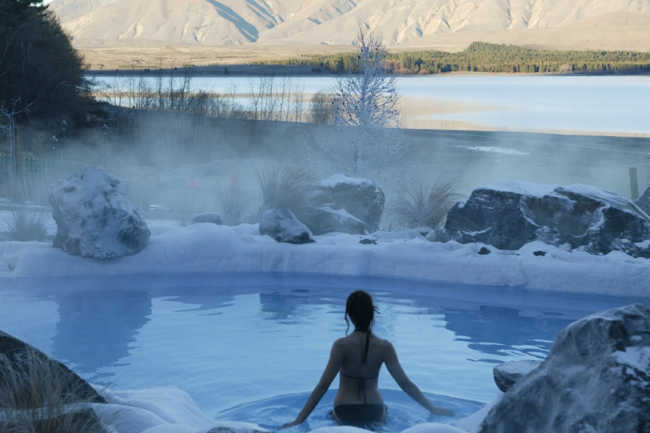
Hot Pools in Snow: The warm, Harbin, heart-shaped pool, ethnographically
Harbin ethnography:
... 'Place,' here, is the geothermally heated waters which flow into the Harbin warm pool and the aqueous milieu they create. Place's significance relates to what emerges in this milieu.
The warm, Harbin, heart-shaped pool is shaped like the heart symbol (Fig. http://www.harbin.org/assets/p-heartpoolL.jpg), slightly cooler in temperature than the Harbin warm pool, and kids can play in it, in contrast to the warm pool which is too deep for children. In some ways, it emerges from the idea of the nearby Harbin warm pool, perhaps symbolically in the form of a heart, signifying, in my reading, connection between people, intimately, in warm water, out of attraction – so, heart - and as a place-expression of Harbin's vision. The Heart-Shaped Pool's name, itself, as well as the idea, shares a word in Heart Consciousness Church's name (which owns and operates Harbin Hot Springs). Unlike the Harbin warm pool, which was built as early as the 1870s (Klages 1991:97), and since 1972 has only changed significantly with the removal of tiles, the Harbin heart-shaped pool was built by Harbin residents, around 1985. I think, too, that the amount of geothermally-heated water emerging out of the ground can only fill and warm this heart-shaped pool, besides the hot pool and the warm pool. Here's an early haiku-ish (a poetic form, informed by haiku) which I wrote about the Harbin heart pool, as a new form of ethnographic representation.
Snow covers the pools' ridge line
Steam rises from the heart pool
Pool's warmth lingers in my body
(MacLeod, Harbin Field Notes 2007-2008, January 28, 2008).
And here's another note about the heart-shaped pool, an actual history of this place, with Ishvara in the heart pool.
“It’s alligator day (warm pool cleaning day, which can make expectant visitors feel like alligators, when they can't go in the pool), so the warm pool’s water is getting drained, and I sat there with water more than half-gone exploring the relaxation response, and then going to the Heart-Shaped pool, where Ish was. We just nodded hello. I went into padmasana (lotus pose) again with my eye’s shut. After a while Ishvara got out, and picked the mulberries from the earth under the tree, and then went back into the heart-shaped pool. I was doing yoga-twists in lotus pose in the heart pool, and after went to the sauna, where I found someone chanting. This was o.k. with me, and I said to her, I'm happy to join you chanting … ” (MacLeod, Harbin Field Notes 2007-2008, June 3, 2008).
Ethnography as poetry vis-a-vis the Harbin Heart-Shaped Pool is a kind of representation which can highlight the beauty of that which is being represented. It thus focuses the idea of place in a word, and representation, form, which is an expression of the heart-idea, - here in the form of the heart-shaped pool.
Place, and the idea of place, as distinct from the actual world ...
(http://scott-macleod.blogspot.com/2010/09/hot-pools-in-snow-warm-harbin-heart.html - September 8, 2010)
Hemiptera: Social History of I.T. Revolution, FREE, online course, for WUaS credit, on Harvard's virtual island in Second Life starts this Saturday
Social History of the I.T. Revolution - a FREE, open, online course - http://socinfotech.pbworks.com/ - for WUaS credit, on Harvard's virtual island in Second Life starts this Saturday, Sept. 11 from 11a - 1p PT ... the first for-credit class at World Univ & Sch - http://worlduniversity.wikia.com/ Invite a friend ... join the conversation : information technologies' emergence is fascinating :).
What's your Second Life avatar's name? Getting an avatar is free, easy and fun ... come check out this virtual world - http://secondlife.com/ and the IT revolution
*
Greetings! Welcome to "Information Technology & Society" and to World University & School.
Please join these Google (http://groups.google.com/group/World-University-and-School) and Facebook (http://www.facebook.com/group.php?gid=48753608141) groups to stay in touch.
WUaS is an open, free, editable world university and school idea, so anyone can teach here, - to their web camera or interactively in a virtual world, like Second Life, and you'll find an enormous amount of material here already.
To teach or learn, after you've joined the Google Group (http://groups.google.com/group/World-University-and-School), you can schedule when you'd like to teach on the Google wiki-like calendar there, or see what's on the schedule, or simply post a course online to http://worlduniversity.wikia.com/wiki/Courses#Individual_courses, or to the subject page - http://worlduniversity.wikia.com/wiki/Subjects .
There's a lot! of teaching and learning content here already, including 2000 courses, with syllabi, from MIT Open Course Ware (http://worlduniversity.wikia.com/wiki/Courses#University_course_listings), Berkeley Webcast, and many main pages including "Languages," "Educational Software," "Museums," "Library Resources," "Nation States," and much more so click through WUaS for an overview.
What's your Second Life avatar's name?
See you in-world on Saturday.
Looking forward to talking further soon. :)
*
Dear Association of Internet Researchers,
World University & School is incorporated and is offering a free, open class on the I.T. Revolution - http://socinfotech.pbworks.com/ - for WUaS credit, on Harvard's virtual island in Second Life starting this Saturday Sept. 11 from 11a - 1p PT. (This course could be a great opportunity for you, or a student of yours, to come into conversation about a paper you are writing, for example).
World University is also planning to video-stream live a free UC Berkeley "Biological Anthropology" undergraduate class beginning in Jan. 2011 (probably on Tuesday and Thursday mornings PT), also for WUaS credit.
Both courses are listed here: http://worlduniversity.wikia.com/wiki/Courses#Individual_courses (where other for-credit courses will be listed).
World University & School is planning for matriculating classes for online degree course work primarily through partnering with great universities like UC Berkeley beginning in 2014, with interactivity in virtual worlds.
Resources are growing at the open, free, editable, wiki World University & School, where we all can teach and learn: http://worlduniversity.wikia.com/wiki/World_University. WUaS is like Wikipedia with MIT OCW, Berkeley Webcast, and facilitating people-to-people teaching and learning.
Please contact worlduniversityandschool@gmail.com with further questions, and check out the WUaS wiki. There are already a lot of open, free, wiki teaching and learning resources at World University & School: http://worlduniversity.wikia.com/wiki/Courses.
Sincerely,
Scott
(http://scott-macleod.blogspot.com/2010/09/hemiptera-social-history-of-it.html - September 8, 2010)
Stags: Autumn sings coolness in Canyon, California. Stags along the road, A natural turn, Virtual ethnography of World Univ & Sch?, Flow
Autumn sings coolness in Canyon, California. This week: stags along the road, explorer ants in the house ... a natural turn
*
A virtual ethnography of World Univ & Sch - http://worlduniversity.wikia.com/ - participant observation - cyber field work? Where to begin?
*
A friend wonders:
wonders if it is a bad thing that both his children spent their last weekend of summer vacation making weapons.
(Other interesting replies in FB)
Scott:
Tool-making is 'thing' - a good thing, and old - how to move this along to MIT's drag-and-drop, free, fun, colorful Scratch programming language (http://scratch.mit.edu/) is one question I'll ask myself in the next years with kids. Is language-use an extension of tool / weapon making, and might it be substituted for 'weapon-making'? A friend visited recently, and his 7 year old son was making a weapon with stone and stick, but not his 5 year old daughter... All 7 billion-ish of us have language from age 2-ish
*
A friend writes:
C'mon. Doesn't anyone want to debate? Who is your favorite Reductionist? heheh
Scott:
I'll see what I can find at MIT OCW, Berkeley Webcast, Yale OYC et al. ... looking first at philosophy of science (and the Oxford Companion to Philosophy :) ... invite friends to teach this, or add their blog posting to http://worlduniversity.wikia.com/ ... check out, too, the online, free Stanford Encyclopedia of Philosophy (http://plato.stanford.edu/entries/reduction-biology/), if folks want to learn more immediately :)
World Univ & Sch's 'Religious Studies' subject has a evolutionary focus - http://worlduniversity.wikia.com/wiki/Religious_Studies :)
Click 'edit this page' at WUaS to add resources, teach and learn :) Please invite friends to do the same ...
*
A Quaker friend in FB writes:
would happily borrow more books from the library (instead of buying them used online)...if the library actually had the books I want to read.
Another friend:
I have that same problem. Actually, university libraries are better, but getting access can be tricky.There's also inter-library loan.
Scott:
Here are the beginnings of World Univ & Sch's "Library Resources" wiki page - with a lot of books and resources - all of which are in the public domain: http://worlduniversity.wikia.com/wiki/Library_Resources . As a free, open, wiki this will grow with what we add to it. :)
Just added Read Print - http://www.readprint.com/ - recommended by Time Magazine (as one of 50 best web sites for the year - http://www.time.com/time/specials/packages/completelist/0,29569,2012721,00.htm) to WUaS's Library Resources: http://worlduniversity.wikia.com/wiki/Library_Resources.
*
A friend posts a speech by Microsoft's Bill Gates:
Bill Gates speech: 11 rules your kids did not and will not learn in school
Rule 1: Life is not fair - get used to it!
Rule 2: The world doesn't care about your self-esteem. The world will expect you to accomplish something BEFORE you feel good about yourself.
Rule 3: You will NOT make $60,000 a year right out of high school. You won't be a vice-president with a car phone until you earn both.
Rule 4: If you think your teacher is tough, wait till you get a boss.
Rule 5: Flipping burgers is not beneath your dignity. Your Grandparents had a different word for burger flipping: they called it opportunity.
Rule 6: If you mess up, it's not your parents' fault, so don't whine about your mistakes, learn from them.
Rule 7: Before you were born, your parents weren't as boring as they are now. They got that way from paying your bills, cleaning your clothes and listening to you talk about how cool you thought you were. So before you save the rain forest from the parasites of your parent's generation, try delousing the closet in your own room.
Rule 8: Your school may have done away with winners and losers, but life HAS NOT. In some schools, they have abolished failing grades and they'll give you as MANY TIMES as you want to get the right answer. This doesn't bear the slightest resemblance to ANYTHING in real life.
Rule 9: Life is not divided into semesters. You don't get summers off and very few employers are interested in helping you FIND YOURSELF. Do that on your own time.
Rule 10: Television is NOT real life. In real life people actually have to leave the coffee shop and go to jobs.
Rule 11: Be nice to nerds. Chances are you'll end up working for one.
http://www.facebook.com/note.php?note_id=131190066891088&id=513625075&ref=mf
Scott wonders in response:
:) Unspoken codes? Is Bill Gates becoming an anthropologist? Perhaps WUaS could invite him to join the anthropology conversation at http://worlduniversity.wikia.com/wiki/Anthropology :)
*
A friend who is entering a Master's program at Columbia writes:
feeling like a kid who can't swim and suddenly got tossed into the deep end. will take a few weeks of kicking and struggling until i settle into all this learning.
Scott:
find the focus, read, write rhythm :) Self-motivation wins the day ... and can lead to rich 'flow: the psychology of optimal experience' experiences (Csikszentmihalyi)
*
Napa Valley - Silverado Trail - sun going down - illuminated wonderland - Grateful Dead 1969 jam heaven - heading to Harbin's waters
(http://scott-macleod.blogspot.com/2010/09/stags-autumn-sings-coolness-in-canyon.html - September 8, 2010)
*
A virtual ethnography of World Univ & Sch - http://worlduniversity.wikia.com/ - participant observation - cyber field work? Where to begin?
*
A friend wonders:
wonders if it is a bad thing that both his children spent their last weekend of summer vacation making weapons.
(Other interesting replies in FB)
Scott:
Tool-making is 'thing' - a good thing, and old - how to move this along to MIT's drag-and-drop, free, fun, colorful Scratch programming language (http://scratch.mit.edu/) is one question I'll ask myself in the next years with kids. Is language-use an extension of tool / weapon making, and might it be substituted for 'weapon-making'? A friend visited recently, and his 7 year old son was making a weapon with stone and stick, but not his 5 year old daughter... All 7 billion-ish of us have language from age 2-ish
*
A friend writes:
C'mon. Doesn't anyone want to debate? Who is your favorite Reductionist? heheh
Scott:
I'll see what I can find at MIT OCW, Berkeley Webcast, Yale OYC et al. ... looking first at philosophy of science (and the Oxford Companion to Philosophy :) ... invite friends to teach this, or add their blog posting to http://worlduniversity.wikia.com/ ... check out, too, the online, free Stanford Encyclopedia of Philosophy (http://plato.stanford.edu/entries/reduction-biology/), if folks want to learn more immediately :)
World Univ & Sch's 'Religious Studies' subject has a evolutionary focus - http://worlduniversity.wikia.com/wiki/Religious_Studies :)
Click 'edit this page' at WUaS to add resources, teach and learn :) Please invite friends to do the same ...
*
A Quaker friend in FB writes:
would happily borrow more books from the library (instead of buying them used online)...if the library actually had the books I want to read.
Another friend:
I have that same problem. Actually, university libraries are better, but getting access can be tricky.There's also inter-library loan.
Scott:
Here are the beginnings of World Univ & Sch's "Library Resources" wiki page - with a lot of books and resources - all of which are in the public domain: http://worlduniversity.wikia.com/wiki/Library_Resources . As a free, open, wiki this will grow with what we add to it. :)
Just added Read Print - http://www.readprint.com/ - recommended by Time Magazine (as one of 50 best web sites for the year - http://www.time.com/time/specials/packages/completelist/0,29569,2012721,00.htm) to WUaS's Library Resources: http://worlduniversity.wikia.com/wiki/Library_Resources.
*
A friend posts a speech by Microsoft's Bill Gates:
Bill Gates speech: 11 rules your kids did not and will not learn in school
Rule 1: Life is not fair - get used to it!
Rule 2: The world doesn't care about your self-esteem. The world will expect you to accomplish something BEFORE you feel good about yourself.
Rule 3: You will NOT make $60,000 a year right out of high school. You won't be a vice-president with a car phone until you earn both.
Rule 4: If you think your teacher is tough, wait till you get a boss.
Rule 5: Flipping burgers is not beneath your dignity. Your Grandparents had a different word for burger flipping: they called it opportunity.
Rule 6: If you mess up, it's not your parents' fault, so don't whine about your mistakes, learn from them.
Rule 7: Before you were born, your parents weren't as boring as they are now. They got that way from paying your bills, cleaning your clothes and listening to you talk about how cool you thought you were. So before you save the rain forest from the parasites of your parent's generation, try delousing the closet in your own room.
Rule 8: Your school may have done away with winners and losers, but life HAS NOT. In some schools, they have abolished failing grades and they'll give you as MANY TIMES as you want to get the right answer. This doesn't bear the slightest resemblance to ANYTHING in real life.
Rule 9: Life is not divided into semesters. You don't get summers off and very few employers are interested in helping you FIND YOURSELF. Do that on your own time.
Rule 10: Television is NOT real life. In real life people actually have to leave the coffee shop and go to jobs.
Rule 11: Be nice to nerds. Chances are you'll end up working for one.
http://www.facebook.com/note.php?note_id=131190066891088&id=513625075&ref=mf
Scott wonders in response:
:) Unspoken codes? Is Bill Gates becoming an anthropologist? Perhaps WUaS could invite him to join the anthropology conversation at http://worlduniversity.wikia.com/wiki/Anthropology :)
*
A friend who is entering a Master's program at Columbia writes:
feeling like a kid who can't swim and suddenly got tossed into the deep end. will take a few weeks of kicking and struggling until i settle into all this learning.
Scott:
find the focus, read, write rhythm :) Self-motivation wins the day ... and can lead to rich 'flow: the psychology of optimal experience' experiences (Csikszentmihalyi)
*
Napa Valley - Silverado Trail - sun going down - illuminated wonderland - Grateful Dead 1969 jam heaven - heading to Harbin's waters
(http://scott-macleod.blogspot.com/2010/09/stags-autumn-sings-coolness-in-canyon.html - September 8, 2010)
Tuesday, September 7, 2010
Warm, Underground Water: Brief histories of Harbin 'place' as its waters, The warm pool, the warm, heart-shaped pool, ethnographically
Harbin ethnography:
... Brief histories of Harbin 'place,' as its waters, with their effects, follow.
As actual histories of the Harbin warm pool, here are some notes from my field notes, that bring into focus some of the fascinating aspects of the Harbin Pools that I'll explore in this ethnography.
“There’s a quality of seeing people’s true, lovely ‘spirits’ when soaking in pools – their soft selves. When people are naked and relaxed and in a beautiful place, and talking quietly, and meditating, something good emerges. It makes me want to spend a lot of time around warm pools. This is the poetry I’d like to write of Harbin, and which I’d like to explore in part (MacLeod, Harbin Field Notes 2007-2008, January 21, 2008).”
“As T. and I went into the warm pool separately, some folks were doing water dance, very intimately, normally, erotically, relaxedly and as part of the fabric of life at Harbin, and what happens in the pools, probably since when Ish came 36 years ago (MacLeod, Harbin Field Notes 2007-2008, February 1, 2008).”
“Meditating in the Harbin warm pool this morning, in padmasana (lotus pose in yoga), at the far end of the pool, I mirrored the bouquet of flowers above the hole where the hot water comes out (MacLeod, Harbin Field Notes 2007-2008, February 1, 2008).”
“Scott: . . . and I was camping, with good equipment, fortunately (in wintery, rainy, freezing January) [smile]. The warm pools, community kitchen, nice restaurant, lots of comfortable spaces to come inside to, like a library, a beautiful, masterpiece of a temple (hippie-minded), etc., make such living as good as it gets. (MacLeod, Harbin Field Notes 2007-2008, February 1, 2008 - from an online chat conversation in a cafe in Middletown, near Harbin, with a friend in Massachusetts).”
“I saw HeartSong give a Watsu last night (Fig. http://www.soulscode.com/wp-content/uploads/2007/06/mas_watsu365_pic.jpg) in the warm pool to someone. It was beautiful, and will be interesting to try to model the movement and art of it in Second Life (MacLeod, Harbin Field Notes 2007-2008, February 14, 2008).”
Each note highlights aspects of the Harbin warm pool with their effects on people. 'Place,' here, is the geothermally heated waters which flow into the Harbin warm pool and the aqueous milieu they create. Place's significance relates to what emerges in this milieu.
The warm, Harbin, heart-shaped pool is shaped like the heart symbol (Fig. http://www.harbin.org/assets/p-heartpoolL.jpg), slightly cooler in temperature than the Harbin warm pool, and kids can play in it, in contrast to the warm pool which is too deep for children. ...
(http://scott-macleod.blogspot.com/2010/09/warm-underground-water-brief-histories.html - September 7, 2010)
Monday, September 6, 2010
Kalmia angustifolia: Actual Harbin's histories richly inform explorations of the concept of virtuality because place matters
Harbin ethnography:
... What will emerge and develop vis-a-vis virtual Harbin both follows and is to be seen.
HARBIN HISTORIES, ACTUAL AND VIRTUAL
While the above, personal Harbin histories extend ways I explore the concept of virtual vis-a-vis virtual Harbin Hot Springs in this ethnography, actual Harbin histories richly inform these explorations of the concept of virtuality because place matters; the Harbin valley, and its pool area and especially its warm pool and other pools are central to, and intertwined with, emergent (Fischer 2004), virtual Harbin. Without actual Harbin, virtual Harbin wouldn't have begun to emerge. And while “place is the first of all beings, since everything that exists is in a place and cannot exist without a place” (Archytas, commentary on Aristotle’s 'Categories'), the Harbin Hot Springs' valley and the Harbin waters, in northern California - these experiences of Harbin as place, emergent from the 1960s and written ethnographically – are the first context from which Harbin histories emerge new. Brief histories of Harbin 'place,' as its waters, with their effects, follow.
As actual histories of the Harbin warm pool, here are some notes from my field notes, that bring into focus some of the fascinating aspects of the Harbin Pools that I'll explore in this ethnography. ...
(http://scott-macleod.blogspot.com/2010/09/kalmia-angustifolia-actual-harbins.html - September 6, 2010)
Sunday, September 5, 2010
Desmodium callianthum: Affection - in life - between people ... how to generate this?
Affection - in life - between people ... how to generate this? Simply like (show affection to) people more & then complementary affection will grow? Add to http://worlduniversity.wikia.com/wiki/Affection as subject - ? Affection is wonderful ... often emerges in families with kids & between teens, in my experience ... how else? Avatar affection in SL?
And bliss neurochemistry when you want it? Music listening is the easiest way I know of to elicit this. Loving Bliss neurophysiology - http://worlduniversity.wikia.com/wiki/Loving_Bliss_%28eliciting_this_neurophysiology%29 - at this Loving Biss subject to explore learning together, wiki-wise. :)
Build friendship and trust ...
I'm curious why a lot of people aren't exploring eliciting loving bliss neurophysiology much of the time in life {besides that they aren't many practices for this, comparable to, say, playing chamber music}? Why not?
What's the metaphorical musical score for this?
(http://scott-macleod.blogspot.com/2010/09/desmodium-callianthum-affection-in-life.html - September 6, 2010)
Subscribe to:
Posts (Atom)


 Posts