I have a dream, ~ to elicit loving bliss {it's neurophysiology, with MDMA as a reference experience}, naturally, when and as we want {5 letters - scottmacleod.com/links.htm}, and to explore how to do this, so aws to make this possible for anyone, in multiply qualities, ~ wherever and however. I'd love to think this through, and develop a language and culture for this, in such a way that we generate a loving bliss economy, as well.
{The word 'dream' (from OE meaning joy, mirth, gladness) is fascinating - MLK jr.'s dream is coming true with Obama's election, in some ways. To 'dream' here includes envisioning {a complex and fascinating process}, as well as articulating - that is, expressing symbolically - these visions, so that people, i.e. conversants, come to engage the envisioning process}.
In this 'dream,' - meaning 'envisioning' here - learning {in a MIT Open Course Ware knowledge context} is part of the process, ~ we can learn loving bliss.
World University and School Wiki {editable web pages} - worlduniversity.wikia.com - is one information technology example involving envisioning, teaching and learning whatever we want.
Here's the Facebook group facebook.com/group.php?gid=48753608141&ref=ts
Ah, loving bliss and learning ...
to the Harbin pools, soon ...
Tuesday, January 20, 2009


Monday, January 19, 2009
Cheetah: Happy Dr. Martin Luther King, jr. Day!, Obama, Hope
Happy Dr. Martin Luther King, jr. Day!
What are some 'cultural' implications of his "I Have a Dream" speech (1963) this MLK jr. national holiday, and Obama's election and presidency tomorrow? How does 'culture' work, especially vis-a-vis language? How is the 'American Dream' extended with Obama's presidency, and what cards will Obama and his government play over the next many years to further this dream for all of us, especially for democracy, freedom, justice and prosperity?
How does an individual's way of thinking, and his or her circles or networks, such as MLK jr.'s or Obama's, influence a set of wide-spread 'cultural' understandings, that may come and go over time, but which people can elicit or draw upon, and build upon, here in the name of social justice?
*
To contact improv soon ... :)
What are some 'cultural' implications of his "I Have a Dream" speech (1963) this MLK jr. national holiday, and Obama's election and presidency tomorrow? How does 'culture' work, especially vis-a-vis language? How is the 'American Dream' extended with Obama's presidency, and what cards will Obama and his government play over the next many years to further this dream for all of us, especially for democracy, freedom, justice and prosperity?
How does an individual's way of thinking, and his or her circles or networks, such as MLK jr.'s or Obama's, influence a set of wide-spread 'cultural' understandings, that may come and go over time, but which people can elicit or draw upon, and build upon, here in the name of social justice?
*
To contact improv soon ... :)
Sunday, January 18, 2009
Golden Light: My Home Was Like A Glancing, Golden-Light Ship When I Awoke
My Home Was Like A Glancing, Golden-Light Ship When I Awoke
My home was like a
glancing, golden-light ship
when I awoke,
from a nap today.
Sunlight danced dazzlingly
all around, and,
the temperature was perfect.
Sun illuminated
the wooden center beam,
like water lapping
against the keel
of a craft,
kissing the prow's
sunlit waterline.
And I delighted
in this light ~
no warm water nigh.
My house, a light craft
on a ridge,
in the afternoon,
in Canyon,
California,
bearing gene goods,
was sailing
through time,
and space,
amid dancing light.
*

...
(http://scott-macleod.blogspot.com/2009/01/my-home-was-like-glancing-golden-lit.html - January 18, 2009)
Baby Chameleon: Relaxation Response, Space Between, Freeing and Easing Practices
In eliciting the relaxation response everyday, usually soon after I awake, I sit, and then soften and soften. I sometimes find that I come to a space between, which is very freeing and easy. As I soften again and again {e.g. my eyes, activity in my face, my brain, etc.}, I experience this process of progressive easing, at times, as a series of kisses, inner~caressing joys.
A chameleonic series of inner body responses, that give rise - aw - to baby chameleons ... ;)
It's a lovely response to cultivate, especially as a kind of bodymind place to return to, whenever you want.
A chameleonic series of inner body responses, that give rise - aw - to baby chameleons ... ;)
It's a lovely response to cultivate, especially as a kind of bodymind place to return to, whenever you want.
Saturday, January 17, 2009
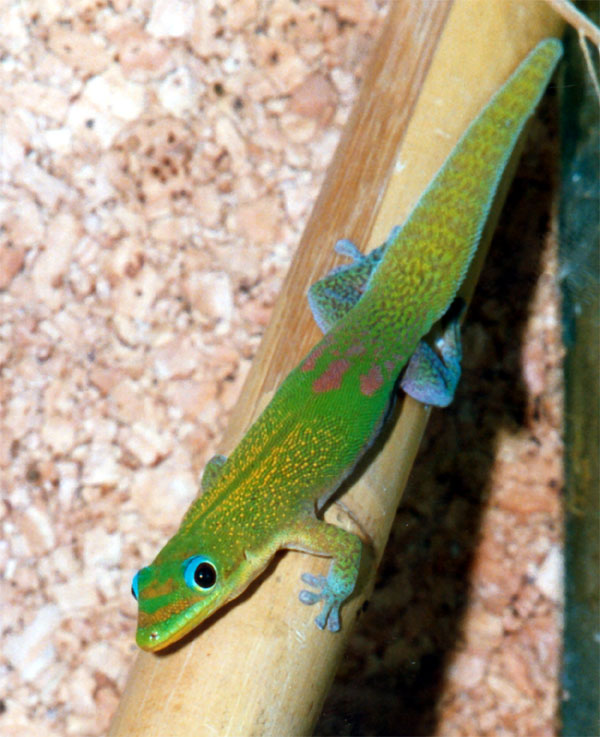
Gecko: Milieu and Agency
Might milieu help give rise to happiness (social psychology experiments?), and might we be able to shape milieu (agency?).
Harbin Hot Springs is a fascinating milieu, which just kind of emerged out of the 1960s and '70s.
*
...
Friday, January 16, 2009
Cardamom Flower: Singing with Your Partner, Eliciting Bliss Through Harmonizing, Mango Lassi, John Muir
I'm curious to explore how singing together, a cappella and improvisationally, with a partner might elicit bliss ...
Listening to the a cappella singing group Chanticleer's "Loch Lomond" on their compact disk Wondrous Love brought tears to my eyes today.
In what ways was this a kind of technological, or even a bodymind computer-like, process, which can inform ways to elicit loving bliss, for example? Computer-wise, the input here is the music, my bodymind 'read' or 'processed' the tones as beauty, and the output was tears and far-reaching feelings. But the music (code) as input to your bodymind computer (software shaped by taste and subculture, that is, the music you and your friends like) changes through our lives.
If only I could sing like Chanticleer with a partner, we'd elicit a lot of bliss ...
Practices, sweet practices: singing together beautifully and improvisationally is an amazing practice to develop.
**
A sublime drink: Mango Lassi - blend equal parts of mango and yoghurt with half as much milk, and add a little ground cardamom on top ... MMmmm ...
***
Naturalist, conservationist and writer John Muir was 'extreme' or engaged in ways he explored wilderness. {http://www.yosemite.ca.us/john_muir_writings/} He got into the most interesting situations, by traveling as remotely and exploratorily in wilderness as possible, and then learned from, and wrote about, them ... :)
Listening to the a cappella singing group Chanticleer's "Loch Lomond" on their compact disk Wondrous Love brought tears to my eyes today.
In what ways was this a kind of technological, or even a bodymind computer-like, process, which can inform ways to elicit loving bliss, for example? Computer-wise, the input here is the music, my bodymind 'read' or 'processed' the tones as beauty, and the output was tears and far-reaching feelings. But the music (code) as input to your bodymind computer (software shaped by taste and subculture, that is, the music you and your friends like) changes through our lives.
If only I could sing like Chanticleer with a partner, we'd elicit a lot of bliss ...
Practices, sweet practices: singing together beautifully and improvisationally is an amazing practice to develop.
**
A sublime drink: Mango Lassi - blend equal parts of mango and yoghurt with half as much milk, and add a little ground cardamom on top ... MMmmm ...
***
Naturalist, conservationist and writer John Muir was 'extreme' or engaged in ways he explored wilderness. {http://www.yosemite.ca.us/john_muir_writings/} He got into the most interesting situations, by traveling as remotely and exploratorily in wilderness as possible, and then learned from, and wrote about, them ... :)
Thursday, January 15, 2009
Hot Springs Canyon: Happy New Year, Holiday Letter, Greetings

Happy New Year! Here's my holiday letter.
January 1, 2009
Dear Friends,
Greetings from Canyon, California, 20 minutes southeast of Berkeley in the San Francisco Bay Area. Happy New Year! How are you? I’d love to hear your news.
I've traveled a lot this year, focusing mostly on doing fieldwork at Harbin Hot Springs, - http://harbin.org - a hot springs retreat center 2 hours northeast of San Francisco. I'm writing an ethnography about it, and planning to create a virtual Harbin in Open Sim and/or Second Life. In addition to this, I've taught “Society and Information Technology” about the digital revolution in the 3-D virtual world of Second Life this year, both on Berkman Island (not on Harvard's faculty) and on Penn State Island. In addition to teaching, I've taken classes this fall at Berkeley to focus the chapter writing for my book.
In the course of the year, I also visited Sierra Hot Springs, Harbin's sister springs in the Sierra Valley in northeast corner of California, a number of times for research, traveled to the Pacific Northwest - Oregon and Washington - seeing many old friends :), and visiting my alma mater Reed College, attended a "Cultures of Virtual Worlds" conference at U.C. Irvine near Los Angeles, went to the Rainbow Gathering in early July in Wyoming, and visited Cuttyhunk Island, Massachusetts in the summer.
I think a fair amount about my father, around this first anniversary of his death on November 25, 2007. It was caused by complications from a subdural hematoma from a concussion he received while in Belize 4 years ago, on Semester at Sea on December 30, 2004. While I'm very sad he's gone, I'm glad he's past the challenges he was facing over the last three years of his life. We all miss him. Here’s an entry in Wikipedia about him: http://en.wikipedia.org/wiki/Gordon_K_MacLeod, with some additional web sites about his life. My mother and brother, who I just visited in Pittsburgh, are doing relatively well.
I’m re-visiting here some ideas from my holiday letter 2 years ago. What is wisdom in modernity, or the network society, (http://en.wikipedia.org/wiki/Modernity), social conditions that some social theorists suggest is ‘shaping’ life today (say, since the printing press, the Enlightenment and 'industrialization'), now influenced significantly by computing and the Internet? How does the Internet help reshape modernity and post-modernity? In this now information-rich world in which we live, is wisdom a moot idea? I think that wisdom in the network society has both to do with networking, and in making connections in a broad sense, and which, in my experience, is somehow made better in conjunction with the relaxation response (Benson 1972). Here are some steps to elicit the relaxation response - relaxationresponse.org/steps.
I’ve had an eventful few years. In the fall of 2005 I was on Semester at Sea, and, at the end of this voyage, I spent 3 ½ weeks traveling through a lot of India, a fascinating motherland. In the spring of 2005 I lived at Harbin Hot Springs in northern California for a few months. Since studying at Berkeley (2000-2001), the University of California, Santa Barbara (2001-2003), and the University of Edinburgh (2000-2004), I’ve taught college in anthropology and sociology, most recently in the 3-D virtual world of Second Life. I study some social effects of the Internet and information technologies.
One place you might enjoy exploring is the virtual emerging world and society in Second Life - http://secondlife.com/community/downloads.php. The program and going in-world are free, and there are a lot of virtual islands to explore (your computer needs to have a gigabyte of RAM). And all kinds of things take place there like musical performances and lectures, universities and nightclubs. In addition, you can communicate with other avatars, through type-chat and voice, and create and build anything imaginable. And there's a currency, the Linden dollar, which has an exchange rate with the U.S. dollar, if you want eventually to buy things, but at no time do you have to give your credit card. Second Life, like other virtual worlds, is developing quickly and will change a lot in the upcoming years. Virtual worlds are fascinating and it’s worth getting an avatar – having an avatar is a little like having an e-mail address - but exploring in world doesn’t compare with having good friends. The Internet and virtual worlds allow for all of us to become information producers, relatively freely, with far-reaching implications.
In the spring of 2007 I taught "Sociology" at Penn State, and “Society and Information Technology,” at Chatham University, and through the University of Pittsburgh’s OSHER program, all 'in-the-actual-classroom.' And in that summer and fall of 2007, and the spring and summer of 2008, I taught "Society and Information Technology" in Second Life on Berkman Island. Virtual worlds like Second Life make meeting at any time, and across great distances, a possibility, - online academic conferences and courses, for example, are a ‘real’ possibility – and virtual worlds allow opportunities for innovation in many other ways. And they’re easy to use. My research interests are leading me to examine some of the distinctions between ‘real’ and virtual processes, which have arisen due to information technologies like Second Life.
In June 2007, I spent about 2 ½ weeks in Greece taking a yoga course with Angela Farmer and Victor van Kooten, who are unique and creative yoga teachers.
In August 2007, I helped celebrate my parents 50th Anniversary on Cuttyhunk Island in Massachusetts. I was so glad my father could participate a year and a half ago.
Sandy, my brother, is a sculptor in Maine: http://sandymacleod.com. His art is an ongoing exploration for him, and beautiful.
My mother is fully engaged in Pittsburgh on the board of the Pittsburgh Chamber Music Society, walking, gardening, traveling and visiting friends.
Concerning health, I return to the thinking that a very low-fat, varied, natural foods diet, 30 minutes of daily movement (vis-a-vis Dean Ornish’s, M.D., clinical, medical research showing the heart disease is reversible through lifestyle changes – WebMD - http://www.webmd.com/content/pages/9/3068_9408.htm), a multi-vitamin, and omega-3s {for mood, heart disease, and more} (Dr. Andy Weil: drweil.com/drw/u/id/QAA356000) have numerous health benefits. Dr. Andy Weil’s web site’s search field, in particular, offers much useful integrative and complementary medical information. In a related vein, keeping one’s brain active learning, for example, a foreign language or a musical instrument benefits the mind, and is useful for lessening the effects of aging, particularly memory loss (http://www.mayoclinic.com/health/memory-loss/HA00001). (Use it or lose it?)
Thinking outside the ‘box,’ I wonder how one might realize great happiness / bliss, in conjunction with the pragmatics of daily life? My Friends’ Dalton Letter and 4 other related letters are partly an exploration of this: http://scottmacleod.com/daltonletter.htm, and I continue to find creative possibilities in thinking about these letters. Listening to Mozart’s arias, doing contact improvisational dance, contra-dance, and talking with friends, are ways for me to access qualities of bliss, - so yes, it is possible. I'm curious how extensively and with what qualities? Click on ‘notes’ on my yoga page - http://scottmacleod.com/yoga.htm - for related perspectives. I’m interested in your thoughts about this.
This past year, I've also begun to envision and realize World University and School: A Global, Virtual, Open, Free-to-Students, Multilingual University {potentially Degree-Granting, with Great Universities as Key Players} and School, using a Wikipedia model, for the Developing World {One Laptop Per Child countries to begin with} and Everyone - worlduniversity.wikia.com/wiki/World_University. So, all languages, all subjects. Add or take a class. Here's the Facebook page: facebook.com/group.php?gid=48753608141&ref=ts. World University and School is based on a kind of Wikipedia-cum-MIT Open Course Ware model. While the possibility that many people will contribute an amazingly wide variety of courses is exhilaratingly exciting with creative potential, and academically, too, I'm particularly interested in how we might make learning fun, and to explore questions of eliciting loving bliss here, as well. Post a course about this :).
I've also started to play my Scottish Highland Bagpipe regularly, and for events like weddings, too - scottmacleod.com/piping.htm.
I also started this blog - scott-macleod.blogspot.com - in June 2008, and as of January 16, 2009, have made 189 entries. Click on the 'poetry' tag here to read some poetry I'm writing, including some haiku-ish :)
hot pool, cold plunge
light through a leaf ~ fig:
green light smile
Whether or not wisdom has something to do with connecting positively, the world continues to be a beautiful and symbolically-rich place, especially with the Internet. Engaging it creatively is enjoyable. And for me, the relaxation response - relaxationresponse.org/steps - accentuates this.
Warm regards in the New Year,
Scott
*
The computer adds new ways to create things, easily. Here's a perspective on the Apple MacBook:
The new-ish Apple MacBook, which runs both main operating systems (Mac OS - operating system - and Windows OS), has useful and easy video technologies, including making video-making and conferencing easy. The Mac OS makes computing elegantly easy. There’s now a program that runs both the Mac OS and Windows OS at the same time on the same machine, called Parallels.
There's no reason not to get an Apple MacBook now. (You can run all your old Window's software on it). Getting a MacBook with a large hard drive and the maximum memory will make it useful well into the future. The thirteen inch screen Apple MacBook has a battery that lasts much than the 2 hours of the larger screen of Apple’s MacBook Pro, and does everything the larger laptop does for $1850, instead of $2900 for the MacBook Pro. Everything is done and ordered through the Apple web site. Here’s a CNET review about it:
http://cnn-cnet.com.com/laptops/apple-macbook-13-inch/4505-3121_7-31884384.html?tag=mncol;lst. If you have or get an Apple MacBook, and want to video-conference using iChat, which makes it very easy, let me know your .mac or free AIM address.
**
And MIT’s new One Laptop per Child, the XO – is another fascinating convergence development.
***
This click-to-give web site: thehungersite.com - with 6 possible clicks daily, plus more with mult. browsers, and x 2 with a MacBook w/ Parallels, allows you to give to worthy causes just by mouse clicking.
HAPPY NEW YEAR
http://scott-macleod.blogspot.com/2009/01/happy-new-year.html
(Scott Macleod Bagpiping at Easter Harbin Hot Springs with wizard and Easter Bunny
photo: Harbin Hot Spring's Easter 2005 (Scott MacLeod and Eric R.) photo credit ?)
Wednesday, January 14, 2009
Children: Loving Bliss as Friends, Harmonizing, Bathtub
Loving bliss as friends
Friends,
I've been exploring questions and experiences of loving bliss :), partly from a nontheistically friendly perspective, and have been posting these ideas to this web page - "Loving bliss and practices to elicit this." Enjoy!
I'm curious what you think about loving bliss, and possibly to facilitate generating a conversation among friends about this. I enjoy exploring and generating practices toward these qualities of experience, so my 'love bliss letters' are an exploration in progress. Let me know what you think, and how we might or can generate qualities of loving bliss, in the ways we want, and when you want to.
While the following definition doesn't fully explain what loving bliss is for me, it does involve experiences that are deeply, gratefully harmonizing, and reciprocally appreciative and affectionate, both with a friend or friends, and alone, as well as profoundly and naturally high at the same time, and which are ongoing, biological, 'flow' experiences. What is loving bliss for you? For me, it may be, metaphorically, '... the valley of love and delight.'
One way in to explore loving bliss experientially might be to imagine what the drug Ecstasy - (MDMA - methylene_dioxy_meth_amphetamine) - might do {~> oxytocins~dopamine}, say, over a seven hour time span, and without any side effects, with friends. Another way into exploring loving bliss experientially might be to explore what gives rise to your happiness, joy or enjoyment (listening to a favorite piece of music?) in your own life, and then cultivate and 'grow' that experience profoundly, socially, and with consciousness (writing about loving bliss is a good way to begin, - print this letter, below, and add to it, for example). For me, from a nontheistically friendly perspective, in part, the word spiritual doesn't hold much meaning, - and I suspect that what some ecstatics, who may have explored loving bliss, have called 'spiritual' is solely neurophysiological, - but that symbols and language of the 'spirit' can evoke these experiences, i.e. this neurophysiology. So I prefer to explore how to cultivate these experiences first focusing on the neurophysiology, rather than the intermediary language, which I find can lead one far from these qualities of experience, and then develop lovingly blissful language, conversations and community. And when I'm not cultivating loving bliss, I like to relax into the relaxation response, which I explore often when in hot pools, silent meeting, or a bathtub.
Soaking in warm water (100 F / 38 C) deepens the relaxation response in my experience, especially when doing so is in a beautiful, natural area, communal and clothing~optional, but also in the bathtub. Besides the relaxation responses that many soaks per day might elicit (and does so especially at Harbin - the clothing-optional, pool area is very beautiful there, and these aspects help a lot - http://harbin.org), as well as Omega-3 fatty acids (1000 mg of flaxseed oil, 3-4 times a day with food), I'd love to learn of other ways you access or cultivate (this seems to me to be an important aspect, with awareness) loving bliss. Why not practice loving bliss, as you would practice a musical instrument? I've found also that thinking and writing about loving bliss can be both a flow experience, and serve to bring my awareness to these qualities of experience, thus often eliciting it. Try it :)
About meeting together: I think it might be interesting for nontheist friends to meet in a 3-D virtual world like Second Life, in addition to real life gatherings, to explore loving bliss through conversation, among other ways. Here's the Second Life download page; it's free, takes about 20 minutes to get an avatar that is anonymous (but through which you can share your identity, and we may well, in time, be able to animate and make our avatar faces like ours), and requires about 1 gigabyte of RAM. It's easy to navigate in this emerging, virtual society, and people might meet 'there' in a beautiful, virtual, hot pool area to converse. Let me know if you are interested. (For those interested in an unprogrammed, Quaker, silent meeting, one already meets in-world in Second Life on Sea Turtle Island - slurl.com/secondlife/Sea%20Turtle%20Island/197/17/27 - on Saturdays at 10 am SLT / Pacific Time).
I think the relative lack of exploration of the experience of loving bliss from a research perspective is a fascinating societal elision, although Alan Watts, for example, did write about aspects of this in "Joyous Cosmology." I also think this is therefore an opportunity to create a new language, and possibly shape an orientation to qualities of the experience of loving bliss at large, and especially among nontheistic friends. Loving bliss is wondrous.
And while 'Tis the gift to be simple, 'tis the gift to be free, 'tis the gift to come down where you ought to be, ... (centering down - a kind of relaxation response?) ... And when we find ourselves in the place just right, It will be in the valley of love and delight (which, in actuality, is Harbin Hot Springs for me), I have found I can access loving bliss on my own, neurophysiologically, often beginning with the relaxation response, then cultivating loving bliss as it emerges (it can bubble up, or music can help elicit it, for example), and then continue to receive this ongoing, biological experience, with awareness. I think other people can too.
Let's communicate together, directly or indirectly, to cultivate loving bliss, - from our bathtubs, digitally? :)
Warm regards,
Scott
Print Loving Bliss as Friends (.doc)
home: scottmacleod.com
http://scottmacleod.com/LovingBlissAsFriends.htm
Tuesday, January 13, 2009
Wave: California, Traveling, Places to Visit, Art
A friend asked me today what events or places would I recommend in northern California?
I said, I like youth hostels, especially along the California coast.
Yosemite in winter can be beautiful.
Besides Harbin Hot Springs, Sierra Hot Springs, Orr hot springs and Wilbur hot springs are also nice, but not nearly as 'big' or as social as Harbin. (I like Harbin's sociality).
Pt. Lobos State Reserve near Carmel is beautiful, as is Carmel itself, as is the Monterey Aquarium.While not northern California, going slow along the Big Sur coast line is great.
I'd like to explore slowly Mendicino, Trinity and Humboldt Counties in a meandering kind of way. They can be pretty alternative.
And the Siskiyou - Klamath mountains {see David Rains Wallace's "The Klamath Knot: Explorations of Myth and Evolution"} in northern California and southern Oregon draw me, as do most of the wilderness areas and national parks in northern California - e.g. Trinity Alps, Shasta, Mt. Lassen, Desolation - there are many.
I'd also like to follow California wildflowers as they emerge in spring, in the most remote, out-of-the-way, natural and wilderness areas, with a friend :) ~ AW. I'll try to explore much California back country in the years ahead. {Here are some related, inspiring, selected writings - http://www.yosemite.ca.us/john_muir_writings - by John Muir}.
How is the Burning Man, my friend asked? Have you been there last year?
Will you go to Burning Man this year, he asked?
Burning Man seems fascinating, exciting and freeing, I said ...
***
It's the qualities with which one experiences these places that are so interesting to explore.
Eliciting the relaxation response in relation to new places,
exploring loving bliss naturally, in new places,
welcoming on great happiness while traveling,
are fascinating ways to live.
And making art as you go is also opening, regenerative, and can be freeing - photography, writing, painting, bead-making, art with your computer ... so many ways ... let's :)
Let's create :))
Monday, January 12, 2009
Magnolia: Eudaimonia {Personal Flourishing} is 'Flow' and Bliss
Eudaimonia (personal flourishing)
is 'Flow' and Bliss
Dear Friends,
While bliss may be experienced by evoking or exploring good spiritedness, I'm curious about the following.
How to experience eudaimonia, flow, and bliss naturally?
FLOW
What is 'flow' ~ the psychology of optimal experience?
'Flow' is an absorbed mind, being in the "zone," a focused, fugue-like state.
'Flow' involves:
-
Clear goals: short- and long-term, e.g. singing the notes of, and a whole piece of music;
- Immediate feedback, e.g. one knows how one sang the notes and the piece;
- Challenges, where the challenges of activities are matched with the skills of the person, e.g. singing a piece at the appropriate level;
- Focus or concentration;
- A lack of worry about other things, - esp. what people think of you;
- A feeling that one is in control of one's life;
- A loss of self-consciousness;
- And often a sense of loss of time, because one is absorbed in enjoyment (Csikszentmihalyi 1991).
'Flow' can happen in yoga-related movement. Exploring your 'inner body' in movement is a very enjoyable kind of 'flow.'
'Flow' leads to greater complexity, as one engages challenges at the right level.
To increase 'flow,' increase challenge, at the right level; for example, the challenge of 'letting go,' while singing a piece of music.
The opposite of flow is psychic entropy, - scatteredness.
To find 'flow,' the following are integral: clarity, centering, choice, commitment and challenge. You can find 'flow' in so many different ways.
'Flow' is concentration, and concentration is one of the eight limbs of yoga. Yoga is particularly beneficial for 'flow,' because it's a path to holistic health, and can lead to a kind of freedom, and sometimes loving bliss.
BLISS
is great happiness. Bliss is also one aspect of eight-limbed yoga.
I think 'flow' can be a basis for bliss, but I'm also interested in more 'Taoist' or natural approaches to it. It can happen naturally, as a consequence of how one's brain~bodymind works, - it kind of comes in waves, flushes, flowerings, or bubbles up. Experiences can stimulate it. For example, yogic breathing in a very released state of mind can provide a basis for bliss. Laughter and appreciation can bring it on, e.g. for me, listening to Mozart's 'Magic Flute.' Being in love can elicit it. How can one cultivate it naturally, if bliss is one of the most enjoyable experiences in life, - involving, in part for me, feeling and engaging lovingly toward everyone in your life, with people who are doing the same?
EUDAIMONIA (Greek ~ good spirit) ~ happy, personal flourishing
When 'flow' and bliss come together, eudaimonia can occur, a kind of liberation. Is it possible to 'play' our brains' neurophysiologies like a virtuosic (or beginning) musician vis-à-vis loving bliss? Experiment and explore how you might create ~ cultivate this, with friends or by yourself.
Omega-3 fatty acids (1000 mg flax seed oil, 3-4 times a day with food) and a healthy bodymind through some vigorous movement and a good diet are also helpful bases.
Enjoy,
Scott
Reference
Csikszentmihalyi, Mihalyi (pr. chick sent me hi). 1991. Flow: The Psychology of Optimal Experience. New York: Harper Perennial.
Print Eudaimonia is Flow & Bliss (.doc)
home: scottmacleod.com
scottmacleod.com/EudaimoniaFlow.htm
Scott MacLeod's Arts - Copyright 2008
Subscribe to:
Posts (Atom)


 Posts
Posts