Heading to a contact improv jam in Berkeley this evening ...
Finding 'flow' through movement which is releasing and inspiring is a fascinating possibility with contact improv, and changes your focus after a day spent at a computer. Ah, good movement leading to health, good touch, and freeing mind through contact improv ...
Freedom bodymind ...
This is contact improv:
http://www.youtube.com/watch?v=GUNfM-n_Soo
(Yee, Sandra M. 2006. Making Contact: Atlanta Contact Improv Jam 2006. Atlanta, GA: A 7Adinkras Production).
{Hawrbin and writing ahead ... loving bliss neurophysiology}
Thursday, January 29, 2009


Wednesday, January 28, 2009
Alps Wilderness: World University and School
Some of the things unique about this World University and School Wiki approach are the following.
First, it uses a Wiki approach, where I think a lot of creativity and innovation will come from, because anyone can post or take a class. Like Wikipedia and Craig's List, I hope it will make available courses and information people want, and to a lot of people, freely and openly - to complement learning opportunities already available on the WWW and on the ground.
Second, it focuses on excellence in education, vis-a-vis great universities, including MIT, Ivy League Schools, Stanford, U.C. Berkeley, Oxford, T.U.M., Sorbonne, L.M.U., Juilliard, Cambridge, Caltech, Berlin Technical University, University of Chicago, etc., first by aggregating what's already on the World Wide Web. There's a lot 'out there' already. If a degree-granting side emerges, engaging an already existing University system makes most sense.
Third, it also focuses on the developing world, as well as everyone, which may make chip, telecommunication and computer makers want to support WUaS, because it offers a rationale for extending the WWW further in the name of learning. Here's a book from the MIT press which addresses how to wire the developing world: "The Road to Broadband Development in Developing Countries Is By Competition Driven By Wireless and Internet Telephony" -
mitpressjournals.org/doi/abs/10.1162/itid.2007.3.2.21?cookieSet=1&journalCode=itid as a complementary perspective.
And fourth, WUaS's vision includes the beginnings of a virtual medical school, Ph.D. program, music school, and International Baccalaureate certificates, - potentially all degrees in all languages and subjects.
World University and School - worlduniversity.wikia.com/wiki/World_University
World University and School Facebook Group - facebook.com/group.php?gid=48753608141&ref=ts
World University and School has the potential to help a lot of people.
First, it uses a Wiki approach, where I think a lot of creativity and innovation will come from, because anyone can post or take a class. Like Wikipedia and Craig's List, I hope it will make available courses and information people want, and to a lot of people, freely and openly - to complement learning opportunities already available on the WWW and on the ground.
Second, it focuses on excellence in education, vis-a-vis great universities, including MIT, Ivy League Schools, Stanford, U.C. Berkeley, Oxford, T.U.M., Sorbonne, L.M.U., Juilliard, Cambridge, Caltech, Berlin Technical University, University of Chicago, etc., first by aggregating what's already on the World Wide Web. There's a lot 'out there' already. If a degree-granting side emerges, engaging an already existing University system makes most sense.
Third, it also focuses on the developing world, as well as everyone, which may make chip, telecommunication and computer makers want to support WUaS, because it offers a rationale for extending the WWW further in the name of learning. Here's a book from the MIT press which addresses how to wire the developing world: "The Road to Broadband Development in Developing Countries Is By Competition Driven By Wireless and Internet Telephony" -
mitpressjournals.
And fourth, WUaS's vision includes the beginnings of a virtual medical school, Ph.D. program, music school, and International Baccalaureate certificates, - potentially all degrees in all languages and subjects.
World University and School - worlduniversity.wikia.com/wiki/World_University
World University and School Facebook Group - facebook.com/group.php?gid=48753608141&ref=ts
World University and School has the potential to help a lot of people.
Tuesday, January 27, 2009
Leaves on the Ground: World University and School Wikipedia Entry Which Was Deleted.
Here's a version of the Wikipedia entry 'World University and School,' one before the last one, which was deleted. [See this Friday, January 23, 2009 blog entry for what happened: http://scott-macleod.blogspot.com/2009/01/milkweed-wikipedia-world-university-and.html]
World University and School is a global, virtual, open, free-to-students, multilingual university (potentially degree-granting, with great universities as key players) and school, using a Wikipedia with MIT Open Course Ware 'model,' for the developing world (One Laptop per Child countries to begin with} and everyone.
Anyone can add or take a course or class by posting videos to http://youtube.com, for example, in all subjects and in all languages. World University and School encourages creativity and innovation in courses. World University and School participants can meet in real time in virtual worlds to share ideas, or via a variety of other technologies.
Contents [hide]
1 History
1.1 Organizations
1.2 Song
1.3 Library system and museums
1.4 Admissions
2 Campus
2.1 Major expansion
3 Sustainability
4 Further reading
5 See also
6 References
7 External links
[edit]
History
Scott MacLeod started World University and School in 2008. He taught "Society and Information Technology" on two islands in 3-D virtual world of Second Life for 5 semesters prior to that. World University and School is applying for grants to generate revenue to develop it.
[edit]
Organizations
World University and School is developing a foundation with an advisory board.
[edit]
Song
World University and School does not have any songs yet.
[edit]
Library system and museums
World University and School will link with multiple library systems, as well as potentially create online libraries and museums.
[edit]
Admissions
World University and School is an open University and School.
[edit]
Campus
World University and School meets virtually.
[edit]
Major expansion
World University and School through its Wiki seeks to lead in facilitating online digital learning and education in all languages and subjects. World University and School uses a Wiki approach.
[edit]
Sustainability
Endowments Institute on its College Sustainability Report Card 2008 does not rate World University and School "College Sustainability Report Card 2008". Sustainable Endowments Institute. Retrieved on 2008-05-21.
[edit]
Further reading
[edit]
See also
Potentially in development:
World University and School Open School
World University and School Arts
World University and School Business School
World University and School College
World University and School Dental Medicine
World University and School Graduate School of Arts and Sciences
World University and School International Baccalaureate Courses
World University and School Law School
World University and School Medical School
World University and School Music School
World University and School of Engineering and Applied Sciences
World University and School of Public Health
World University and School School of Design
World University and School School of Education
World University and School School of Government
World University and School Veterinary Medicine
[edit]
References
[edit]
External links Wikimedia Commons has media related to: World University and School
Official website
World University and School - worlduniversity.wikia.com/wiki/World_University
World University and School Facebook Group - facebook.com/group.php?gid=48753608141&ref=ts
And the Wikipedia entry web site URL was http://en.wikipedia.org/wiki/World_University_and_School
World University and School is a global, virtual, open, free-to-students, multilingual university (potentially degree-granting, with great universities as key players) and school, using a Wikipedia with MIT Open Course Ware 'model,' for the developing world (One Laptop per Child countries to begin with} and everyone.
Anyone can add or take a course or class by posting videos to http://youtube.com, for example, in all subjects and in all languages. World University and School encourages creativity and innovation in courses. World University and School participants can meet in real time in virtual worlds to share ideas, or via a variety of other technologies.
Contents [hide]
1 History
1.1 Organizations
1.2 Song
1.3 Library system and museums
1.4 Admissions
2 Campus
2.1 Major expansion
3 Sustainability
4 Further reading
5 See also
6 References
7 External links
[edit]
History
Scott MacLeod started World University and School in 2008. He taught "Society and Information Technology" on two islands in 3-D virtual world of Second Life for 5 semesters prior to that. World University and School is applying for grants to generate revenue to develop it.
[edit]
Organizations
World University and School is developing a foundation with an advisory board.
[edit]
Song
World University and School does not have any songs yet.
[edit]
Library system and museums
World University and School will link with multiple library systems, as well as potentially create online libraries and museums.
[edit]
Admissions
World University and School is an open University and School.
[edit]
Campus
World University and School meets virtually.
[edit]
Major expansion
World University and School through its Wiki seeks to lead in facilitating online digital learning and education in all languages and subjects. World University and School uses a Wiki approach.
[edit]
Sustainability
Endowments Institute on its College Sustainability Report Card 2008 does not rate World University and School "College Sustainability Report Card 2008". Sustainable Endowments Institute. Retrieved on 2008-05-21.
[edit]
Further reading
[edit]
See also
Potentially in development:
World University and School Open School
World University and School Arts
World University and School Business School
World University and School College
World University and School Dental Medicine
World University and School Graduate School of Arts and Sciences
World University and School International Baccalaureate Courses
World University and School Law School
World University and School Medical School
World University and School Music School
World University and School of Engineering and Applied Sciences
World University and School of Public Health
World University and School School of Design
World University and School School of Education
World University and School School of Government
World University and School Veterinary Medicine
[edit]
References
[edit]
External links Wikimedia Commons has media related to: World University and School
Official website
World University and School - worlduniversity.wikia.com/wiki/World_University
World University and School Facebook Group - facebook.com/group.php?gid=48753608141&ref=ts
And the Wikipedia entry web site URL was http://en.wikipedia.org/wiki/World_University_and_School
Old Growth Forest: Loving Bliss Neurochemistry as Winning, Musical Forms, Studies of Gatheredness
If, after all these tens of thousands of generations, the neurochemistry of loving bliss is highly desirable, and may be freely and easily attainable or accessible, say, over decades, when and as we want, in conjunction with the great visions of the 1960s and early 1970s {environmentalism, sustainability, social justice, civil rights, peace and anti-war, communitarianism, equity for all, freedom, et al.}, and the pragmatics of daily life (whether this be as a father, a mother, a philosophy professor, or a wooden boat builder, for example), would accessing this when and as we want be a kind of 'winning' in life? The bodymind and brain are biological systems, so we may be able to figure how to create our own ecstasy {viz. MDMA}, naturally, freely and easily. In the context of a kind of evolutionary biological, love-life nihilism, I think accessing the neurochemistry of loving bliss, naturally, with contentment, when and as we want it, is 'winning.'
And what's the 'musical form' of free and easy love all the time, in a kind of structural sense - but without the musical notation - so, through practices {so, code or thinking, e.g. Tibetan Buddhist chanting, which I've seen to have a transformative effect - e.g. a Tibetan man in a shop in Berkeley, California}? If such musical forms, like some of Mozart's arias, can give rise to loving bliss neurochemistry {as they do for me}, what's the form to do it, without listening to these arias, for example? What's the thinking?
And how would one begin to study this anthropologically, as well as share this, besides via the World Wide Web?
Could I, for example, as an expression of this code, begin to play my bagpipe to give explicit form to qualities of loving bliss? (The great pipers Donald MacLeod and Duncan Johnstone played in ways, for example, that created aspects of these qualities for me}.
*
Here's another e-mail I sent to a nontheist friends email list recently.
If we wanted to develop or pursue a scientifically-grounded, related, nontheist friends' study of 'gathered meetings,' I think communicating with Harvard cardiologist Herbert Benson MD, at the Massachusetts General Hospital, who wrote "The Relaxation Response" in 1972 would be a good first starting point. His research from that time showed that oxygen intake lessened with the relaxation response (he was looking at meditation in the context of Transcendental Meditation, at the time, I think). This approach might not, at first, address questions of Quaker discourse, or nontheist friends' discourse vis-a-vis 'gathered meetings' - what is said during and after, and the historical context of Quakerism or nontheist friends - but it might be able to address 'group' aspects of the 'relaxation response.' I'm not sure how we might begin to examine scientifically questions of "gatheredness," vis-a-vis this nontheist friends email list, but let's explore this.
I find the ability to elicit 'gatheredness' facilitated richly, on my own, in warm pools, like at Harbin Hot Springs, or in my own bath tub. The warm water and releasing help.
With friendly greetings,
Scott
And what's the 'musical form' of free and easy love all the time, in a kind of structural sense - but without the musical notation - so, through practices {so, code or thinking, e.g. Tibetan Buddhist chanting, which I've seen to have a transformative effect - e.g. a Tibetan man in a shop in Berkeley, California}? If such musical forms, like some of Mozart's arias, can give rise to loving bliss neurochemistry {as they do for me}, what's the form to do it, without listening to these arias, for example? What's the thinking?
And how would one begin to study this anthropologically, as well as share this, besides via the World Wide Web?
Could I, for example, as an expression of this code, begin to play my bagpipe to give explicit form to qualities of loving bliss? (The great pipers Donald MacLeod and Duncan Johnstone played in ways, for example, that created aspects of these qualities for me}.
*
Here's another e-mail I sent to a nontheist friends email list recently.
If we wanted to develop or pursue a scientifically-grounded, related, nontheist friends' study of 'gathered meetings,' I think communicating with Harvard cardiologist Herbert Benson MD, at the Massachusetts General Hospital, who wrote "The Relaxation Response" in 1972 would be a good first starting point. His research from that time showed that oxygen intake lessened with the relaxation response (he was looking at meditation in the context of Transcendental Meditation, at the time, I think). This approach might not, at first, address questions of Quaker discourse, or nontheist friends' discourse vis-a-vis 'gathered meetings' - what is said during and after, and the historical context of Quakerism or nontheist friends - but it might be able to address 'group' aspects of the 'relaxation response.' I'm not sure how we might begin to examine scientifically questions of "gatheredness," vis-a-vis this nontheist friends email list, but let's explore this.
I find the ability to elicit 'gatheredness' facilitated richly, on my own, in warm pools, like at Harbin Hot Springs, or in my own bath tub. The warm water and releasing help.
With friendly greetings,
Scott
Monday, January 26, 2009
Wild Oats: Go Back to the Back Country
Go back to the back country
Go back to the back country
to dance in the wind
and laugh with the sun.
Rest easy on the rock,
and be there
with someone you like.
Everything changes,
day by day,
when you go there,
as you come home.
Make contact there,
make music there,
be present
with a friend, -
there in the wild oats.
Sing together,
and care.
Travel together,
and explore ~
And create, ~
yes, love.
*

...
(http://scott-macleod.blogspot.com/2009/01/wild-oats-backcountry-poetry-contact.html - January 26, 2009)
Sunday, January 25, 2009
Black-Eyed Susans: Omega-3 Fatty Acids, Contra Dance, Bliss
How to generate harmony in multiply ways in life, profoundly and neurophysiologically, as practices, is a question I'm thinking about.
*
Here's a great contra-dance youtube.com/watch?v=UlVZtX4dpAQ - :) with far-reaching, bliss-eliciting qualities. The music is played by The Groovemongers {with "rhythm, flair and drive"} at Contra Carnivale 2009 on the central coast in California. Contra-dances are very kid-friendly and also offer great opportunities for movement.
Time to go to a lot of these.
How does this bliss work in contra-dance? While an appreciation for this music and dance plays a role, I think the following are significant: the music for a variety of reasons, the related movement, twirling, the progression in the dances, touch, the 'groove,' flirtation, giving weight, smiling, beaming, falling in love ...
**
I began to re-read Ursula K. Le Guin's remarkable "Always Coming Home" today, noting Taoist ideas. It's an extraordinary vision. Ursula writes:
"The only way I can think to find them, the only archaeology that might be practical, is as follows: You take your child or grandchild in your arms, or you borrow a baby, not a year old yet, and go down into the wild oats in the field below the barn. Stand under the oak on the last slope of the hill, facing the creek. Stand quietly. Perhaps the baby will see something, or hear a voice, or speak to somebody there, somebody from home" {from "Always Coming Home's" introduction: 'Towards an Archaeology of the Future,' pp 4-5}.
Being as simple as a baby is a theme in Lao Tzu's "Tao te Ching," - the sage is like a baby.
In 10
"Carrying body and soul as well as embracing the One,
Can you escape from the distinction?
Attending fully and becoming supple,
Can you be a Newborn baby?"
In 20
"And am cheerless, like a baby who has not yet learned to smile..."
In 28
"If become the Valley for heaven and earth,
You will be inseparable with the constant virtue (potency),
And you will returns to a new born baby."
In 55
"The person charged with the virtue resembles to a new born baby.
Neither wasp, nor serpent, stings him.
No predator devours him.
No bird of prey strikes him.
His bones are still weak, his muscles are indeed yielding."
Lao Tzu: The Tao Te Ching / An English Translation, 1998© by Eiichi Shimomissé
http://www.csudh.edu/phenom_studies/laotzu/taoteching.htm
In 55
"One who remains rich in virtuous power
Is like a newborn baby."
Translated during the summer of 1991 by Charles Muller
Revised, July 1997
http://www.mindgazer.org/tao/
Here's Feng and English's translation of the "Tao te Ching."
And in "Always Coming Home," the author's {Ursula's} baby becomes a symbol of the future ... coming home.
*


...
Saturday, January 24, 2009
Jellyfish: Eliciting Resting Neurochemistry, Relaxation Response, Ethno-wiki-virtual-world-graphy
Can we also elicit resting neurochemistry, when and as we want it? We sleep for so long regularly - with the rest it brings - in spite of the possible threat of predators in ancestral environments over millions of years. It seems to be some kind of bodymind program - 8-12 hours of sleep, over tens of thousands of generations.
Enough sleep makes me feel well, and not enough, tired. Eliciting the relaxation response shows that it's possible to elicit certain kinds of neurophysiology. And the relaxation response also is restful and regenerative, but not like sleep is. How would one even begin to elicit the neurophysiology or neurochemistry of restfulness, when awake, for example, and tired, naturally?
How to begin?
*
Here's an e-mail I posted to a nontheist friends' email list I participate in, about how to conceive of Quaker silent meeting, biologically and socioculturally.
Focusing on the biological and the 'sociocultural' vis-a-vis nontheist friends, I think that the relaxation response (something biological and neurophysiological) - relaxationresponse.
I also find gathered meetings salutary. I explore the relaxation response almost every day. :)
With friendly greetings,
Scott
***
Conceiving of Ethno-wiki-virtual-world-graphy
An example:
An anthropology or sociology graduate student could start a Wiki {editable web pages} for the Haight Ashbury area in San Francisco, or Goa, India, for example, where anyone could add anything about, say 1967-1972 {lots of fascinating neural activity, music, ideas ...}, or whenever, and you have a new form of multi-voiced (and multi-media) ethnography. Add an on-going group building project {Wiki-world-building?} of that place in a virtual world, like Second Life, for the time period you're interested in, bring the Wiki and virtual world together and you have a new kind of group, 'textual,' ethnographic production, which, over time, lets a lot of people who live in that place, and are-were 'there' at the time, add their own experiences, ideas, viewpoints, representations and dreams. What emerges is a new form of group knowledge production, which will then get even richer as these information technologies develop, and as more technologies are engaged.
The ethnographic researcher would invite and engage people to add their knowledge, possibly over decades, and eventually through generations ahead. I'd love to get to know many of the fascinating folks in the Haight who have been there continually since the 1960s. And many of these people may have video, photos, art from this time, which they might want to share and digitize on the web in the context of this Wiki-Virtual-World ongoing Haight community, building on their connections over 40 years. The 1960s time had far-reaching effects in so many ways. :)
A new ethno-wiki-virtual-world methodology ...
****
Ah, Monterey Aquarium jellyfish ...
and in warm water? :)

Enough sleep makes me feel well, and not enough, tired. Eliciting the relaxation response shows that it's possible to elicit certain kinds of neurophysiology. And the relaxation response also is restful and regenerative, but not like sleep is. How would one even begin to elicit the neurophysiology or neurochemistry of restfulness, when awake, for example, and tired, naturally?
How to begin?
*
Here's an e-mail I posted to a nontheist friends' email list I participate in, about how to conceive of Quaker silent meeting, biologically and socioculturally.
Focusing on the biological and the 'sociocultural' vis-a-vis nontheist friends, I think that the relaxation response (something biological and neurophysiological) - relaxationresponse.
I also find gathered meetings salutary. I explore the relaxation response almost every day. :)
With friendly greetings,
Scott
***
Conceiving of Ethno-wiki-virtual-world-graphy
An example:
An anthropology or sociology graduate student could start a Wiki {editable web pages} for the Haight Ashbury area in San Francisco, or Goa, India, for example, where anyone could add anything about, say 1967-1972 {lots of fascinating neural activity, music, ideas ...}, or whenever, and you have a new form of multi-voiced (and multi-media) ethnography. Add an on-going group building project {Wiki-world-building?} of that place in a virtual world, like Second Life, for the time period you're interested in, bring the Wiki and virtual world together and you have a new kind of group, 'textual,' ethnographic production, which, over time, lets a lot of people who live in that place, and are-were 'there' at the time, add their own experiences, ideas, viewpoints, representations and dreams. What emerges is a new form of group knowledge production, which will then get even richer as these information technologies develop, and as more technologies are engaged.
The ethnographic researcher would invite and engage people to add their knowledge, possibly over decades, and eventually through generations ahead. I'd love to get to know many of the fascinating folks in the Haight who have been there continually since the 1960s. And many of these people may have video, photos, art from this time, which they might want to share and digitize on the web in the context of this Wiki-Virtual-World ongoing Haight community, building on their connections over 40 years. The 1960s time had far-reaching effects in so many ways. :)
A new ethno-wiki-virtual-world methodology ...
****
Ah, Monterey Aquarium jellyfish ...
and in warm water? :)
.
Friday, January 23, 2009
Milkweed: Wikipedia, World University and School, Natural Language and the Web
I created a Wikipedia entry for World University and School today - en.wikipedia.org/wiki/World_University_and_School.
[January 24, 2009: But Wikipedia 'marked it for quick deletion,' on the basis of 'significance,' a standard tag of theirs. I inserted the {{hangon}} tag, and wrote on the related Wikipedia 'talk page' how the significance of World University and School relates to its Wiki {editable web pages} approach to education and learning in all languages and subjects, where anyone can post or take a course, and WUaS' focus on the developing world and everyone. I also wrote that Jimmy Wales, the co-founder of Wikipedia, and founder of the Wikia foundation which has been hosting "World University and School" for almost a year, had said to me {in a Facebook chat} that he and Wikia would host it. I wonder why Wikipedia didn't acknowledge any of these reasons concerning significance, and chose to delete the entry instead.
The entry was deleted when I woke up the next day. World University and School's Wiki on Wikia has been up for almost a year now, and WUaS will potentially help a lot of people, especially in the developing world, and may complement richly the digital renaissance which we're in the midst of. It could also help to make computer use much more widespread in the developing world. So Wikipedia's system didn't work in this instance.
This happened with one other entry I made in Wikipedia on 'Democracy School.' It was deleted right away, but I was later able to re-enter it as the 'Daniel Pennock Democracy School,' here - en.wikipedia.org/wiki/Daniel_Pennock_Democracy_School. So I may be able to create an entry on 'World University and School' again in Wikipedia, possibly by changing its name a little. I may also contact Jimmy Wales. I wonder how many great entries we've lost due to Wikipedia's policy and practices.
Drawing on Wikipedia's experience, I wonder how to develop more open approaches to stewardship and policies for course entries for World University and School is an interesting question, while articulating WUaS with great universities and schools.]
Here's World University and School's Wiki: worlduniversity.wikia.com/wiki/World_University.
And here's World University and School's Facebook page: facebook.com/group.php?gid=48753608141&ref=ts
*
I learned about Ubiquity - en.wikipedia.org/wiki/Ubiquity_(Firefox) - today, which Ubiquity calls "an experiment into connecting the Web with language in an attempt to find new user interfaces that make it possible for everyone to do common Web tasks more quickly and easily." It allows you to structure questions in your browser, using natural language, and what could become voice commands. Super cool.
**
Ah, the relaxation response - relaxationresponse.org/steps ... and Harbin pools soon :)
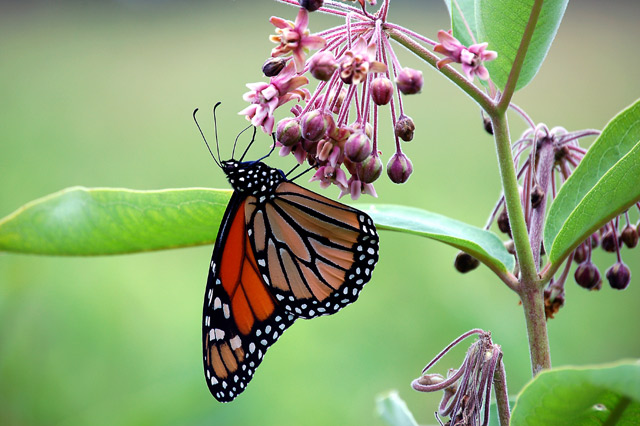
Milkweed and Monarch butterfly symbiosis in the photograph {click on title} ...
[January 24, 2009: But Wikipedia 'marked it for quick deletion,' on the basis of 'significance,' a standard tag of theirs. I inserted the {{hangon}} tag, and wrote on the related Wikipedia 'talk page' how the significance of World University and School relates to its Wiki {editable web pages} approach to education and learning in all languages and subjects, where anyone can post or take a course, and WUaS' focus on the developing world and everyone. I also wrote that Jimmy Wales, the co-founder of Wikipedia, and founder of the Wikia foundation which has been hosting "World University and School" for almost a year, had said to me {in a Facebook chat} that he and Wikia would host it. I wonder why Wikipedia didn't acknowledge any of these reasons concerning significance, and chose to delete the entry instead.
The entry was deleted when I woke up the next day. World University and School's Wiki on Wikia has been up for almost a year now, and WUaS will potentially help a lot of people, especially in the developing world, and may complement richly the digital renaissance which we're in the midst of. It could also help to make computer use much more widespread in the developing world. So Wikipedia's system didn't work in this instance.
This happened with one other entry I made in Wikipedia on 'Democracy School.' It was deleted right away, but I was later able to re-enter it as the 'Daniel Pennock Democracy School,' here - en.wikipedia.org/wiki/Daniel_Pennock_Democracy_School. So I may be able to create an entry on 'World University and School' again in Wikipedia, possibly by changing its name a little. I may also contact Jimmy Wales. I wonder how many great entries we've lost due to Wikipedia's policy and practices.
Drawing on Wikipedia's experience, I wonder how to develop more open approaches to stewardship and policies for course entries for World University and School is an interesting question, while articulating WUaS with great universities and schools.]
Here's World University and School's Wiki: worlduniversity.wikia.com/wiki/World_University.
And here's World University and School's Facebook page: facebook.com/group.php?gid=48753608141&ref=ts
*
I learned about Ubiquity - en.wikipedia.org/wiki/Ubiquity_(Firefox) - today, which Ubiquity calls "an experiment into connecting the Web with language in an attempt to find new user interfaces that make it possible for everyone to do common Web tasks more quickly and easily." It allows you to structure questions in your browser, using natural language, and what could become voice commands. Super cool.
**
Ah, the relaxation response - relaxationresponse.org/steps ... and Harbin pools soon :)
Milkweed and Monarch butterfly symbiosis in the photograph {click on title} ...
Thursday, January 22, 2009
Toadstool: New Ethno-Genres, Language, Flow
Some new genres of writing under the toadstool cap of sociocultural anthropology:
ethno-blog-o-graphy - writing ethnography in the form of a blog (which is short for 'web log') - {It's more finished as a form than field notes} - so-named.
or ethno-blog-virtual-world-o-graphy {in conjunction with virtual worlds}.
or ethno-wiki-virtual-world-o-graphy {MMmmm :)}.
*
I heard a beautiful soliloquy about language yesterday {by a linguist-anthropologist} at Cal, which drew on the way people have thought about it 'scientifically,' first as a system, then the departures from that. So I had some "flow: the psychology of optimal experience" experiences, and when one's 'there,' the experience of 'flow' in one's bodymind is freeing - a kind of floating freely in the brain which sailing with a fair wind. {What is going on neurally?} Hearing about the beauty of language, by someone who knows language, can articulate why and how people have thought it 'works,' and how language is remarkable and beautiful, engaging reason, can be like flying & ...
ethno-blog-o-graphy - writing ethnography in the form of a blog (which is short for 'web log') - {It's more finished as a form than field notes} - so-named.
or ethno-blog-virtual-world-o-graphy {in conjunction with virtual worlds}.
or ethno-wiki-virtual-world-o-graphy {MMmmm :)}.
*
I heard a beautiful soliloquy about language yesterday {by a linguist-anthropologist} at Cal, which drew on the way people have thought about it 'scientifically,' first as a system, then the departures from that. So I had some "flow: the psychology of optimal experience" experiences, and when one's 'there,' the experience of 'flow' in one's bodymind is freeing - a kind of floating freely in the brain which sailing with a fair wind. {What is going on neurally?} Hearing about the beauty of language, by someone who knows language, can articulate why and how people have thought it 'works,' and how language is remarkable and beautiful, engaging reason, can be like flying & ...
Wednesday, January 21, 2009
Earthquake: Inauguration, Change.gov, Paradigm Shift?
Here are some thoughts about Obama's inauguration, many of which I posted to twitter.com:
Here are two inauguration poems, - Elizabeth Alexander's "Praise Song for the Day" (2009) http://tinyurl.com/9a7zsg, and Robert Frost's "Dedication" (1961) http://tinyurl.com/9tezuk.
With Obama's presidency and the World Wide Web, we may have the potential for positively extending the freedom-oriented American Revolution of 1776 significantly. Vote ideas, for example, with blogger.com. Let the world know your ideas.
There's such potential for positive, smart change ahead. Blogger.com is one way to write about it, and, also, email your ideas directly to the White House: http://change.gov/content/home.
Anti-war, friendly, index investing: Vanguard's Bogle ~ http://tinyurl.com/7gjg6o ~ Indexing is the best way to invest, rationally and sensibly. You'll probably do best financially in the long run this way.
Obama as symbol, as intellectual, and, metaphorically, as computer server software - networked with academics around the globe, people who think critically about world issues {some bloggers}, and leaders around the globe - has amazing potential to stream ideas anew.
The discourse on race in this country has now changed dramatically. We have a new black president!
Nice to have atheism - Barack used the word 'non-believer' - included in this nation's rhetoric. Concerning religion, to have mentioned the 7-8 Huston Smith's "Religions of Man" religions, plus the openings emerging in 1960s would have been more inclusive - it's probably ahead, ... but it's hard to 'win' with religious rhetoric in a plural U.S. world .... :)
There's a "Durkheimian" social fact situation occurring here. And the social networking technology twitter was 'spectating,' and in some ways generating a kind of social fact conversation, one of an amazing number of media-mediated conversations. What about the budget ahead? - http://fcnl.org.
Marshall McLuhan's 'the medium is the message' - the video streaming of the inauguration on the Internet was pretty good; the medium now is a new network of thinking.
'This Land is Your Land' - Pete Seeger and friends at the Lincoln Memorial - http://youtube.com/watch?v=n-PCpRWqXv8 . It's too bad Woody Guthrie isn't here to see this day.
We're scaling up significantly this idea-renaissance we're digitizing, and have a remarkable opening with Obama and possibility. ... Idea-izing the world? > Write on.
OK, everybody, we're in charge now, vote with your 10-fingered ideas. Here's one free source - http://blogger.com . Democracy ideas.
And here's a letter I wrote to a nontheist friend's e-mail group.
Nontheist friends,
Here's a letter I'm sending to Barack and Joe. Change.gov seems to give us direct access to a very high level of government, via the Internet. I found out about change.gov from twitter.com and facebook.com. And, from a nontheist friend, I found out recently that you can send messages to the White House here, too: whitehouse.gov.
Let's all write emails regularly. Start a conversation with them.
Scott
Dear Barack and Joe,
Your inaugurations offer great possibility and hope.
Is there a paradigm shift ahead?
There are lots of cards to 'play' in this new 4 year game of 'poker' (vis-a-vis Harvard Law Professor Charlie Nesson). But I hope the cards that are significant are those of blogger's ideas, in particular. Please read blogs to allow us to idea-vote the 'program' of democratic government anew. {They can also offer a lot of useful, timely and topical ideas for in this rapidly changing world}.
To innovate today, too, I hope we can far-reachingly and sensibly open and extend the following:
software (via Open Source),
hardware (e.g. Bug Labs),
law (wikify the law, and e.g. Creative Commons law),
energy infrastructure (allow people to sell extra solar and wind energy that they generate back to the electrical grid, to significantly diversify the power grid),
university and education (World University and School, a Global, Virtual/Digital, Open, Free, Degree-Granting, Multilingual University & School, where anyone can teach or take a class or course - worlduniversity.wikia.com ),
and so much more.
Make peace a priority - vis-a-vis the Friends' Committee on National Legislation - fcnl.org - budget priorities.
I'm glad your bodyminds - as 'computers,' as well as these networks shaped by the World Wide Web and the Internet - are making key decisions and helping to think and strategize ahead.
Best wishes,
Scott
scottmacleod.com
*
To the Harbin pools soon ...
Here are two inauguration poems, - Elizabeth Alexander's "Praise Song for the Day" (2009) http://tinyurl.com/9a7zsg, and Robert Frost's "Dedication" (1961) http://tinyurl.com/9tezuk.
With Obama's presidency and the World Wide Web, we may have the potential for positively extending the freedom-oriented American Revolution of 1776 significantly. Vote ideas, for example, with blogger.com. Let the world know your ideas.
There's such potential for positive, smart change ahead. Blogger.com is one way to write about it, and, also, email your ideas directly to the White House: http://change.gov/content/home.
Anti-war, friendly, index investing: Vanguard's Bogle ~ http://tinyurl.com/7gjg6o ~ Indexing is the best way to invest, rationally and sensibly. You'll probably do best financially in the long run this way.
Obama as symbol, as intellectual, and, metaphorically, as computer server software - networked with academics around the globe, people who think critically about world issues {some bloggers}, and leaders around the globe - has amazing potential to stream ideas anew.
The discourse on race in this country has now changed dramatically. We have a new black president!
Nice to have atheism - Barack used the word 'non-believer' - included in this nation's rhetoric. Concerning religion, to have mentioned the 7-8 Huston Smith's "Religions of Man" religions, plus the openings emerging in 1960s would have been more inclusive - it's probably ahead, ... but it's hard to 'win' with religious rhetoric in a plural U.S. world .... :)
There's a "Durkheimian" social fact situation occurring here. And the social networking technology twitter was 'spectating,' and in some ways generating a kind of social fact conversation, one of an amazing number of media-mediated conversations. What about the budget ahead? - http://fcnl.org.
Marshall McLuhan's 'the medium is the message' - the video streaming of the inauguration on the Internet was pretty good; the medium now is a new network of thinking.
'This Land is Your Land' - Pete Seeger and friends at the Lincoln Memorial - http://youtube.com/watch?v=n-PCpRWqXv8 . It's too bad Woody Guthrie isn't here to see this day.
We're scaling up significantly this idea-renaissance we're digitizing, and have a remarkable opening with Obama and possibility. ... Idea-izing the world? > Write on.
OK, everybody, we're in charge now, vote with your 10-fingered ideas. Here's one free source - http://blogger.com . Democracy ideas.
And here's a letter I wrote to a nontheist friend's e-mail group.
Nontheist friends,
Here's a letter I'm sending to Barack and Joe. Change.gov seems to give us direct access to a very high level of government, via the Internet. I found out about change.gov from twitter.com and facebook.com. And, from a nontheist friend, I found out recently that you can send messages to the White House here, too: whitehouse.gov.
Let's all write emails regularly. Start a conversation with them.
Scott
Dear Barack and Joe,
Your inaugurations offer great possibility and hope.
Is there a paradigm shift ahead?
There are lots of cards to 'play' in this new 4 year game of 'poker' (vis-a-vis Harvard Law Professor Charlie Nesson). But I hope the cards that are significant are those of blogger's ideas, in particular. Please read blogs to allow us to idea-vote the 'program' of democratic government anew. {They can also offer a lot of useful, timely and topical ideas for in this rapidly changing world}.
To innovate today, too, I hope we can far-reachingly and sensibly open and extend the following:
software (via Open Source),
hardware (e.g. Bug Labs),
law (wikify the law, and e.g. Creative Commons law),
energy infrastructure (allow people to sell extra solar and wind energy that they generate back to the electrical grid, to significantly diversify the power grid),
university and education (World University and School, a Global, Virtual/Digital, Open, Free, Degree-Granting, Multilingual University & School, where anyone can teach or take a class or course - worlduniversity.wikia.
and so much more.
Make peace a priority - vis-a-vis the Friends' Committee on National Legislation - fcnl.org - budget priorities.
I'm glad your bodyminds - as 'computers,' as well as these networks shaped by the World Wide Web and the Internet - are making key decisions and helping to think and strategize ahead.
Best wishes,
Scott
scottmacleod.com
*
To the Harbin pools soon ...
Subscribe to:
Posts (Atom)


 Posts
Posts