There's something about the Harbin pools, that brings one to this very free and easy space, – neurophysiologically. I just came out of the pools, and am 'there' a little.
What goes on? How can one characterize this and study it?
How can one look at this from the perspective of brain research? I'll talk more with a faculty member at Berkeley about this. I'm enjoying sitting-in occasionally in his class on the evolution of language and the brain a lot. How can one study this, in order to make the experience more accessible for people?
It's the otherness of this way of being, a kind of transformation from normal day-to-day patterns and analyses, - to this harmonizing-way-of-being, that is very interesting to me. And it's understanding this in material and biological terms that is also fascinating, and may be relatively under-studied.
My focus with Harbin, in some ways, is on life in the pools, the effects of the pools on people, and in relation to the social life that is at Harbin. The Harbin warm pool is my field, anthropologically, - my field site.
The day is warm on the sun deck, but the light is growing long, and sunset is coming earlier than ever. It's only 5 pm and it feels like almost-dusk. There are only a few more weekends of warm weather when everyone will be out relaxing on the sun deck, so we're coming toward the end of summer. That people have come out and relaxed on this sun deck for around 37 years with great regularity in the warm weather suggests a kind of reproduction of a pattern, of a set of practices which I might call a culture, or an assemblage. But maybe it's just the Harbin pool area, and what is and has been, - without explanation.
Harbin can often attract folks who are 'out there,' or willing to think on their own or in ways that are different.
Could we all be in the pools together, dancing together in ease, - in and around every city in the U.S.?
And if so, why aren't there unique hot spring retreat centers everywhere? The cultural reasons I would suggest have to do with 'taboos' about the body, shaped possibly by the Judeo-Christian or spiritual traditions or a folk metaphysic, taboos about relaxation, enjoyment and pleasure, as well as ideas and practices relating to what's possible. Many people don't recognize how regenerative and sensible Harbin is.
Saturday, September 13, 2008


Friday, September 12, 2008
Grasses: People Are Mostly Nude at Harbin
People are mostly naked at Harbin, especially around the pool area. People find freedom this way, as well as a degree of harmony, and return again and again for this. This is also affirmed in Harbin's social milieu, in contrast, perhaps, to practices in U.S. society.
People are also mostly nude in the pools themselves. This leads somehow to a mingling of energies that is both communal and salutary.
People are also mostly nude in the pools themselves. This leads somehow to a mingling of energies that is both communal and salutary.
Wednesday, September 10, 2008
Phloem: How We May Elicit Loving Bliss
In brief, here's how I think it works. I'll start with a first person account, and then extrapolate, so that you might begin to explore this. I'm curious also to explore this through fundamental biological research.
Having explored and experimented with eliciting this neurophysiology naturally {through thinking}, I think bliss and loving bliss are 'flow: the psychology of optimal experience' experiences. I find ready access to this experience sometimes when I relax into the relaxation response first. I can relax into the relaxation response quite readily in the warm pool at Harbin Hot Springs, but also in many other situations, but perhaps not quite so fully in other places. When I do release, bliss can start to rise up in my bodymind, which I experience, in my language, neurophysiologically. (Here's my definition of bliss: ~ experiences that are deeply, gratefully, reciprocally appreciative and affectionate, both with a friend or friends, and alone, as well as profoundly and naturally high at the same time, and which are ongoing, biological, 'flow' experiences). This focus {flow experience} of releasing and then continuing to release/relax {my face, my eyes, my ear passage ways, activity in my mind, tensions in my body, softening in conjunction with deepening and easing my breathing as I focus on it for some minutes, etc.} is a key basis, but in some situations only. Whether or not bliss begins for me in any given situation, or releasing process, is variable. When bliss is starting to happen, I find it helpful to continue to focus on releasing and relaxing, as I welcome on these experiences/this chemistry of this bliss. When these experiences are intense, I would readily call the experience loving bliss. When bliss~loving bliss is happening in my bodymind, moving back and forth between the Harbin hot pool and cold plunge, while releasing, can deepen this experience. The beautiful natural surroundings at Harbin also facilitate these experiences.
I'm also able to access these experiences naturally, and predictably repeatedly, through contra-dancing and listening to some arias in Mozart's 'Magic flute.' Both can bring on intense neural cascades of pleasure (my language), in different ways. In a sense, these are both interventions and technologies that elicit bliss with some regularity.
Sometimes I can elicit bliss and loving bliss with just a memory. This process of remembering, by bringing my awareness to prior blissful experiences is integral to eliciting it now. Sometimes I can imagine bliss to experience it.
I'm interested both in what is occurring in my bodymind research-wise {for example, vis-a-vis Richard Davidson, Terrence Deacon, and Herbert Benson MD's approaches to related research}, as well as how to elicit these experiences with more regularity, and freedom, as if one were surfing a wave, or singing a line of music rapturously and floating on this, perhaps via wu wei (non-action), - by doing less. What is going on in the brain in these instances neurophysiologically?
Here are some initial ideas/hypotheses about how this might work neurophysiologically. In the brain, the nucleus acumbent would have experienced this pleasure / chemistry before and encourage this chemistry again and again. The amygdala would not play an inhibitory role here, or give rise to aversive experience. In one kind of loving bliss experience, MDMA-related chemicals (from the drug Ecstasy) and romantic love chemicals (heightened levels of four neurotrophins, - i.e. NGF, BDNF, NT-3, and NT-4 (Emanuele et al., 2005)) would possibly cross a threshold of intensity and start flourishing in the brain. This might start in many ways. All of these experiences are 'flow: the psychology of optimal experience' experiences, when they involve concentration; the response from MDMA is a drug response, as reference experience. How might we examine this both rigorously, pragmatically, as well as if music that inspires us?
I'm curious how one might deepen these experiences and make them more varied, as well. Might one listen to certain pieces of music, or actually sing, in such a way as to elicit loving bliss more deeply and innovatively. How might you create a dance with these experiences in your own mind, to deepen these feelings / enhance this chemistry? Might we create a parallel to chamber music, bliss-brains (MDMA ~ Ecstasy ~ methylene_dioxy_meth_amphetamine) making music, and create/find a form which facilitates this fantastically? I think so, but I'm not sure how. Here are some exploratory guidelines for eliciting loving bliss as if we were practicing a musical instrument: http://scottmacleod.com/GuidelinesPracticingLovingBlissvavMusicalInstrument.htm
In writing these paragraphs above, I experienced some 'flow' experience, but not what I call bliss. I'm curious how to integrate the experience of bliss ~ say, a 'MDMA brain' ~ with many ways of engaging life, including writing. Metaphorically, I conceive of these experiences partly as forms of water transport in plants, ~ from the Harbin tree down into our bodyminds.
*

...
Tuesday, September 9, 2008
Xylem: Communal House in Berkeley, Harbin, Deleuze's Virtuality
I stayed at an old friend's communal, or collective, house in Berkeley last night. About 10 people live there in a loose community, including one 4 year old. We shared a delicious moussaka dinner, with a very tasty bechamel sauce, and salad. There are two cottages in the backyard. I was impressed that the 4 year old and everyone but one other person had visited Harbin Hot Springs numerous times. So my friend's housemates are some of the people who visit Harbin. Many of my new friends have gone to the "Rainbow Gathering" and "Burning Man," too.
In a Berkeley graduate class and in Wikipedia, I learned of Gilles Deleuze's contribution to conceiving of virtuality. Here's an excerpt:
"Like Kant and Bergson, Deleuze considers traditional notions of space and time as unifying categories imposed by the subject, that is, he considers them to be forms of identity. Therefore he concludes that pure difference is non-spatio-temporal; it is an idea, what he calls "the virtual". (The coinage refers not to the "virtual reality" of the computer age, but to Proust's definition of the past: "real without being actual, ideal without being abstract."[14]) While Deleuze's virtual ideas superficially resemble Plato's forms and Kant's ideas of pure reason, they are not originals or models, nor do they transcend possible experience; instead they are the conditions of actual experience, the internal difference in itself. "The concept they [the conditions] form is identical to its object."[15] A Deleuzean idea or concept of difference is not a wraith-like abstraction of an experienced thing, it is a real system of differential relations that creates actual spaces, times, and sensations.[16]"
14 Proust, Le Temps Retrouvé, ch. III: see the fourth line from the bottom of this page, or, in English translation, the thirteenth paragraph here.
15 Desert Islands, p. 36.
16 See "The Method of Dramatization" in Desert Islands, and "Actual and Virtual" in Dialogues.
- Deleuze, Gilles. 1977 (2nd exp. ed. 1996, with Claire Parnet). Dialogues. Trans. Dialogues (1987, 2nd exp. ed. 2002).
- Deleuze, Gilles. 2002. L'île déserte et autres textes. Trans. Desert Islands and Other Texts 1953-1974 (2003).
- Proust, Marcel. Le Temps Retrouvé.
Virtual worlds like Second Life make possible the instantiation of ideas, and, in particular, potentially, these ideas.
Friends, Harbin visitors and virtuality are all water transport systems (xylem) of the Harbin tree.
In a Berkeley graduate class and in Wikipedia, I learned of Gilles Deleuze's contribution to conceiving of virtuality. Here's an excerpt:
"Like Kant and Bergson, Deleuze considers traditional notions of space and time as unifying categories imposed by the subject, that is, he considers them to be forms of identity. Therefore he concludes that pure difference is non-spatio-temporal; it is an idea, what he calls "the virtual". (The coinage refers not to the "virtual reality" of the computer age, but to Proust's definition of the past: "real without being actual, ideal without being abstract."[14]) While Deleuze's virtual ideas superficially resemble Plato's forms and Kant's ideas of pure reason, they are not originals or models, nor do they transcend possible experience; instead they are the conditions of actual experience, the internal difference in itself. "The concept they [the conditions] form is identical to its object."[15] A Deleuzean idea or concept of difference is not a wraith-like abstraction of an experienced thing, it is a real system of differential relations that creates actual spaces, times, and sensations.[16]"
14 Proust, Le Temps Retrouvé, ch. III: see the fourth line from the bottom of this page, or, in English translation, the thirteenth paragraph here.
15 Desert Islands, p. 36.
16 See "The Method of Dramatization" in Desert Islands, and "Actual and Virtual" in Dialogues.
- Deleuze, Gilles. 1977 (2nd exp. ed. 1996, with Claire Parnet). Dialogues. Trans. Dialogues (1987, 2nd exp. ed. 2002).
- Deleuze, Gilles. 2002. L'île déserte et autres textes. Trans. Desert Islands and Other Texts 1953-1974 (2003).
- Proust, Marcel. Le Temps Retrouvé.
Virtual worlds like Second Life make possible the instantiation of ideas, and, in particular, potentially, these ideas.
Friends, Harbin visitors and virtuality are all water transport systems (xylem) of the Harbin tree.
Sunday, September 7, 2008
The water is smart at Harbin
The water is smart at Harbin. A language is emerging in this valley, too. To listen to the water, though, involves becoming quiet.
Saturday, September 6, 2008
Gully: Harbin Hot Springs Cold Plunge
Tucked in a small gully in a small valley in northern California, the Harbin cold plunge complements and makes cool what happens in the hot pool. Right up in the woods and very beautifully situated, about 8 people can go into the Harbin cold plunge at any one time. Harbin usually puts fresh flowers at two places around it. The cold plunge is filled by a pipe from the upper side, and some people drink this fresh water. There's forest and hillside all around the cold plunge, - you're right in nature here, in a very quiet and beautiful corner of the world, doing something very regenerative.
You walk up wooden steps, from right outside the hot pool room, and near the warm pool, to get to it. The wooden steps can only really accommodate one person. Sometimes people passing the wind chimes at the top of the stairs push them to make a sound. There are two benches where people can lie or sit on the platform outside the cold plunge. There's a 2 foot high statue of Kwan Lin in front of one of the benches, and a very well-used foot-in-diameter black mortar, but no pestel. Kwan Lin usually has a some flowers, and colorful rocks line the stone wall here, - these become vivid when wet. The railing into the cold plunge is a beautiful arc of metal work made by the same sculptor that made the Dragon Gate and the hot plunge railing. While a sign says "Quiet Area," most people usually do not talk here.
I'm curious why the experience of going into the cold plunge, especially after the hot plunge, brings out everything from a smile to bliss in me quite frequently, just on a biological level.
Walking by the warm pool toward the hot pool and cold plunge is like going into a tropical forest in the high summer. The broad, richly green leaves of the Fig tree over the warm pool with the flora to the left of this path makes a kind of tunnel that is really forest like. It's a delight and makes me wonder whether we have kinds of ancestral memories of this encoded in DNA, or whether it just reminds me of Malaysia or India.
You walk up wooden steps, from right outside the hot pool room, and near the warm pool, to get to it. The wooden steps can only really accommodate one person. Sometimes people passing the wind chimes at the top of the stairs push them to make a sound. There are two benches where people can lie or sit on the platform outside the cold plunge. There's a 2 foot high statue of Kwan Lin in front of one of the benches, and a very well-used foot-in-diameter black mortar, but no pestel. Kwan Lin usually has a some flowers, and colorful rocks line the stone wall here, - these become vivid when wet. The railing into the cold plunge is a beautiful arc of metal work made by the same sculptor that made the Dragon Gate and the hot plunge railing. While a sign says "Quiet Area," most people usually do not talk here.
I'm curious why the experience of going into the cold plunge, especially after the hot plunge, brings out everything from a smile to bliss in me quite frequently, just on a biological level.
Walking by the warm pool toward the hot pool and cold plunge is like going into a tropical forest in the high summer. The broad, richly green leaves of the Fig tree over the warm pool with the flora to the left of this path makes a kind of tunnel that is really forest like. It's a delight and makes me wonder whether we have kinds of ancestral memories of this encoded in DNA, or whether it just reminds me of Malaysia or India.
Friday, September 5, 2008
Vent: Harbin's Hot Pool ~ Just-Right-Too-Hot
When entering the Harbin hot pool for the first time, one can barely do so. It's very hot (about 113 degrees fahrenheit / 60 degrees celsius) and sometimes it takes people a number of minutes to immerse themselves. Many people decide not to go in, for a while, and back out up the stairs, and sit down.
But when you're familiar with the temperature, going in gets relatively easy, and can even elicit bliss for me, with some regularity, - and the moving between hot pool and cold plunge can accentuate this emotional experience, neurophysiologically.
Hot Pool Room Art
In the hot pool room is a beautiful whale-with-ocean sculpture, and the hot water flows out of this whale's mouth. The railing, around the pool and including the banisters along the stairways, is made by the same sculptor, who also made the magnificent Dragon Gate casting near Harbin's office. The rail's fluid lines, sturdiness, artistry, and symbols both support people, allowing them to walk on both sets of steps securely, as well as swing freely into and out of the pools, and contribute richly to the aesthetic quality of being there. The symbols on this metal casting include a dinosaur egg with emerging dinosaur, a serpent eating an apple, a frog, clasped hands with a wing on one of them, a Native American peace pipe, a Buffalo head, a skinks or a local lizard-like reptile, a dolphin, a condor's head, a slightly sleepy and bemused dragon, a heart, two circles, and some other symbols. You would touch the dolphin on the banister if you were walking up the far steps, and you might hold onto the condor head walking up the steps closer to the two doors on the side of the room through which most people enter and exit. The railing was made in the mid-1990s. Attached to the rail on the side of the room with two doors is a black slab of a bench. Sometimes one's blood pressure changes (?) when leaving the pools, and setting on this bench is important and useful. These physiological changes are biological processes I'd like to learn more about.
There are 2 windows and 3 doorways in this lovely, 'atmospheric' room. In front of the upper window above the whale is the bust of a woman with flowing hair, into which fresh flowers are placed regularly. I enjoy looking at them when I enter the hot water as they focus my attention on lovely shapes and colors. Under this are some candle holders with lit candles at night. And in the whale sculpture are two candle holders, as well. At the quieter, farther side of the room from which people come in, are two benches, and a door out to the main warm pool walkway. Relatively few people use these benches in my experience. Behind the benches is a window that looks out on some tree trunks and hillside, which sometimes can appear naturally illuminated quite remarkably. Above the benches in the left hand ceiling corner is a metal candle holder/lamp that looks a little like a samovar. The colors in the mural on the wall opposite the whale remind me of being on the ocean with its clouds, blues and grays, - specifically of Buzzard's Bay near New Bedford, Massachusetts, curiously. Waves crest along the bottom of this mural and the painting can be integral to being in the hot pool. I once saw an artist, up to her shins in the hot water, touching it up. I sometimes let the image and its shades bring my imagination to releasing and watery places. The light in the hot pool room in pleasantly shaded, and very varied during the course of the day, although I see it as blue-green much of the time. The roof of the hot pool room is simple wood which has weatherd. Above the wall painting are some colored curvy glass pieces of many colors. Art is alive at Harbin, and sometimes I think of all of Harbin as a kind of live canvas.
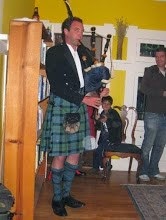
Even though Harbin is a kind of a liminal - a betwixt and between retreat center - place, where communitas arises quite readily, Harbin also produces its own structure, - rules and social ordering, etc. So, for example, the sign in the hot pool says "Silence" and people observe this. (But Harbin did ask me to play my bagpipes in the pool area on Easter in 2005, including walking through the pool area, creating a kind of liminality within generally liminal space. So Harbin is flexible).

The cold plunge is just above the hot pool, and moving between the two pools, while releasing and relaxing, can be very enjoyable, integrating and even blissful for me, an experience which is different from loving bliss. The experience of being in the hot pool is very varied, but intense and enlivening for many.
The neurophysiology of being in the pools, and moving, in particular, between the hot pool and cold plunge, is something I'd like to focus on further. What is this neurophysiology?
While the hot pool, and warm pool adjacent to it, were here when Ishvara bought the property in 1972, the cold plunge above it was created since that time. Both are near 'perfect' in their own ways, and it's these pools that seem to bring people back again and again., and give rise to so many unique aspects of Harbin's experience.
But when you're familiar with the temperature, going in gets relatively easy, and can even elicit bliss for me, with some regularity, - and the moving between hot pool and cold plunge can accentuate this emotional experience, neurophysiologically.
Hot Pool Room Art
In the hot pool room is a beautiful whale-with-ocean sculpture, and the hot water flows out of this whale's mouth. The railing, around the pool and including the banisters along the stairways, is made by the same sculptor, who also made the magnificent Dragon Gate casting near Harbin's office. The rail's fluid lines, sturdiness, artistry, and symbols both support people, allowing them to walk on both sets of steps securely, as well as swing freely into and out of the pools, and contribute richly to the aesthetic quality of being there. The symbols on this metal casting include a dinosaur egg with emerging dinosaur, a serpent eating an apple, a frog, clasped hands with a wing on one of them, a Native American peace pipe, a Buffalo head, a skinks or a local lizard-like reptile, a dolphin, a condor's head, a slightly sleepy and bemused dragon, a heart, two circles, and some other symbols. You would touch the dolphin on the banister if you were walking up the far steps, and you might hold onto the condor head walking up the steps closer to the two doors on the side of the room through which most people enter and exit. The railing was made in the mid-1990s. Attached to the rail on the side of the room with two doors is a black slab of a bench. Sometimes one's blood pressure changes (?) when leaving the pools, and setting on this bench is important and useful. These physiological changes are biological processes I'd like to learn more about.
There are 2 windows and 3 doorways in this lovely, 'atmospheric' room. In front of the upper window above the whale is the bust of a woman with flowing hair, into which fresh flowers are placed regularly. I enjoy looking at them when I enter the hot water as they focus my attention on lovely shapes and colors. Under this are some candle holders with lit candles at night. And in the whale sculpture are two candle holders, as well. At the quieter, farther side of the room from which people come in, are two benches, and a door out to the main warm pool walkway. Relatively few people use these benches in my experience. Behind the benches is a window that looks out on some tree trunks and hillside, which sometimes can appear naturally illuminated quite remarkably. Above the benches in the left hand ceiling corner is a metal candle holder/lamp that looks a little like a samovar. The colors in the mural on the wall opposite the whale remind me of being on the ocean with its clouds, blues and grays, - specifically of Buzzard's Bay near New Bedford, Massachusetts, curiously. Waves crest along the bottom of this mural and the painting can be integral to being in the hot pool. I once saw an artist, up to her shins in the hot water, touching it up. I sometimes let the image and its shades bring my imagination to releasing and watery places. The light in the hot pool room in pleasantly shaded, and very varied during the course of the day, although I see it as blue-green much of the time. The roof of the hot pool room is simple wood which has weatherd. Above the wall painting are some colored curvy glass pieces of many colors. Art is alive at Harbin, and sometimes I think of all of Harbin as a kind of live canvas.
Even though Harbin is a kind of a liminal - a betwixt and between retreat center - place, where communitas arises quite readily, Harbin also produces its own structure, - rules and social ordering, etc. So, for example, the sign in the hot pool says "Silence" and people observe this. (But Harbin did ask me to play my bagpipes in the pool area on Easter in 2005, including walking through the pool area, creating a kind of liminality within generally liminal space. So Harbin is flexible).

The cold plunge is just above the hot pool, and moving between the two pools, while releasing and relaxing, can be very enjoyable, integrating and even blissful for me, an experience which is different from loving bliss. The experience of being in the hot pool is very varied, but intense and enlivening for many.
The neurophysiology of being in the pools, and moving, in particular, between the hot pool and cold plunge, is something I'd like to focus on further. What is this neurophysiology?
While the hot pool, and warm pool adjacent to it, were here when Ishvara bought the property in 1972, the cold plunge above it was created since that time. Both are near 'perfect' in their own ways, and it's these pools that seem to bring people back again and again., and give rise to so many unique aspects of Harbin's experience.
Wednesday, September 3, 2008
Thistle: Foucault's Care of the Self and Harbin Hot Springs
Foucault's Care of the Self and Harbin Hot Springs
In examining how caring for the self functions, Michel Foucault, in the 'Course Summary' in his "Hermeneutics of the Subject," problematizes how caring works. For Foucault, care of the self - epimeleia heautou and cura sui (491) - refers philosophically to taking care of oneself and being concerned about oneself. For Foucault, this involves a kind of therapeutic practice, and also having free time to further this. For Foucault, even as a philosophical activity, it's “a form of activity, where the term epimeleia itself refers not just to an attitude of awareness or a form of attention focused on oneself; it designates a regular occupation, a work with its methods and objectives" (493). So the questions I'll problematize in this essay are: “How would care of the self 'function' on-the-ground at Harbin Hot Springs?” What does the concept of self-knowledge (494), in caring for the self, refer to for Foucault, using Harbin as a site of inquiry? And what does the concept of askesis (498) refer to, also in relation to Harbin. Lastly, what are examples of practices of care of the self at Harbin? Harbin is significant as a site of inquiry because it's an unique assemblage that may make possible specific ways to care for the self.
Foucault uses the metaphor of a farm as his first example of how caring for the self would function, presumably referring to farming practices - caring for and raising plants and animals, presumably as one would oneself. Engaging this metaphor, the aspect of how caring for the self 'functions' that I'm most interested in, vis-a-vis Foucault, has to do with the flourishing and effortlessness that farms at certain times of the year exhibit, to which the practice of farming as a form of caring would give rise.
Foucault's starting point is the Alcibiades, concerning the care of the self, in relation to politics, pedagogy, and self-knowledge. With regard to pedagogy, engaging the practice of philosophy – thinking as an activity - provides a method for caring of the self at all ages. For Foucault, this consists of three functions: 1) a critical function (unlearning), 2) struggle (engagement) and 3) the culture of the self which is therapeutic and curative (495-496).
For Foucault, care of the self occurs through askesis (self-formation) – training as an athlete would (498). For Foucault this includes 1) listening, 2) writing, and 3) taking stock of oneself (500). These activities of self-formation engage then the activity of thinking – the practice of philosophy. The purpose of these care of the self techniques, through askesis, is to link together the truth and the subject.
So, the problematization that interests me most, in terms of caring for the self, vis-a-vis the metaphor of the farm, and the practices of self-learning and askesis (self-formation), is how one might cultivate this flourishing that a farm exhibits, through pedagogy and askesis, informed by philosophy, as a set of practices, in relation to Harbin.
As a farmer can help a farm to flourish through practices that shape it, caring for the self at Harbin Hot Springs, a hot springs' retreat center in northern California that emerged from counterculture in the early 1970s, occurs in a specific assemblage of practices for caring of the self. Fieldwork is one important approach to understanding this assemblage. In addition to examining Harbin ethnographically as a field site, I'd like to problematize the care of the self vis-a-vis Harbin additionally by creating a virtual Harbin - an interactive assemblage - in the form of a field (farm) or even field site. Creating a virtual Harbin Hot Springs might then even make possible a cultivation of comparable assemblages - actual and virtual Harbins - both of which might lead to an understanding of the care of the self vis-a-vis flourishing, in the ongoing examination of how caring for the self functions.
To further this problematization, and in conclusion, if one constructed a virtual Harbin using OpenSim (using open access virtual world software that engages the Second Life library of resources) as open equipment (Koopman et al 2007), how would care of the self function, in terms of pedagogy and askesis in this context. Both writing (ethnography) and programming (virtual world building) as practices could then contribute to problematizing the care of the self in new ways.
References
Foucault, Michel. 2001. The Hermeneutics of the Subject. New York, NY: Picador.
Koopman, Colin, Murrell, Mary and Schilling, Tom. 2007. A Diagnostic of Emerging Openness Equipment. Available at SSRN: http://ssrn.com/abstract=1069067
McGushin, Edward F. 2006. Foucault's Askesis: An Introduction to the Philosophical Life. Chicago, IL: Northwestern.
Rabinow, Paul. 2003. Anthropos Today: Reflections on Modern Equipment. Princeton, NJ: Princeton University Press.
Essay written for Professor Paul Rabinow's "Modes of Veridiction and Jurisdiction" class at UC Berkeley
Back to the pools soon ~
Tuesday, September 2, 2008
Honey: Care of the Self, Discourse and Harbin
For a course called 'Modes of Veridiction and Jurisdiction,' I'll focus here on the problematic in Foucault's “Course Summary” in his "Hermeneutics" of how the self 'functions,' in caring for the self, and examine Foucault's concepts of askesis (self-formation or practice) and discourse, using Harbin Hot Springs as a site of inquiry.
For Foucault, care of the self - epimeleia heautou and cura sui (491) - refers philosophically to taking care of oneself and being concerned about oneself. For Foucault, this involves a kind of therapeutic practice, and also having free time to further this. For Foucault, even as a philosophical activity, it's “a form of activity, where the term epimeleia itself refers not just to an attitude of awareness or a form of attention focused on oneself; it designates a regular occupation, a work with its methods and objectives" (493). So the questions I'll address here are: “how would care of the self 'function' on-the-ground at Harbin Hot Springs?” - And how would we know? What does the concept of discourse refer to for Foucault, using Harbin as a site of inquiry? And what does the concept of askesis (self-formation) refer to, also referring to Harbin. So, what are examples of practices of care of the self at Harbin? Harbin is significant as a site of inquiry because it's an unique assemblage.
Foucault uses the metaphor of a farm as his first example of how caring for the self would function, presumably referring to farming practices - caring for and raising plants and animals, as one would oneself. Engaging this metaphor, the aspect of how caring for the self 'functions' that I'm most interested in, vis-a-vis Foucault, has to do with the flourishing and effortlessness that farms at certain times of the year exhibit.
In a related vein, I'm also interested in:
{ways in which grounded research – field work – might shape the contours of a discourse that then gives rise to a set of practices – askesis – that then leads to self-formation {agency} vis-a-vis Harbin}
{the neurophysiology of bliss vis-a-vis Foucault}
So, the problematization that interests me most, in terms of caring for the self, vis-a-vis the metaphor of the farm, is how one might cultivate this flourishing, as a set of practices (askesis).
Understanding or studying a discourse - referring to a language that shapes knowledge and possibilities - then offers a way to cultivate and use statements that then might lead to practices which lead to flourishing, as a farmer helps a farm to flourish, at times. But since farming is a metaphor for Foucault for caring for the self, and discourse is the 'real farm,' in a sense, I'd like to explore creating an interactive discourse - a field or even field site - such as is possible in creating a virtual world. Creating a virtual Harbin Hot Springs might then even make possible a cultivation of comparable assemblages - real and virtual Harbins - both of which might lead to flourishing, as a discourse, in the ongoing examination of how caring for the self functions.
To further this problematization, and in conclusion, if one constructed a virtual Harbin using OpenSim (open access virtual world software that uses the Second Life library of resources), how would care of the self 'function,' in terms of askesis. What new information technology discourse emerges?
For Foucault, care of the self - epimeleia heautou and cura sui (491) - refers philosophically to taking care of oneself and being concerned about oneself. For Foucault, this involves a kind of therapeutic practice, and also having free time to further this. For Foucault, even as a philosophical activity, it's “a form of activity, where the term epimeleia itself refers not just to an attitude of awareness or a form of attention focused on oneself; it designates a regular occupation, a work with its methods and objectives" (493). So the questions I'll address here are: “how would care of the self 'function' on-the-ground at Harbin Hot Springs?” - And how would we know? What does the concept of discourse refer to for Foucault, using Harbin as a site of inquiry? And what does the concept of askesis (self-formation) refer to, also referring to Harbin. So, what are examples of practices of care of the self at Harbin? Harbin is significant as a site of inquiry because it's an unique assemblage.
Foucault uses the metaphor of a farm as his first example of how caring for the self would function, presumably referring to farming practices - caring for and raising plants and animals, as one would oneself. Engaging this metaphor, the aspect of how caring for the self 'functions' that I'm most interested in, vis-a-vis Foucault, has to do with the flourishing and effortlessness that farms at certain times of the year exhibit.
In a related vein, I'm also interested in:
{ways in which grounded research – field work – might shape the contours of a discourse that then gives rise to a set of practices – askesis – that then leads to self-formation {agency} vis-a-vis Harbin}
{the neurophysiology of bliss vis-a-vis Foucault}
So, the problematization that interests me most, in terms of caring for the self, vis-a-vis the metaphor of the farm, is how one might cultivate this flourishing, as a set of practices (askesis).
Understanding or studying a discourse - referring to a language that shapes knowledge and possibilities - then offers a way to cultivate and use statements that then might lead to practices which lead to flourishing, as a farmer helps a farm to flourish, at times. But since farming is a metaphor for Foucault for caring for the self, and discourse is the 'real farm,' in a sense, I'd like to explore creating an interactive discourse - a field or even field site - such as is possible in creating a virtual world. Creating a virtual Harbin Hot Springs might then even make possible a cultivation of comparable assemblages - real and virtual Harbins - both of which might lead to flourishing, as a discourse, in the ongoing examination of how caring for the self functions.
To further this problematization, and in conclusion, if one constructed a virtual Harbin using OpenSim (open access virtual world software that uses the Second Life library of resources), how would care of the self 'function,' in terms of askesis. What new information technology discourse emerges?
Monday, September 1, 2008
Beautiful Weather: Loving Bliss Explorations
Loving Bliss Explorations
Seeking Loving Bliss 'Chamber Music' Musicians, Improvisers and Composers :)
for the next many decades
For a Creative Exploration of Qualities of Loving Bliss
Naturally and Neurophysiologically
Contact - scott@scottmacleod.com
for the next many decades
For a Creative Exploration of Qualities of Loving Bliss
Naturally and Neurophysiologically
Contact - scott@scottmacleod.com
Loving Bliss as Musical Explorations
Guidelines
for practicing loving bliss
scottmacleod.com/GuidelinesPracticingLovingBlissvavMusicalInstrument.htm
vis-à-vis practicing a musical instrument
for practicing loving bliss
scottmacleod.com/GuidelinesPracticingLovingBlissvavMusicalInstrument.htm
vis-à-vis practicing a musical instrument
Subscribe to:
Posts (Atom)

 Posts
Posts


