Wednesday, September 24, 2008

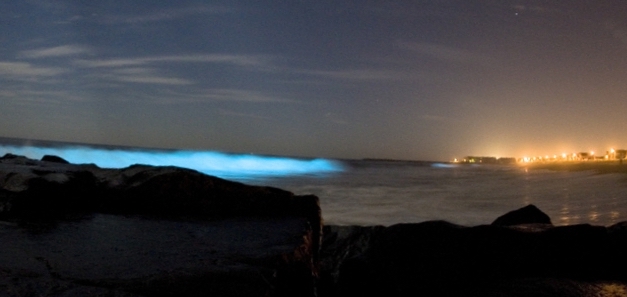
Bioluminescence: Deleuze and Virtuality

Here are some Deleuzian perspectives on virtuality that I'll articulate with my creation of a virtual Harbin in Open Sim / Second Life as anthropological field site, and as ethnography, ~ partly to explore eliciting bliss as a form of 'care of the self' {Foucault}:


From the entry on "Gilles Deleuze" in the Stanford Encyclopedia of Philosophy:

"In his magnum opus Difference and Repetition, he tries to develop a metaphysics adequate to contemporary mathematics and science—a metaphysics in which the concept of multiplicity replaces that of substance, event replaces essence and virtuality replaces possibility."


"In Bergsonism (1966), Deleuze develops the ideas of virtuality and multiplicity that will serve as the backbone of his later work. From Maimon's reading of Kant, we know that Deleuze needs to substitute the notion of the condition of the genesis of the real for the notion of conditions of possibility of representational knowledge. The positive name for that genetic condition is the virtual, which Deleuze adopts from the following Bergsonian argument. The notion of the possible, Bergson holds in Creative Evolution, is derived from a false problem that confuses the “more” with the “less” and ignores differences in kind; there is not less but more in the idea of the possible than in the real, just as there is more in the idea of nonbeing than in that of being, or more in the idea of disorder than in that of order. When we think of the possible as somehow “pre-existing” the real, we think of the real, then we add to it the negation of its existence, and then we project the “image” of the possible into the past. We then reverse the procedure and think of the real as something more than possible, that is, as the possible with existence added to it. We then say that the possible has been “realized” in the real. By contrast, Deleuze will reject the notion of the possible in favor of that of the virtual. Rather than awaiting realization, the virtual is fully real; what happens in genesis is that the virtual is actualized.

The fundamental characteristic of the virtual, that which means it must be actualized rather than realized, is its differential makeup. Deleuze always held the critical axiom that the ground cannot resemble that which it grounds; he constantly critiques the “tracing” operation by which identities in real experience are said to be conditioned by identities in the transcendental. For instance, Deleuze criticizes Kant for copying the transcendental field in the image of the empirical field. That is, empirical experience is personal, identitarian and centripetal; there is a central focus, the subject, in which all our experiences are tagged as belonging to us. Kant says this empirical identity is only possible if we can posit the Transcendental Unity of Apperception, that is, the possibility of adding “I think” to all our judgments. Instead of this smuggled-in or “traced” identity, Deleuze will want to have the transcendental field be differential. Deleuze still wants to work back from experience, but since the condition cannot resemble the conditioned, and since the empirical is personal and individuated, the transcendental must be impersonal and pre-individual. The virtual is the condition for real experience, but it has no identity; identities of the subject and the object are products of processes that resolve, integrate, or actualize (the three terms are synonymous for Deleuze) a differential field. The Deleuzean virtual is thus not the condition of possibility of any rational experience, but the condition of genesis of real experience.

As we have seen, the virtual, as genetic ground of the actual, cannot resemble that which it grounds; thus, if we are confronted with actual identities in experience, then the virtual ground of those identities must be purely differential. Deleuze adopts “multiplicity” from Bergson as the name for such a purely differential field. In this usage, Deleuze later clarifies, “multiplicity” designates the multiple as a substantive, rather than as a predicate. The multiple as predicate generates a set of philosophical problems under the rubric of “the one and the many” (a thing is one or multiple, one and multiple, and so on). With multiplicity, or the multiple as substantive, the question of the relation between the predicates one/multiple is replaced by the question of distinguishing types of multiplicities (as with Bergson's distinction of qualitative and quantitative multiplicities in Time and Free Will). A typological difference between substantive multiplicities, in short, is substituted for the dialectical opposition of the one and the multiple."


"Deleuze pushes Leibniz's thought to a point where Leibniz could never have taken it, given his theological presuppositions. This is the point where one begins to consider the virtual domain on its own account, freed from its actualization in a world and its individuals. On this score, Deleuze often likes to cite Jorge Luis Borges's famous story, “The Garden of the Forking Paths,” in which such a virtual world is described in the labyrinthine book of a Chinese philosopher named Ts'ui Pên: “In all fiction, when a man is faced with alternatives, he chooses one at the expense of others. In the almost unfathomable Ts'ui Pên, he chooses—simultaneously—all of them… In Ts'ui Pên's work, all the possible solutions occur, each one being the point of departure for other bifurcations.” Leibniz had in fact given a similar presentation of the world at the conclusion of the Theodicy. In Deleuze's transformation of the Leibnizian / Borgesian image, the three Kantian transcendent Ideas of God, World, and Self all take on a completely different demeanor. First, God is no longer a Being who compares and chooses the richest compossible world; he has now become a pure Process that affirms incompossibilities and passes through them. (As the notion of “process” here attests, Deleuze's relation to Whitehead is one of the most important contemporary issues for students of his thought; although the points of comparison are many, Deleuze himself rarely discussed Whitehead, save for several important pages in The Fold.) Second, the world is no longer a continuous world defined by its pre-established harmony; instead, divergences, bifurcations, and incompossibles must now be seen to belong to one and the same universe, a chaotic universe in which divergent series trace endlessly bifurcating paths, and give rise to violent discords and dissonances that are never resolved into a harmonic tonality: a “chaosmos,” as Deleuze puts it (borrowing a word from Joyce) and no longer a world. In contrast, Leibniz could only save the “harmony” of this world by relegating discordances and disharmonies to other possible worlds—this was his theological sleight of hand. Third, selves or individuals, rather than being closed upon the compossible and convergent world they express from within, are now torn open, and kept open through the divergent series and incompossible ensembles that continually pull them outside themselves. The “monadic” subject, as Deleuze puts it, becomes the “nomadic” subject. In other words, if Deleuze is Leibnizian, it is only by eliminating the idea of a God who chooses the best of all possible worlds, with its pre-established harmony and well-established selves; in Deleuze, incompossibilities and dissonances belong to one and the same world, the only world, our world. But they belong to our world as its virtual register; developing the thought of the virtual is one of the great challenges of Deleuze's masterpiece, Difference and Repetition, to which we now turn."


"In isolating the conditions of genesis, Deleuze sets up a tripartite ontological scheme, positing three interdependent registers: the virtual, intensive, and actual. Overlooking many important nuances, we can say that Deleuze's basic notion is that in all realms of being intensive morphogenetic processes follow differential virtual multiplicities to produce localized and individuated actual substances with extensive properties. Simply put, the actualization of the virtual proceeds by way of intensive processes. For orientation purposes, it's useful to consider Gilbert Simondon's theory of individuation as a very simple model for what Deleuze calls “actualization.” For Simondon, crystallization is a paradigm of individuation: a supersaturated solution is metastable; from that pre-individuated field, replete with gradients of density that are only implicit “forms” or “potential functions,” individual crystals precipitate out. The crucial difference is that crystals form in homogenous solutions, while the Deleuzean virtual is composed of “Ideas” or “multiplicities” involving differential relations among heterogeneous components, linked rates of change of, for instance, cell division and gene expression in embryogenesis as mediated by “positional information.”"


"To see how Ideas are transcendental and immanent, we have to appreciate that an Idea is a concrete universal, unlike Kantian concepts of the understanding. In an early article on Bergson (“The Conception of Difference in Bergson” [1956]), Deleuze gave a particularly helpful example of this distinction. In La Pensée et le Mouvant, Bergson had shown that there are two ways of determining what the spectrum of “colors” have in common. (1) You can extract from particular colors an abstract and general idea of color (“by removing from the red that which makes it red, from the blue what makes it blue, from the green what makes it green”). Or, (2) you can make all these colors “pass through a convergent lens, bringing them to a single point,” in which case a “pure white light” is obtained that “makes the differences between the shades stand out.” The former case defines a single generic “concept” with a plurality of objects; the relation between concept and object is one of subsumption; and the state of difference remains exterior to the thing. The second case, on the contrary, defines a differential Idea in the Deleuzean sense: the different colors are no longer objects under a concept, but constitute an order of mixture in coexistence and succession within the Idea; the relation between the Idea and a given color is not one of subsumption, but one of actualization and differenciation; and the state of difference between the concept and the object is internalized in the Idea itself, so that the concept itself has become the object. White light is still a universal, but it is a concrete universal, and not a genus or generality. The Idea of color is thus like white light, which “perplexes” within itself the genetic elements and relations of all the colors, but which is actualized in the diverse colors and their respective spaces. (Like the word “problem,” Deleuze uses the word “perplexion” to signify, not a coefficient of doubt, hesitation, or astonishment, but the multiple and virtual state of Ideas. Indeed, Deleuze adopts a number of neoplatonic notions to indicate the structure of Ideas, all of which are derived from the root word ‘pli’ [fold]: perplication, complication, implication, explication, and replication.) Similarly, the Idea of sound could be conceived of as a white noise, just as there is also a white society or a white language, which contains in its virtuality all the phonemes and relations destined to be actualized in the diverse languages and in the remarkable parts of a same language."


"A Thousand Plateaus maintains the tripartite ontological scheme of all of Deleuze's work, but, as the title indicates, with geological terms of reference. Deleuze and Guattari call the virtual “the Earth,” the intensive is called “consistency,” and the actual is called “the system of the strata.” As the latter term indicates, one of the foci of their investigations is the tendency of some systems to head toward congealment or stratification. More precisely put, any concrete system is composed of intensive processes tending toward the (virtual) plane of consistency and/or toward (actual) stratification. We can say that all that exists is the intensive, tending towards the limits of virtuality and actuality; these last two ontological registers do not “exist,” but they do “insist,” to use one of Deleuze's terms. Nothing ever instantiates the sheer frozen stasis of the actual nor the sheer differential dispersion of the virtual; rather, natural or worldly processes are always and only actualizations, that is, they are processes of actualization structured by virtual multiplicities and heading toward an actual state they never quite attain. More precisely, systems also contain tendencies moving in the other direction, toward virtuality; systems are more or less stable sets of processes moving in different directions, toward actuality and toward virtuality. In still other words, Deleuze and Guattari are process philosophers; neither the structures of such processes nor their completed products merit the same ontological status as processes themselves. With this perspective, Deleuze and Guattari offer a detailed and complex “open system” which is extraordinarily rich and complex. A useful way into it is to follow the concepts of coding, stratification and territorialization. They are related in the following manner. Coding is the process of ordering matter as it is drawn into a body; by contrast, stratification is the process of creating hierarchal bodies, while territorialization is the ordering of those bodies in “assemblages,” that is to say, an emergent unity joining together heterogeneous bodies in a “consistency.”"


"We will deal with Deleuze and the arts in some detail below. In discussing What is Philosophy?, let us concentrate on the treatment of the relation of philosophy and science. We should remember at the outset that the nomad or minor science evoked in A Thousand Plateaus is not the Royal or major science that makes up the entirety of what Deleuze and Guattari call ‘science’ in What is Philosophy?. The motives for this conflation are unclear; in the eyes of some, this change considerably weakens the value of the latter work. Be that as it may, in What is Philosophy? Deleuze and Guattari vigorously deny that philosophy is needed to help science think about its own presuppositions (“no one needs philosophy to reflect on anything” [WP 6]). Instead, they emphasize the complementary nature of the two. First, they point out a number of similarities between philosophy and science: both are approaches to “chaos” that attempt to bring order to it, both are creative modes of thought, and both are complementary to each other, as well as to a third mode of creative thought, art. Beyond these similarities, Deleuze and Guattari distinguish between philosophy as the creation of concepts on a plane of immanence and science as the creation of functions on a plane of reference. Both relate to the virtual, the differential field of potential transformations of material systems, but in different ways. Philosophy gives consistency to the virtual, mapping the forces composing a system as pure potentials, what the system is capable of. Meanwhile, science gives it reference, determining the conditions by which systems behave the way they actually do. Philosophy is the “counter-effectuation of the event,” abstracting an event or change of pattern from bodies and states of affairs and thereby laying out the transformative potentials inherent in things, the roads not taken that coexist as compossibles or as inclusive disjunctions (differentiation, in the terms of Difference and Repetition), while science tracks the actualization of the virtual, explaining why this one road was chosen in a divergent series or exclusive disjunction (differenciation, according to Difference and Repetition). Functions predict the behavior of constituted systems, laying out their patterns and predicting change based on causal chains, while concepts “speak the event” (WP 21), mapping out the multiplicity structuring the possible patterns of behavior of a system—and the points at which the system can change its habits and develop new ones. For Deleuze and Guattari in What is Philosophy?, then, science deals with properties of constituted things, while philosophy deals with the constitution of events. Roughly speaking, philosophy explores the plane of immanence composed of constellations of constitutive forces that can be abstracted from bodies and states of affairs. It thus maps the range of connections a thing is capable of, its “becomings” or “affects.” Science, on the other hand, explores the concretization of these forces into bodies and states of affairs, tracking the behavior of things in relation to already constituted things in a certain delimited region of space and time (the “plane of reference”). How do concepts relate to functions? Just as there is a “concept of concept” there are also “concepts of functions,” but these are purely philosophical creations “without the least scientific value” (WP 117). Thus concrete concepts like that of “deterritorialization” are philosophical concepts, not scientific functions, even though they might resonate with, or echo, scientific functions. Nor are they metaphors, as Deleuze and Guattari repeatedly insist:

"Of course, we realize the dangers of citing scientific propositions outside their own sphere. It is the danger of arbitrary metaphor or of forced application. But perhaps these dangers are averted if we restrict ourselves to taking from scientific operators a particular conceptualizable character which itself refers to non?scientific areas, and converges with science without applying it or making it a metaphor (Deleuze 1989: 129).

Deleuze and Guattari's refusal to recognize that their work contains metaphors is due to their struggle against the “imperialism” of the signifying regime, a major theme in both Anti-Oedipus and A Thousand Plateaus: not every relation between different intellectual fields can be grasped by the most common notions of “metaphor,” reliant as they are on the notion of a transfer of sense from primary to secondary signification.""


"5. Deleuze and the Arts

Kant had dissociated aesthetics into two halves: the theory of sensibility as the form of possible experience (the “Transcendental Aesthetic” of the Critique of Pure Reason), and the theory of art as a reflection on real experience (the “Critique of Aesthetic Judgment” in the Critique of Judgment). In Deleuze's work, these two halves of aesthetics are reunited: if the most general aim of art is to “produce a sensation,” then the genetic principles of sensation are at the same time the principles of composition for works of art; conversely, it is works of art that are best capable of revealing these conditions of sensibility. Deleuze therefore writes on the arts not as a critic but as a philosopher, and his books and essays on the various arts—including the cinema (Cinema I and II), literature (Essays Critical and Clinical), and painting (Francis Bacon: The Logic of Sensation)—must be read as philosophical explorations of this transcendental domain of sensibility. The cinema, for instance, produces images that move, and that move in time, and it is these two aspects of film that Deleuze set out to analyze in The Movement-Image and The Time-Image: “What exactly does the cinema show us about space and time that the other arts don't show?” Deleuze thus describes his two-volume Cinema as “a book of logic, a logic of the cinema” that sets out “to isolate certain cinematographic concepts,” concepts which are specific to the cinema, but which can only be formed philosophically. Francis Bacon: The Logic of Sensation likewise creates a series of philosophical concepts, each of which relates to a particular aspect of Bacon's paintings, but which also find a place in “a general logic of sensation.” In general, Deleuze will locate the conditions of sensibility in an intensive conception of space and a virtual conception of time, which are necessarily actualized in a plurality of spaces and a complex rhythm of times (for instance, in the non-extended spaces and non-linear times of modern mathematics and physics)."


http://plato.stanford.edu/entries/deleuze/


*



...


Tuesday, September 23, 2008

Web: Avatar Agency, A Talking Richard Rorty Bot?

Z & Scott's facebook conversation yesterday - conceiving how independent avatars might conversationally emerge, using Richard Rorty as an example, and vis-a-vis poker bots, Chomsky bot and the Turing test


3:31pmScott
Hey, Z, briefly

How's it going?

3:31pmZ
hey scott

i'm doing well, how are you

3:31pmScott
Well, thanks, too.

3:31pmZ
what are you up to these days

3:32pmScott
Any further thoughts about avatar agency?

3:35pmScott
Lost you

3:35pmZ
whoops

you there?

3:35pmScott
What are you working on?

3:35pmZ
i'm in consulting

telecom media tech

3:37pmScott
Have you finished your BA?

3:37pmZ
yeah i just graduated

probably going to law school next year

3:37pmScott
interesting projects, compared with what you might find optimal?

Congratulations

makes sense

what might you find optimal?

3:38pmZ
hmm tough to say

i dunno, i wanted to try the business thing

and making a bit of money is nice, i guess

and its certainly in an area that i'm interested in

3:39pmScott
there are creative opportunities there, too, especially with IT still

I can imagine

3:39pmZ
yeah... i think i'll probably end up going to law school, do ip law or something

its a good merger of my interests and my skills. i'll probably do dc or local politics for a while too.

3:40pmScott
Z is no longer online. The following was not sent:

I'm exploring creating a World University - MIT OCW and Wikipedia

3:41pmZ
what are you up to these days, scott?

3:43pmScott
you may have two emails in facebook about what I'm up to - teaching "Society and Information Technology in SL, ethnography and world university

1
Teaching "Society and Information Technology" in SL, and working on an ethnography about Harbin Hot Springs, with a 3-D modeling aspect - harbin.org
And you?

2
I'm exploring creating a World University - MIT OCW and Wikipedia - where anyone might post a course or request a course, - and probably with a foundation, as well as opportunities to teach.
http://worlduniversity.wikia.com/wiki/World_University


World University is a very open ended project, and potentially will continue that way

3:45pmZ
gotcha

that's cool stuff

so you must still be very involved with berkman

3:45pmScott
I'd like to start a foundation for World Univ

What's optimal is an interesting question in terms of learning and Universities. What would be most fun ways or subjects to learn for you at the Univ level?

3:47pmZ
hmm

3:47pmScott
I'm in touch with a number of faculty at Berkman - just heard Palfrey talk about "Born Digital" in SF

3:47pmZ
yeah, he's a rockstar.

3:47pmScott
really - optimality that soars, thinking broadly

:):)

3:48pmZ
gosh, i don't know--i feel like i'm pretty biased from my college experience

there were courses that i thought i'd like that i was bored sick of

and courses i thought would be boring that were incredible

intro computer science, for instance

3:48pmScott
and the incredible ones were? And why?

3:49pmZ
i enjoyed cs, intro psych

3:49pmScott
structured flow experiences that led to constructing something?

3:49pmZ
kantian ethics

all sorts of weird stuff

yeah that helped

but ultimately just stuff i was interested in.

3:49pmScott
why kantian ethics?

I can see why the 1st two might be interested in terms of 'flow'

3:50pmZ
it's just fascinating. kant's ethics is sublime--the epitome of pure reason.

3:50pmScott
probably similarly with kantian ethics?

3:50pmZ
kant's ethics is very... analytic

very logically driven

3:50pmScott
is it well structured? or one aspect?

3:51pmZ
well a great professor

well structured by any standard, i'm sure

but its hard to compare across fields like that

3:51pmScott
Yea - Was psych logical, as well? or insightful, or both?

3:51pmZ
more the latter.

3:52pmScott
they are such distinct fields

3:51pmZ
just really fascinating stuff -- this is how we think.

sorry i can't be more helpful. i'll think about it, though.

3:52pmScott
i'm curious, - about psych vis-a-vis avatar agency, too

3:52pmZ
definitely.

3:52pmScott
Rorty recorded into a database and then delivered semantically and interactively through an avatar?

3:54pmScott
if you come across any parts of that scenario - programs, etc. - please let me know - do you know of any?

3:54pmZ
yeah

3:54pmScott
stating with poker bots that might be coded to deliver sentences rather than poker hands

for example

3:55pmZ
that sounds sweet

3:55pmScott
and realizable, - but how?

3:58pmZ
hmm

i imagine that would be the easy part

making the delivery meaningful, harder

4:00pmScott
so the 'semantic' program might get as close as the chomsky bot, for example, but not closer?

4:00pmZ
yeah

at least you'd have to do some convincing

4:01pmScott
more bandwidth? :):)

4:01pmZ
always a start.

4:01pmScott
run chomsky bot faster, and get to more reaslitic meaning more quickly?

believable, that is - closer to Turing's ideal (that's what it is, isn't it?)

4:03pmZ
yeah

will it be enough? i guess we'll see.

4:04pmScott
why not start afresh with a sophisticated poker bot, or does that basic software 'underlie' the chomsky bot?

4:06pmScott
...where the playing of hands was accelerated with bandwidth, such that semantic delivery developed in 3-4 directions, and thus conversationally, and thus depart from the premises of Chomsky bot software?

4:08pmZ
developing the semantic delivery doesn't solve the root problem though

4:08pmScott
a kind of theater-game, word game, dialogue generativity software approach

4:08pmZ
it's still an algorithim

4:08pmScott
for flexible understanding

4:09pmZ
understanding is a malleable term

4:09pmScott
and novel conjunctions of ideas?

4:09pmZ
by understanding, you mean it's a mutating algorithim, or some such thing

the argument isn't that such an algorithim couldn't solve the problem. it's just that its highly unlikely given we don't understand what the problem is.

4:10pmScott
mutating or conversational

4:10pmZ
we don't know enough about our own language, our own brains, to create a machine capable of emulating it

4:10pmScott
defining understanding in computational terms? or defining conversation similarly? or, in terms of Rorty, defining philosophy?

so, semantics, superficially, is what you mean

4:11pmZ
more or less

i'm just a skeptic of reverse engineering.

4:11pmScott
which, I wonder?

4:12pmZ
superficially is too perjorative

4:13pmScott
I have to go soon, but Terrence Deacon at Berkeley who wrote "The Symbolic Species: The Co-Evolution of the Brain and Language" (his Harvard Ph.D.) takes a reverse engineering approach, - there are lots of sophisticated communicative species as a start

4:13pmZ
i'll keep an eye out for it

thanks for the heads up

and for the conversation.

4:13pmScott
I have to do something now, but let's talk soon - likewise

ciao

4:13pmZ
cheers scott


(http://scott-macleod.blogspot.com/2008/09/web-avatar-agency-talking-richard-rorty.html - September 23, 2008)

Monday, September 22, 2008

Flowers: Optimalness for People When There's No Warm Water

Great ideas in clothing-optional warm pools

or

delightful flow experiences in an anthropology, philosophy or idea-oriented class?

Positive intimacy?

Music?

Neurophysiological loving bliss?


How to synthesize and orchestrate these over decades?


Relaxation Response
{Meditation?}

Sunday, September 21, 2008

Green Figs: Loving Bliss, Film in Harbin Theater, Harbin Domes and Watsu Freedom

https://blogger.googleusercontent.com/img/b/R29vZ2xl/AVvXsEiwlOwPmd3IAPkhg1-nqzcZmhW8UPGRph9wHxRrk3Pj5bthf7NeJMNF92eKIeAsaNZI2ggpyrs227eI0WmlGCLEwoJuGjENeAOowMM5A8HfOcrg2LvgGBXa0aYtKlZ5pUQNf8k_m7Jl0ZjS/s400/*IMG_0323.JPG


The green figs are ripe and sweet on the hill just below the new little deck at the Harbin pool area. Mmmmm.

A mother is kissing her baby very lovingly near me on the sundeck. She's cuddled over her baby, and he's very happy, smiling, elated, ~ he's laughing and glowing. Both are naked. They're both very happy. Her full breast graces his foot. He smiles and giggles as she kisses his neck and face again and again. What a happy boy and loving mother. It looks like very loving Bonobo behavior, which Bonobo do throughout their lifetime. Where is this in human affairs? How might one generate this locally and societally, good will and all? Both mother and son are creating a state of natural, loving bliss.


I saw the film “Surfwise” (2007) last night in the Harbin theater. It's about a California family – the father received his medical degree from Stanford University – who, after getting fed up with society and practicing medicine in Hawaii (he was the president of the American Medical Association in Hawaii) in 1956, got into a camping van, and traveled up and down the California and Mexican coasts to surf. His whole family's life came to revolve around this love of surfing, as a response to the disaffections of society. They became very connected to the Pacific Ocean, and lived very simply in doing so. They did this for decades, having 9 children. They all lived together like puppies in a number of small-ish recreational vehicles. As one son says in the film, they had a perfect spirituality. They were free, very happy and since everyone grew up surfing, they became very good surfers. It's an example of a response to modernity. And Dorian, the father, shapes this independent response to modernity through his individual will and unique vision of a surfing family having fun. And things seem to work out well for the kids, both socially and economically, as well as for the family after the kids became independent adults. The film is inspiring, and echoes Harbin's orientation to freedom.


As I was walking up from the Temple last night after hearing LeAnn and her partner, Carlos (wavegarden.net), sing, play dulcimer-autoharp (pentatonic zithers), and play singing bells that vibrate beautifully, a woman, C, standing at the top of the steps of Stonefront Lodge near the restaurant, asked me by name if I would like to have a Watsu {water shiatsu} the next morning. She was taking a class and needed a model. It would be free. I said yes.


I arrived at 9 am at the Harbin Domes this morning. As you walk toward this beautiful and interesting structure, you see three domes that look like beige bubbles with windows. They house the School of Watsu and Massage at the Harbin Hot Springs Watsu Center, but seem a little mysterious and 'other,' like some kinds of indigenous architecture. The area around the Harbin Domes is still natural, wild and very beautiful, situated on other side of the Harbin Valley from the Mainside pool area.

Inside the Watsu Center, there are a number of pools designed specifically with Watsu in mind. I went to the lower pool and A~ from Santa Cruz, California, about 4 hours away, was holding a class. We all wore bathing suits in the lower pool, different from in the Harbin Mainside area. A couple from Germany, and a woman from Holland who lives locally, were taking the week-long workshop. A~ was teaching some specific techniques to these folks. The people taking the class seemed new to Harbin, and weren't aware of the 'freedoms' here - just laying out in the sun and going into the pools naked and seeing what comes up in the milieu - in the Mainside area across the Valley. But as Watsu students from another country coming to the place where Watsu started, they were offered what seemed to me a kind of slightly more familiarly structured (learning and with clothes) environment, than Harbin's free-form focus. C's floating me as she learned Watsu was lovely.

Watsu can be very free, intimate, fluid, mutual and freeing, and kind of began with hippies floating each other in the Harbin warm pool, and sometimes making love together afterward. These week-long schools will help people do Watsu better, as well as spread it.


~~~
http://scott-macleod.blogspot.com/2008/09/green-figs-loving-bliss-film-in-harbin.html

Saturday, September 20, 2008

Landscape: Dances of Universal Peace, Musical Philosophy at Harbin

What's optimal in life vis-a-vis Harbin and how to get there? Harbin is actualized and very cool. I'd like to explore loving bliss and these 5 related love bliss letters I've written, which I'm exploring in related ways here in this blog. How to turn this into 'music' and far-reaching thought?

Create a rambling, musical philosophy?


I hear a flute in the distance from my tent at Harbin. Synchronicity can be very salutary and fascinating at Harbin.


I went to “Dances of Universal Peace” in the Harbin Temple last night. Gaya facilitated this. Many of the musicians drove from Sebastopol, in northern California, a little more than an hour away. It was both beautiful and edifying. Beautiful because people came to a very loving energy, and edifying because it confirms my thinking that this kind of dance is a 'technology' for cultivating love and peace that you can feel, - people generated 'loving' energy pretty wonderfully. I didn't recognize many of the people there last night. I had only met Gaya before, and Joe Tzu, whom I know, was there as well. Five musicians sat in the middle on the circular carpet, and very skillfully and integrally contributed to what emerged. And the people danced in a ring around them. People looked very folksy - Harbin in general is more eclectic - with many women in skirts in earthen colors, or beautiful, bright colors. So, Harbin in its complexity draws people from a variety of places around northern California and becomes a center for these energy-generations and exchanges. But it's really just a hot springs' retreat center.

During the Sufi dance last night, I wondered about Harbin's refractory qualities – people come with their own unique energies, on their own trips, and these can be refracted or redirected like light in new directions through being at Harbin. Harbin has also been around for almost 4 decades now since Ishvara bought the property, and therefore has become complex due to its history – a lot goes on here in a lot of different ways as the result of this time – and people see what they want to see in Harbin, and come for things ~ experiences and thinking ~ they know they may get. It's hard to get an overview of Harbin, although Ishvara and the longest residents have seen a lot.

I hadn't seen Sufi dances of universal peace at Harbin done before, but they probably have happened with some regularity. Why was this on the schedule last night?

Harbin is also a kind of fractal experiment. The waters can rearrange light in novel ways, and create new geometries, metaphorically.

Let's go see. ... I'm heading from my tent to the pools now, along the village path. The sky is beautifully blue again, after raining enough yesterday (Friday, September 19, 2008) to get my sleeping bags, which were out while I was in town, a little wet. This is one of the first rains of the autumn, another sign of fall. This beautiful landscape and Harbin, seen through my tent's rad skylights, make me happy to be here.

Friday, September 19, 2008

Moonlight at Harbin in the Oak Forest

The moonlight at Harbin in the oak forest with boulders all around casts such intricate shadows. I returned last night to camp at Harbin. The pools in the morning are so welcoming.

And the pools ease you richly, creating a harmonizing effect with your neurophysiology.

How to engage this effect musically?

Into the pools soon again ...

Wednesday, September 17, 2008

Bird of Paradise: Relaxation Response, Music, 'Flow' in a City

Practicing a musical instrument can offer somehow richer and more immediate access to "flow: the psychology of optimal experience" experiences, than not. Let's go 'there' now. {Omega-3 fatty acids (1000 mg, 3-4 times per day from flax seed oil, for example) can help}.

While Harbin also more gives rise to "flow: the psychology of optimal experience" experiences in the aggregate, than almost any place I know, Harbin's pools, beauty, easy sense of time and freeing, as well as communal sociality, aren't readily available in a city. So dancing-in-mind, while creating sound patterns - practicing, especially when this information-technology-for-flow is fluent, lyrical and rhythmic {what is optimal here for you, in ongoing ways, - and profoundly so?} - offers avenues for exploring 'flow,' and sometimes bliss. And when the relaxation response in a beautiful, communal, warm pool isn't readily available, one can come inwardly, exploring the relaxation response, for example, quite richly in a city (shaped by Modernity). I find this has beneficial consequences in other aspects of life, as well. I'm not sure how this works neurophysiologically, but I think it has something to do with integrating the biology of one's bodymind through easing, with related social benefits vis-a-vis empathy.

How might I or we learn how to develop this in a virtual University? And how would a virtual Harbin help facilitate this (for example, building on an extraordinary performance, audio or video recording, of Mozart's "Magic Flute," and also making it interactive in innovative, ongoing ways)?

What is the anthropology of this? And of practicing a musical instrument to elicit far-reaching flow experiences? And vis-a-vis brain research?

Tuesday, September 16, 2008

Ocher Rose: Harbin Temple, Architecture, Masterpiece

The Harbin temple is so beautiful. It has 3 copper cones on top, with a brass sun orb at its point. The roof looks alive with many angles, has shingles of 2 colors of brown, a cupola with cone skylight on top, beneath the brass spires. The roof looks like a beautiful, old, straw hat, and from the inside the Temple's roof could be the work of a very fine shipbuilder, with arced beams. The cob finish work around the bathrooms in swirly, and much more richly so than art nouveau, and has a lot of beautiful stone inlays. Everybody put the cob (mud) on the bales (of hay) together, naked, in the spring of 2005 (I was around).

Inside, the floor has texture, but is also smooth, and redden, like red earth, and heated from below. The temple is like a Native American sacred space. It's modern and is comfortable, too. It's made for Harbin, so hippies are comfortable here. There's a harmonium and cushions for circles, gatherings, and Kirtan (chanting), and a sound system for dances, and nice, wooden furniture that holds yoga props. The inside roof sweeps up, all in wood.

The building is situated very beautifully toward the beginning of the Harbin Mainside area, adjacent to the Harbin garden. It expresses Harbin and yet is uniquely beautiful, and compared with the other Harbin buildings. Sun Ray designed it. The building has a harmonizing effect for me.

It's a mini-masterpiece.

Monday, September 15, 2008

Bliss: Harbin Ways and Waterdance

Waterdance is one way to access bliss quite fully at Harbin {for me}. So is realizing the present, - now, especially vis-a-vis waterdance. {Waterdance is done underwater and is a development from Watsu - water shiatsu, which is done on the water's surface}. Why don't many people explore this further?

Engaging waterdance {or, possibly more developed, singing} as a way to chart goals in eliciting loving bliss as if practicing a musical instrument opens so many ways to explore this innovatively - http://scottmacleod.com/GuidelinesPracticingLovingBlissvavMusicalInstrument.htm. After tens of thousands of generations that precede us and as many more ahead, why not richly explore these creative practices to realize bliss now, and in ongoing, new ways?

Sunday, September 14, 2008

Language: Harbin Communication

Harbin's uniqueness is partly about communication. How does this work? At Harbin today, I saw the film "When Animals Talk," (2006) which featured primatologist Jane Goodall, N'Kisi, an African Grey Parrot {who knew 1077 words at the time of this video} and her human friend Aimee Morgana, whale and elephant communication researcher Katy Payne (who has studied very low frequencies of sound, inaudible to humans, with which whales and elephants communicate, first making an association with a pipe organ at Cornell University to initiate this research), and Rupert Sheldrake. There are many animal species with unique, sophisticated, communicative systems, and these researchers above befriend and learn about communication - through communication - in their research.

How to study the unspoken communication processes - the beginnings of a language? - at Harbin Hot Springs, which seem unique and geographically specific? Is there an ecology to it?

In what ways are New Age thinking and astrology at Harbin an expression of unique communication processes? And how do the Harbin pools communicate the harmonizing effect?