Sunday, March 15, 2009

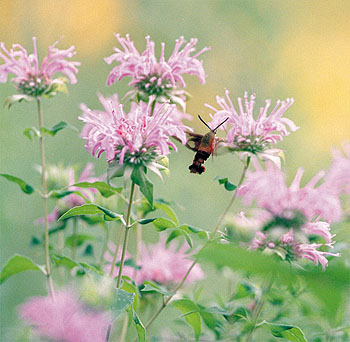
Wild Bergamot: Facebook posts, World University, Shankar's Poetry of Love

Here are some of my recent posts on Twitter which are also sent to Facebook, minus other people's comments and other items between these posts:

Scott MacLeod ~ Ravi Shankar's "Three Ragas" (1956) is wildly beautiful. ... Developing worlduniversity.wikia.com, -like Wikipedia and MIT OCW -free, open

Scott MacLeod ~ world Univ & Sch Facebook group: facebook.com/group.php?gid=48753608141&ref=ts - add or take a class at WUaS, like Wikipedia with MIT OCW

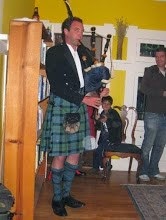
Scott MacLeod returning from playing a bagpipe gig at Chateau in the SF Bay Area, and developing the free, open worlduniversity.wikia.com

Scott MacLeod is going to play a bagiping gig at Chateau in the SF Bay Area ... Scotsaire Hornpipe ... MMmmm

Scott MacLeod Sensible ... check out, too, worlduniversity.wikia.com - an open World University and School, like Wikipedia with MIT Open Course Ware ...


Source: lebleu.org
Problem: community currencies are a $0 Billion market and promoting their development in a way that ensures and maximizes their potential for communities is expensive. Examples include travel costs or Web hosting costs. ...

Scott MacLeod is enjoying "Sweet Honey in the Rock" singing on the free pandora.com, and facilitating worlduniversity.wikia.com, like Wikipedia w MIT OCW

Scott MacLeod is liking the relaxation response - relaxationresponse.org/steps and developing worlduniversity.wikia.com

Scott MacLeod - check out World University and Schools' educational software: worlduniversity.wikia.com/wiki/Educational_Software - & add free, best ware

Scott MacLeod is watching the Ramayana story -"Sita Sings the Blues" - thirteen.org/sites/reel13/indies/indie-sita-sings-the-blues/241/ - beautiful

Scott MacLeod added 'Archaeology," to open worlduniversity.wikia.com/wiki/Archaeology, courses from Berkeley Prof. Ruth Tringham, & a subjects' template


*

Shankar Hemmady's poetry, which he's sharing on Facebook, is lovely and focuses on love ~ http://shankar.hemmady.com. MMmmm ...

Saturday, March 14, 2009

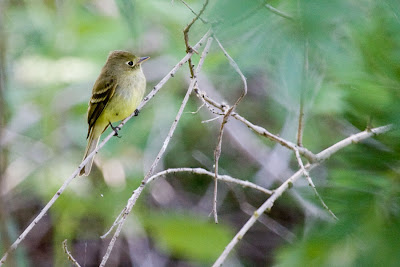
Pacific Slope Flycatcher: World University & School, American Friends Service Committee (AFSC), 'Sita Sings the Blues,' Harbin

Will World University and School worlduniversity.wikia.com {like Wikipedia with MIT Open Course Ware, ~ free and open } be organized like the American Friends Service Committee (AFSC), which started as a way to support conscientious objectors in 1917? Like the AFSC, WUaS has a service mission (also like One Laptop per Child). All are international organizations.

The AFSC focuses on a few main themes that have developed over nearly a century, from conscientious objection and service projects in 1917 and the 1920s, to

Criminal Justice / New Visions of Justice

Economic Justice

Humanitarian Assistance

Immigration / Migration

Peacebuilding / Conflict Prevention

Youth

presently, in 2009. The AFSC also is primarily funded by an endowment, and organized on Quaker principles.

WUaS focuses on providing a Wiki for courses or classes in every language, nation state, and in all subjects, by making it possible for anyone to add or take a class. One Laptop per Child countries are a particular focus. People can teach or learn through video, such as youtube.com videos, and/or interact in virtual worlds, such as in Second Life.

I've heard that around 400 people work at the American Friends Service Committee, which seems like it might be a good size for WUaS over a 10 to 30 year horizon. I'd like to add around two people a year to help develop World University and School.

Yes, let's begin.


*

Harbin was lovely this weekend. I attended a Shamanic workshop with Mellissa Seaman in the Harbin Temple, and talked a fair amount with two friends from the east coast after this, and the next morning. One of these friends may be helpful in developing World University and School Wiki in terms of possibly increasing bandwidth potential to One Laptop per Child countries (Rwanda, Ethiopia, Colombia, Haiti, Mexico, Peru, USA (Birmingham, Alabama), Uruguay, Afghanistan, Mongolia, Cambodia, & Papua New Guinea), starting with Birmingham, Alabama?


**

And mind-opening aspects at Harbin? Quite a few ... the pools ... the alternative way of life ... the freedom-orientation ... talking with people ... the community ... Harbin's milieu


***

The online video "Sita Sings the Blues" - thirteen.org/sites/reel13/blog/watch-sita-sings-the-blues-online/347/ - about the Ramayana epic, which has been influential especially in Indian culture for millennia, showed a trail through central south India, and then to Sri Lanka, which is significant for this narrative. In my future ethnography of hippies in the south of India, I may follow this trail, in relation to the Ramayana story, as an organizing principle for this trip.

Friday, March 13, 2009

Spring Blossoms: Austin ~ How to Do Things with Words

J.L. Austin: "How to Do Things with Words" (Harvard 1962).

12 lectures


Austin is widely associated with the concept of the speech act and the idea that speech is itself a form of action.

He suggested both a theoretical outline and the terminology for the modern study of the modern speech act.

He advocates the examination of the way words are used in order to elucidate meaning.

He claimed his main influence was the exact and exacting common-sense philosophy of G.E. Moore.


How to Do Things With Words

How to Do Things With Words is perhaps Austin's most influential work. In it he attacks what was at his time a predominant account in philosophy, namely, the view that the chief business of sentences is to state facts, and thus to be true or false based on the truth or falsity of those facts. In contrast to this common view, he argues, truth-evaluable sentences form only a small part of the range of utterances. After introducing several kinds of sentences which he asserts are indeed not truth-evaluable, he turns in particular to one of these kinds of sentences, which he deems performative utterances. These he characterises by two features:

  • First, these sentences are not true or false.
  • Second, to utter one of these sentences is not just to "say" something, but rather to perform a certain kind of action.[4]

He goes on to say that when something goes wrong in connection with the utterance then the utterance is, as he puts it, "infelicitous", or "unhappy."[5]

The action which performative sentences 'perform' when they are uttered belongs to what Austin later calls a speech-act [6] (more particularly, the kind of action Austin has in mind is what he subsequently terms the illocutionary act). For example, if you say “I name this ship the Queen Elizabeth," and the circumstances are appropriate in certain ways, then you will have done something special, namely, you will have performed the act of naming the ship. Other examples include: "I take this man as my lawfully wedded husband," used in the course of a marriage ceremony, or "I bequeath this watch to my brother," as occurring in a will. In all three cases the sentence is not being used to describe or state what one is 'doing', but being used to actually 'do' it.

After numerous attempts to find more characteristics of performatives, and after having met with many difficulties, Austin makes what he calls a "fresh start", in which he considers "more generally the senses in which to say something may be to do something, or in saying something we do something".

For example: John Smith turns to Sue Snub and says ‘Is Jeff’s shirt red?’, to which Sue replies ‘Yes’. John has produced a series of bodily movements which result in the production of a certain sound. Austin called such a performance a phonetic act, and called the act a phone. John’s utterance also conforms to the lexical and grammatical conventions of English – that is, John has produced an English sentence. Austin called this a phatic act, and labels such utterances phemes. John also referred to Jeff’s shirt, and to the colour red. To use a pheme with a more or less definite sense and reference is to utter a rheme, and to perform a rhetic act. Note that rhemes are a sub-class of phemes, which in turn are a sub-class of phones. One cannot perform a rheme without also performing a pheme and a phone. The performance of these three acts is the performance of a locution – it is the act of saying something.

John has therefore performed a locutionary act. He has also done at least two other things. He has asked a question, and he has elicited an answer from Sue.

Asking a question is an example of what Austin called an illocutionary act. Other examples would be making an assertion, giving an order, and promising to do something. To perform an illocutionary act is to use a locution with a certain force. It is an act performed in saying something, in contrast with a locution, the act of saying something.

Eliciting an answer is an example of what Austin calls a perlocutionary act, an act performed by saying something. Notice that if one successfully performs a perlocution, one also succeeds in performing both an illocution and a locution.

In the theory of speech acts, attention has especially focused on the illocutionary act, much less on the locutionary and perlocutionary act, and only rarely on the subdivision of the locution into phone, pheme and rheme.

http://en.wikipedia.org/wiki/J._L._Austin


*

Stanford Encyclpedia of Philosophy {Speech Acts}:

Austin, in How To Do Things With Words, spends considerable effort detailing the conditions that must be met for a given speech act to be performed felicitously. Failures of felicity fall into two classes: misfires and abuses. The former are cases in which the putative speech act fails to be performed at all. If I utter, before the QEII, “I declare this ship the Noam Chomsky,” I have not succeeded in naming anything simply because I lack the authority to do so. My act thus misfires in that I've performed an act of speech but no speech act. Other attempts at speech acts might misfire because their addressee fails to respond with an appropriate uptake: I cannot bet you $100 on who will win the election unless you accept that bet. If you don't accept that bet, then I have tried to bet but have not succeeded in betting.

Some speech acts can be performed–that is, not misfire—while still being less than felicitous. I promise to meet you for lunch tomorrow, but haven't the least intention of keeping the promise. Here I have promised all right, but the act is not felicitous because it is not sincere. My act is, more precisely, an abuse because although it is a speech act, it fails to live up to a standard appropriate for a speech act of its kind. Sincerity is a paradigm condition for the felicity of speech acts. Austin foresaw a program of research in which individual speech acts would be studied in detail, with felicity conditions elucidated for each one.


**

3. Illocutions and Perlocutions, and Indirect Speech Acts

I cannot lose ten pounds by saying that I am doing so, and I cannot convince you of the truth of a claim by saying that I am doing so. However, these two cases differ in that the latter, but not the former, is a characteristic aim of a speech act. One characteristic aim of assertion is the production of belief in an addressee, whereas there is no speech act one of whose characteristic aims is the reduction of adipose tissue. A type of speech act can have a characteristic aim without each speech act of that type being issued with that aim: Speakers sometimes make assertions without aiming to produce belief in anyone, even themselves. Instead, the view that a speech act-type has a characteristic aim is akin to the view that a biological trait has a function. The characteristic role of wings is to aid in flight, but some flightless creatures have wings.

Austin called these characteristic aims of speech acts perlocutions (1962, p. 101). I can both urge and persuade you to shut the door, yet the former is an illocution while the latter is a perlocution. How can we tell the difference? We can do this by noting that one can urge by saying, “I urge you to shut the door,” while there are no circumstances in which I can persuade you by saying, “I persuade you to shut the door.” A characteristic aim of urging is, nevertheless, the production of a resolution to act. (1962, p. 107)

Perlocutions are characteristic aims of one or more illocution, but are not themselves illocutions. Nevertheless, a speech act can be performed by virtue of the performance of another one. For instance, my remark that you are standing on my foot is normally taken as, in addition, a demand that you move; my question whether you can pass the salt is normally taken as a request that you do so. These are examples of so-called indirect speech acts (Searle 1975b).

Indirect speech acts are less common than might first appear. In asking whether you are intending to quit smoking, I might be taken as well to be suggesting that you quit. However, while the embattled smoker might indeed jump to this interpretation, we do well to consider what evidence would mandate it. After all, while I probably would not have asked whether you intended to quit smoking unless I hoped you would quit, I can evince such a hope without suggesting anything. Similarly, the advertiser who tells us that Miracle Cream reversed hair loss in Bob, Mike, and Fred, also most likely hopes that I will believe it will reverse my own hair loss. That does not show that he is (indirectly) asserting that it will. Whether he is asserting this depends, it would seem, on whether he can be accused of being a liar if in fact he does not believe that Miracle Cream will staunch my hair loss.

Whether, in addition to a given speech act, I am also performing an indirect speech act would seem to depend on my intentions. My question whether you can pass the salt is also a request that you do so only if I intend to be so understood. My remark that Miracle Cream helped Bob, Mike and Fred is also an assertion that it will help you only if I intend to be so committed. What is more, these intentions must be feasibly discernible on the part of one's audience. Even if, in remarking on the fine weather, I intend as well to request that you pass the salt, I have not done so. I need to make that intention manifest in some way.

How might I do this? One way is by virtue of inference to the best explanation. All else being equal, the best explanation of my asking whether you can pass the salt is that I mean to be requesting that you do so. All else equal, the best explanation of my remarking that you are standing on my foot, particularly if I use a stentorian tone of voice, is that I mean to be demanding that you desist. By contrast, it is doubtful that the best explanation of my asking whether you intend to quit smoking is my intention to suggest that you do so. Another explanation at least as plausible is my hope that you do so. Bertolet 1994, however, develops an even more skeptical position than that suggested here, arguing that any alleged case of an indirect speech act can be construed just as an indication, by means of contextual clues, of the speaker's intentional state–hope, desire, etc., as the case may be. Postulation of a further speech act beyond what has been (relatively) explicitly performed is explanatorily unmotivated.

These considerations suggest that indirect speech acts, if they do occur, can be explained within the framework of conversational implicature–that process by which we mean more than we say, but in a way not due exclusively to the conventional meanings of our words. Conversational implicature, too, depends both upon communicative intentions and the availability of inference to the best explanation. (Grice, 1989). In fact, Searle's 1979b account of indirect speech acts was in terms of conversational implicature. The study of speech acts is in this respect intertwined with the study of conversations; we return to this connection in Section 7.


***

5.1 Force Conventionalism

One well known answer we may term force conventionalism. According to a strong version of this view, for every speech act that is performed, there is some convention that will have been invoked in order to make that speech act occur. This convention transcends those imbuing words with their literal meaning. Thus, force conventionalism implies that in order for use of ‘I promise to meet you tomorrow at noon,’ to constitute a promise, not only must the words used possess their standard conventional meanings, there must also exist a convention to the effect that the use, under the right conditions, of some such words as these constitutes a promise. J.L. Austin, who introduced the English-speaking world to the study of speech acts, seems to have held this view. For instance in his characterization of “felicity conditions” for speech acts, Austin holds that for each speech act

There must exist an accepted conventional procedure having a certain conventional effect, that procedure to include the uttering of certain words by certain persons in certain circumstances… (1962, p. 14).

Austin's student Searle follows him in this, writing

…utterance acts stand to propositional and illocutionary acts in the way in which, e.g., making an X on a ballot paper stands to voting. (1969, p. 24)

Searle goes on to clarify this commitment in averring,

…the semantic structure of a language may be regarded as a conventional realization of a series of sets of underlying constitutive rules, and …speech acts are acts characteristically performed by uttering sentences in accordance with these sets of constitutive rules. (1969, p. 37)

Searle espouses a weaker form of force conventionalism than does Austin in leaving open the possibility that some speech acts can be performed without constitutive rules; Searle considers the case of a dog requesting to be let outside (1969, p. 39). Nevertheless Searle does contend that speech acts are characteristically performed by invoking constitutive rules.


http://plato.stanford.edu/entries/speech-acts/


****

Handout

Thursday, March 12, 2009

Gombe Chimps: 'Tradition' > network society > the contemporary > Harbin

'Tradition' (constructions of what this might have been) > network society (or information age, as superseding modernity and postmodernity - see "Gazing at the Box: Tourism in the Context of the Internet and Globalization" (2001) scottmacleod.com/anth250v.htm) > contemporary (now) > counterculture > Harbin Hot Springs ~ is how I see contextualizing my Harbin ethnography at this point. I'm also curious to think through how our legacies as primates {esp. vis-a-vis our closest ape relatives - see Frans de Waal's "Bonobo: The Forgotten Ape" (1997) or Jane Goodall's "Chimps of Gombe" (1986)}, shaped in ancestral environments over millions of years, might articulate with our interpretations of traditionality, juxtaposed with modernity.


*

Soaking is happening in the Harbin pools now. The Harbin pool is a kind of unique party (in the way 'religiosity' {e.g. Hinduism} can shape freedom) where reunion happens.

Head to Harbin soon ... :) after a contact improv jam ...

Wednesday, March 11, 2009

Orangutan: Primatology of Bliss, Befriending, Wonderful Dreams

Primatology of bliss? What do studies of other higher primates say about great happiness? What might we learn from chimps, orangs, gorillas, and baboons about this?

What has Jane Goodall found in "The Chimps of Gombe " (Belknap 1986)?

I've seen that she befriends the chimps she also studies.

What would Jane Goodall say about other species? Other common chimps? Bonobo? Orangs? Gorillas? Baboons? How might these primates study us (humans)? {Humans study humans a lot}. I haven't read how she engages this question. (Ethno-wiki-virtual-world-graphy is one example).

What would Jane Goodall say about about loving bliss and primates? Other primatologists? I hypothesize that Bonobo chimps through their great amount of sexuality over millions of years come closest to realizing the kind of happiness - neurophysiologically - about which I'm interested in learning.

And, might befriending, in general, be one basis for bliss, per Jane Goodall's practices?


*

Befriending a bully can be a wise thing to do, too.


**

Tired here ... I wonder what the neurophysiology of bliss in sleep is?

Wonderful dreams are perhaps some examples, but I don't yet see how to begin to elicit this ... :)


***

I wonder if the pace of life in the forest or in parkland, as many higher primates live, reflects a pace which our bodyminds have been 'selected for.' Does this pace change dramatically in 'modernity?'


****

I'm curious to see a book which compares and contrasts ethnographic fieldwork approaches / methodologies with primate fieldwork approaches (e.g. Goodall, Fossey, Biruté Galdikas, Sapolsky, Alberts).

I'm also curious to see what ape researchers like Sue Savage-Rumbaugh and Penny Washburn say about how apes they study might be able to study us (homo sapiens).

Ethno-wiki-virtual-world-graphy?

Tuesday, March 10, 2009

Men: Jamming Together, Contact Improv, Freedom

Two Saturdays ago, I contact jammed with a man in Berkeley, where the 'energy' between us was 'clean,' fluid, lithe, strong and freeing.

I often dance contact with women, but we created a space between us here which was great, and very male, but not sexual.


*

Heading to a contact jam soon ...

Monday, March 9, 2009

Women: Contact Improv & Vocal Improv Together, Flourishing Party Jam

In two great spaces for jams in one building in Fairfax, California, we celebrated a birthday this evening as a big jam. Satori wanted to explore contact improv & vocal improv together, and what came out was a flourishing party jam. Folks were pretty happy and free jamming this evening. What a dynamic scene. One room had live music. In the other, someone put up slings for aerial contact for part of the evening. In this room, people gathered to sing improv together; half jammed while the other half sang. Singing is liberating in its own way, especially when space emerges. Satori and some other women here, especially, seem to hold open the 'space' for this jam.

These 'countercultural' folks {lots of long hair and openness}, in some ways, are ongoing journeyers in the explorations begun in the 60s and early 1970s. (Marin saw a lot of the 1960s, and it's still quietly in the fabric of life here). So people last night wore beautiful, colorful clothing, and there was a lot of touch and contact improv, and talking and sharing, but everybody was also clean, and sober, and the vibe was really mellow and harmonious.

What opportunities to explore loving bliss vis-a-vis contact improv in new ways! ...

Sunday, March 8, 2009

Girl: About Eliciting Loving Bliss {Synopsis}, Harbin Art, Cradling


About eliciting loving bliss {a synopsis}:

Eliciting the neurophysiology of loving bliss naturally is an exploration for me. In the context of evolution (tens of thousands of generations that precede us), I've found this to be possible experientially.

I think that evolutionary biology has 'given shape to' or encoded our bodyminds as biological (input~output) systems; sociocultural processes influence much of our daily lives, as do our choices.

I see ecstasy (MDMA) as a reference experience for loving bliss, - a kind of neurophysiological response which might be emblematic of a metaphorical 'on / off switch.' I'm interested in exploring how similar, natural-only loving bliss experiences work. I go 'there' ~ to an experience of loving bliss ~ regularly when I listen to some Mozart arias {Der Hoelle Rache, for example, and others}, and when I do New England contra-dance. {And you?} I imagine that ecstasy (MDMA) also doesn't make possible a range of qualities of this brain neurochemistry in ways we might elicit through engaging great art (Yo-yo Ma's Bach "Cello Suites"), or being in nature, etc.; a great range of qualities of loving bliss are possible. Ecstasy (MDMA) may, however, amplify some of these. Moving between the hot and cold pools at Harbin, as well as its milieu also helps me elicit bliss, but not with the same regularity as Mozart and contra-dance. {I think of Mozart's music and contra-dance sometimes as technologies for eliciting bliss, because they do so repetitively}. I continue to be curious about how naturally to find the metaphorical 'on/off switch' for loving bliss, ~ through awareness ~ but think that the legacy of evolutionary history, and the pragmatics of daily life in modernity make this complicated.

I've found the relaxation response {relaxationresponse.org/steps} to provide a useful basis for eliciting loving bliss, but that it isn't a 'switch.' Rather, it's a way to soften and open ~ to elicit a biological process ~ as well as become aware of how to ease, - and what this experience is. From this bliss bubbles up for me sometimes.

I'm sharing through writing how this might work with people, because I see eliciting loving bliss as one of the best experiences there is in life. I'd also like to come into dialogue with others about this.

Here's one letter I've written that explores loving bliss practices explicitly:

scottmacleod.com/LovingBlissPractices.htm

And I think our bodyminds can be like musical instruments, and that we may be able to play them, like musical instruments, vis-a-vis loving bliss:

scottmacleod.com/GuidelinesPracticingLovingBlissvavMusicalInstrument.htm

Memory - a simple memory of an extraordinary time in life - is one way for me to start this process of eliciting loving bliss, but I've found it difficult to both sustain this and let it unfold richly, as well as a lack of intensity which I know from past experience. But playing one's mind vis-a-vis nature or music to elicit bliss is one process I engage somewhat regularly, but feel like a beginner.

But I'd like to go much further with this, - open much further into it, - in ways that great art can also facilitate.


*

I returned to Harbin Hot Springs yesterday. The weather is great for early March, and Harbin's fabric of life, centering around the pools, goes on. The qualities of creativity and openness I see emerging there continually are fascinating, in that the water keeps flowing out of the ground, and people are open and easy, and things just flow there uniquely.

Art: Local Harbin artists often display their paintings and sculpture in the restaurant or the Blue Room cafe. Harbin has held many art shows through the years, so that Harbin-like art seems to be gaining some 'contours.' The nude, water, folk art, abstraction, 'New Age' art, and the erotic are all rich themes I've seen. Some Harbin residents actively cultivate open a space for artists there.


**

On weekends there are often kids at Harbin in the heart-shaped pool.

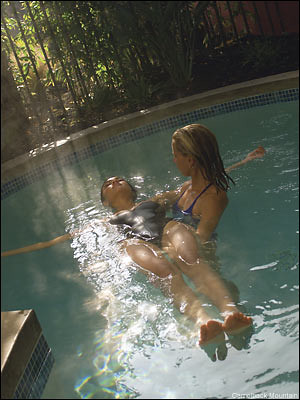
In general at Harbin, women cradle men in the pools, men cradle women, and women women, and men men. Most people in the pools are naked.

And parents cradle their kids in the warm water, - in the heart-shaped pool only - but rarely do girls or boys cradle other girls and boys. They play together, sometimes too loudly for some long-time Harbin residents, but they don't cradle or float one another.


*

Saturday, March 7, 2009

Boy: Contact Improv, Fun, Freedom

At the contact improv jam this afternoon, which often has a lot of kids who come with their parents and just play, a little boy, maybe 3 years old, took off his clothes, and had so much fun running around the room as people jammed. People who were dancing seemed to love it, as well. {People who dance contact come deeply into themselves in a great, released and relaxed way}. His parents would jam with him a while, and then he'd take off running naked around the room. What delight he expressed!

Toward the end of the jam, two people started improvising together playing the piano. MMmmm. And people continued to jam.


*

To the Harbin pools very soon ... :)

Thursday, March 5, 2009

Tilth: An Emergent Farm, Sustainable Agriculture, A Canyon Wedding

A mini farm - here on the ridge in Canyon, California, at the shipbuilder's place? A permacultural, sustainable, do-nothing {Fukuoka} farm, ~ there's a lot of light here on this ridge. I think this is in the thinking ...


*

Sustainable agriculture:
motherjones.com/environment/2009/02/spoiled-organic-and-local-so-2008


**

I have a friend who grew up in Canyon, and is planning a Canyon wedding for a best friend. What does this involve?

... A Canyon Wedding